

Amed Dicle
The Republic of Turkey has escalated its major attacks on the Iraqi Federal Kurdistan Region. The Turkish Army launched its most comprehensive, heavy-handed and strategic operation in recent years when it attacked villages near Duhok’s Amediye (Amediyê) district on the night of 5 July. A little later we will discuss why this latest attack was highly strategic, but first, it is useful to examine the fundamental objectives and strategic goals behind the Republic of Turkey’s assault on the Iraqi Federal Kurdistan Region (KRI).
Strategic goals behind Turkey’s moves
The Misak-ı Milli (National Pact) Borders and the Misak-ı Milli Objective are implicit in both the hidden and the open agendas of the Republic of Turkey. What is the Misak-ı Milli Objective? It is to expand Turkey’s borders and include Mosul (Mûsil) and Kirkuk (Kerkûk) within Turkey’s territory. Turkish state officials claim that Mosul and Kirkuk rightfully belong to Turkey and were left to Iraq as a result of flawed agreements made with the British in the 1920s during the establishment of the Republic of Turkey following the collapse of the Ottoman Empire.
In reality, the aim of the Republic of Turkey is not to acquire these cities as urban centres or to expand its territory. The Republic of Turkey believes that these cities are the borders of Kurdish territory, Kurdistan, and so by controlling all of Kurdistan, they can suppress the Kurds. They are now implementing the same strategy for northern Syria. In other words, the Turkish state asserts that if they do not control the entire geography of the Kurds, they will constantly be troubled by them. Indeed, the Nationalist Movement Party leader Devlet Bahçeli, who is currently a ruler of and a strategist for the Republic of Turkey, has repeatedly emphasised this. He has stated that when conditions are met, Mosul and Kirkuk must be taken. Last week, in an interview with Fırat News Agency, Kurdistan Workers’ Party (PKK) executive committee member Murat Karayılan referred to Bahçeli’s statement. Karayılan was saying that the leaders of Başur, or South Kurdistan (KRI), should heed Bahçeli’s remarks.
Continuation: the strategic role of the PKK and Turkey’s objectives
Turkey is currently using the PKK as an excuse to pursue this strategy, because in order for the Turkish state to have influence in Mosul and Kirkuk, it must also have influence in Duhok and Erbil (Hewlêr), or ensure it has control over these areas. However, being influential in and ensuring control over Duhok and Kirkuk also requires control of the mountains of Kurdistan on the Turkey-Iraq border. In other words, Turkey must eliminate the PKK in order to implement its occupation and annexation strategy in South Kurdistan. Because at the present time, the PKK is the strongest and almost the only force threatening Turkey’s strategy regarding the Kurds and Kurdistan.
Turkey’s efforts to suppress the PKK
The Turkish state believes that by eliminating the PKK, the struggle for the Kurds and Kurdistan can be suppressed. They are not entirely wrong in this regard. And with this aim, they have been pursuing a strategy to suppress the PKK for 10 years. Because apart from the PKK, there is no other organisation that effectively fights politically and militarily against the Turkish state. Yes, there are other Kurdish parties and parties of Kurdistan, but they are either suppressed or only active in politics or in the struggle in one place or one part of Kurdistan. But the PKK is active in all four parts of Kurdistan, in Europe, in the Caucasus and all over the world, fighting for the Kurds and Kurdistan, and from this point of view, the PKK is a structure which disrupts and obstructs the Turkish state’s strategy over the Kurds.
The rhetoric and strategy of the Turkish state
The Turkish state is well aware of this reality. That is why Turkish state officials, including Turkish President Recep Tayyip Erdoğan and his team, do not say, “We are enemies of all Kurds.” They do not say, “We want to occupy all of Kurdistan.” They do not say, “We want to annex it.” They do not say, “Kurds are our enemies.” Because if they said this, they would not be able to justify it to the world. At the same time, it would provoke a reaction from the Kurds. So what do they say? They say, “Our target is the PKK.” They label the PKK as a terrorist organisation. Why do they call the PKK ‘terrorists’? Because the Turkish state labels everyone and every organisation outside its own system as terrorists. And using the PKK as an excuse, they are spreading out into the lands of Kurdistan. Using the PKK as an excuse, they gain legitimacy for their attacks and annexation strategy. But this is not all they are doing. They are also turning other Kurdish organisations, and in particular the Barzani family’s Kurdistan Democratic Party (KDP), into tools of their own strategies, thereby accelerating their annexation policies.
Implementing the strategy: military operations and invasions
As a result of this strategy, from 2018-2019 onwards, major attacks have been carried out against the Iraqi Federal Kurdistan Region. First to be targeted was the Haftanin (Heftanîn) region, a highly strategic area between Zakho (Zaxo) and the Turkish border. They attacked here. Then, in 2019, they attacked the Hakurk region from the direction of Hakkari’s Şemdinli district. And on 17 April 2022, they launched a strategic attack called Operation Pençe-Kilit (Pincer-Lock). The targets of this attack are the regions of Zap, Metina (Metîna) and Avaşin. These areas, namely Hakurk (Xakurkê), Haftanin and Zap, were handed to the PKK according to the terms of an agreement reached following a conflict between the PKK and KDP in 1997. This was not announced to the public, it was a de facto agreement. Therefore, not only the KDP but the entire world, including Turkey, knows that PKK forces are present in Haftanin, Zap and Hakurk. And when Turkey launched this attack on 17 April 2022, the KDP was at the forefront of the assaults. Because the KDP is a family business, now only concerned with its own economic interests.
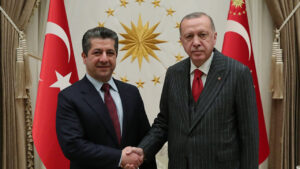
The KDP recognises and believes that its economic interests align with cooperation with Turkey. Believing it preferable to have the Turkish army rather than the PKK in the aforementioned regions, the KDP has blocked all routes against the PKK. It has targeted civilians suspected of supporting the PKK. It has provided intelligence to the Turkish army. In some instances, Turkish soldiers have gone out into the region and the land disguised in KDP uniforms. And all main roads and routes under KDP control have been opened up to the Turkish army. Currently, the Turkish army is in a position of having deployed its own tanks, heavy weapons and armoured vehicles to villages within KDP-controlled areas 25-30 kilometres from the border. They have established checkpoints in these places and are inspecting the identification papers of the locals. Essentially, a foreign state has set up checkpoints within the borders of another state. And it is the KDP who has facilitated and managed this.
Utilising strategic support: military control and invasion
The Turkish army has exploited the strategic support of the KDP to occupy many areas in the region. When the Turkish army launched attacks on these areas in April 2022, they planned to achieve their objective within six months. What was this objective? The objective was to control all these areas, which we call the Behdinan region, from there to occupy Gare Mountain, and to spread out from Gare Mountain to the Plain of Mosul. Gare Mountain is the last mountain chain before reaching the plains of Mosul, Erbil and Kirkuk. The Turkish army aimed to gain influence throughout this entire plain by establishing itself in and around Gare. They are currently pursuing this objective, but they have not achieved it. Why have they been unable to do so? Because they have not been able to secure control over certain strategic hills between Zap and Metina. The most important of these hills is Bahar Hill near the Amediye district. Because these areas had not been brought under their control, the Turkish army has not been able to fully establish dominance in the Zap and Metina regions. Bahar Hill is the highest hill in the region, and forces positioned on these hills have the capability to control the entire area militarily.
The Bahar Hill assault
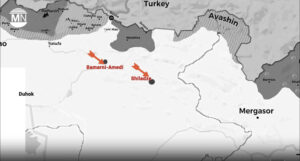
To resolve this issue and secure dominance in the region, the Turkish army launched a comprehensive attack against Bahar Hill on the night of 5 July. According to statements from the People’s Defence Forces (HPG) press liaison centre, the Turkish army attempted to land troops at points where guerrillas were positioned on Bahar Hill two or three times. However, the helicopters had to withdraw due to the resistance of the guerrillas. But soldiers were deployed to other parts of the hill where there were no guerrillas. These soldiers believe they are in the process of surrounding the guerrillas through a protracted operation. But that is not all; the Amediye-Seladize-Deraluk route, which lies below this hill and between Bahar Hill and Gare Mountain, was opened up by the KDP, and the Turkish army has sent 300 tanks here.
Continued conflict and strategic outcomes
As a result, it can be said that the conflict and war in this region will continue throughout this summer. Indeed, the Turkish army keeps making announcements every day, saying “the Lock is closing.” Erdoğan had previously stated that they would finish this job this summer. The “Lock” they speak of is to sever connections in the regions between the Gare, Metina and Zap mountains, thereby making impossible the movement of guerrillas in the Behdinan region, the regions under control of the Barzanis. This then, means that the area controlled by the Barzanis is effectively annexed to Turkey – and the Barzanis’ company Korek, an internet and telephone service provider, is already sharing “Welcome to Turkey” messages with its subscribers around the Amediye district, 25 kilometres south of the Turkish border. Turkey and the KDP have reached an agreement in these areas. Territorial control, road control and intelligence will be provided by the Turkish state, and in return, political and economic control will be given to the KDP. In a sense, the KDP will enjoy the benefits on behalf of the Turkish state.
Feasibility of full control by Turkey
Is this feasible? Can the Turkish state fully establish control over these regions? Or can it develop a solution to the Kurdish problem? No. The Turkish state has a powerful army and advanced technology. They can spread over the land, establishing control in various places, various hills and roads. But this does not make it impossible for the guerrilla forces to move. It can make it difficult but not impossible. Because it is not clear when the guerrillas will be where, whether they will be under the mountain or on top of it. Moreover, if Turkey attacks Gare in this way, it will be unable to occupy the mountain even given 5-10 years. This is a very difficult situation, because it is a huge area, a very steep area, where PKK guerrillas have been present for 20-30 years. Considering the war tunnels alone, it seems unlikely that Turkey will be able to establish control here. Furthermore, in recent months, the guerrillas have rendered Turkish drones ineffective. The twin facts that drones no longer make a significant contribution to the Turkish army beyond its borders, and that kamikaze aircraft are now in the hands of the guerrillas, have partially changed the course of the war.
However, this does not mean that the Turkish army will abandon its objectives. As for the KDP, it should be noted that the KDP has now entered an irreversible relationship and cooperation with the Turkish state. So if the war spreads to Gare Mountain, it means it will spread to all the regions under the KDP’s control. For these reasons, the coming months, days and years will be very important and highly strategic. The Turkish state is targeting villages and settlements in these areas, destroying nature, evacuating villages, depopulating them and turning them into military zones, just as it did in the 1990s. This is not just a problem for the Kurds living here, but a common problem for all Kurds and indeed all of humanity. Unfortunately, this issue does not receive much attention.
Amed Dicle was born and raised in Diyarbakır (Amed), Turkey. He has worked for Kurdish-language media outlets in Europe, including Roj TV, Sterk TV and ANF. His career has taken him to Rojava, Syria, Iraq and many other countries across Europe. Follow him on Twitter.


