

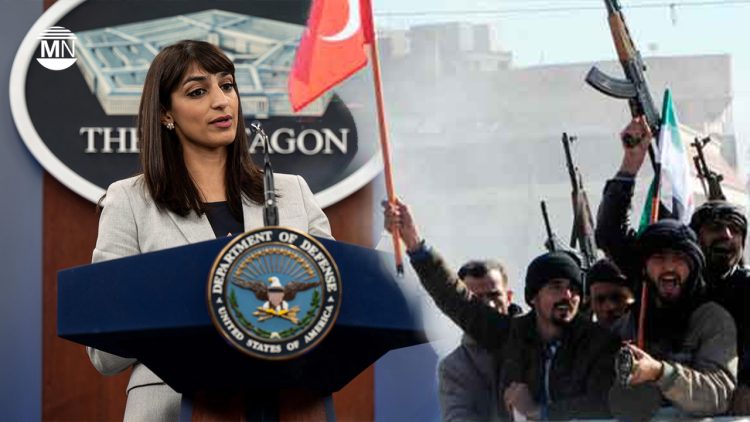
A ceasefire between Turkey and the Kurdish-led Syrian Democratic Forces (SDF) near Manbij (Minbîc) in northern Syria is holding, Pentagon spokesperson Sabrina Singh said on Monday, easing tensions following weeks of clashes. The SDF has not yet issued any statements regarding the ceasefire situation.
The truce was brokered earlier this month by Washington after fighting flared amid advances by the jihadist organisation Hay’at Tahrir Al-Sham (HTS) and Turkish-backed Syrian National Army (SNA) forces targeting Damascus and the ousting of Syrian President Bashar al-Assad. Despite Turkish officials denying a formal ceasefire agreement, Singh confirmed the situation remained calm in the contested area.
The SDF, spearheaded by the People’s Protection Units (YPG) and Women’s Protection Units (YPJ), serve as the United States’ primary ally in the fight against Islamic State (ISIS) militants. However, Ankara views the YPG as an extension of the Kurdistan Workers’ Party (PKK), which it has outlawed and fought against for four decades.
While the United States and its Western allies list the PKK as a terrorist organisation, they do not designate the YPG or the SDF in the same category. Turkey, however, labels all three groups as terrorists, heightening the risk of further clashes.
The United States maintains approximately 2,000 troops in Syria, working alongside the SDF to counter ISIS militants and prevent their resurgence. The extremist group seized vast territories across Iraq and Syria in 2014 but was later pushed back through joint military efforts.
The ceasefire’s fragility comes amid renewed tensions. Last week, Turkish-backed Syrian National Army (SNA) forces ended a temporary truce with the SDF, escalating hostilities near Kobani (Kobanê). Ankara rejected proposals for extending the ceasefire, including the creation of a demilitarised zone along the Syrian-Turkish border.
In response, US Senators Lindsey Graham and Chris Van Hollen warned they would introduce bipartisan sanctions legislation against Turkey if it fails to renew the ceasefire. They stressed that the 2019 ceasefire had saved lives, promoted regional stability, and supported the fight against ISIS.
In a joint statement, the senators highlighted ongoing Turkish-backed attacks which threaten efforts to prevent a resurgence of ISIS. They reaffirmed their bipartisan support for the SDF, with Senator Van Hollen quoting SDF General Commander Mazloum Abdi, who advocated peaceful dialogue over aggression as the path to stability.
“The United States must immediately use all the tools at our disposal to press for a sustained ceasefire and a demilitarised zone,” the senators said. “If Turkey doesn’t immediately accept these terms, we intend to introduce bipartisan sanctions legislation this week, similar to the bill we jointly introduced in 2019.”
The earlier 2019 sanctions bill aimed to hold Ankara accountable for military incursions that jeopardised US interests and allies. Renewed efforts to enforce sanctions reflect growing concern in Washington over Turkey’s escalating operations and their impact on stability.
Meanwhile, escalating attacks by SNA forces against the SDF have endangered the region’s stability, sparking concerns about further destabilisation and prompting calls for international mediation to address security risks and restore peace.


