

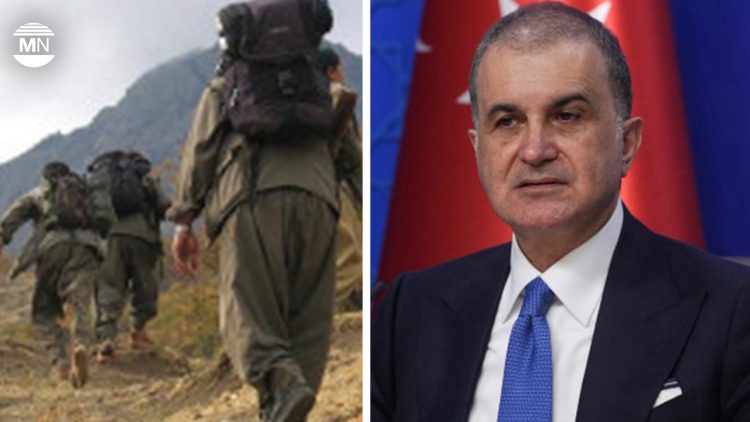
Turkey’s ruling Justice and Development Party (AKP) said on Monday it expects the Kurdistan Workers’ Party (PKK) to disarm and dissolve “within days”, describing the anticipated move as a national turning point towards a “terror-free Turkey”, but still failing to offer a political roadmap to address the longstanding demands of the country’s Kurdish citizens.
“We expect the terrorist organisation to disband and lay down arms in the coming days,” said Ömer Çelik, spokesperson for the AKP, speaking after a party leadership meeting in Ankara. He added that this would “lift political tensions on our democracy” and “lead to a new phase” in Turkish politics.
Çelik did not offer a timeline or verify whether the PKK had signalled such a step, but he framed the anticipated disarmament as a historic development. “Every positive step will automatically trigger another. Once this tension is lifted, democracy will gain new energy,” he said.
Despite recent declarations suggesting a ceasefire and the potential for disarmament, the PKK has not publicly confirmed a timeline for its dissolution.
“We are continuing our efforts to strengthen national unity,” Çelik added. “Achieving a Turkey free of terrorism will relieve the political tension on our democracy and society.”
While government figures present the development as a national security success, critics have noted the absence of any accompanying democratic reform proposals to address long-standing Kurdish concerns.
Çelik made no mention of restoring local democracy in Kurdish-majority areas where elected mayors have frequently been removed by the state, nor of amending anti-terror laws under which hundreds of Kurdish politicians have been prosecuted.
He instead emphasised the state’s determination to proceed “without negotiation or compromise on core national principles”.
The AKP spokesperson also paid tribute to Sırrı Süreyya Önder, a veteran Kurdish politician and filmmaker who recently passed away. Describing Önder as a friend who worked for a “terror-free Turkey”, Çelik said: “We would talk about cinema and philosophy. But in recent months, politics took over. He gave everything to this process.”
Commenting on the wide public turnout at Önder’s funeral, Çelik noted: “People from opposing political camps came together. This was the clearest expression of the bridges he tried to build between different communities.”
Separately, Çelik condemned a physical attack last week against opposition leader Özgür Özel, calling it “a disgraceful assault on democracy”.
“The political sphere must stand united against violence,” he said. “An attack on any political figure is an attack on our entire democratic system.”
While the government frames the expected disarmament of the PKK as a new chapter in Turkey’s political life, it remains unclear whether this moment will lead to genuine democratic transformation or simply a shift in security policy.
Related article:
Turkey’s ruling party touts PKK disarmament but sidesteps democratic reform details


