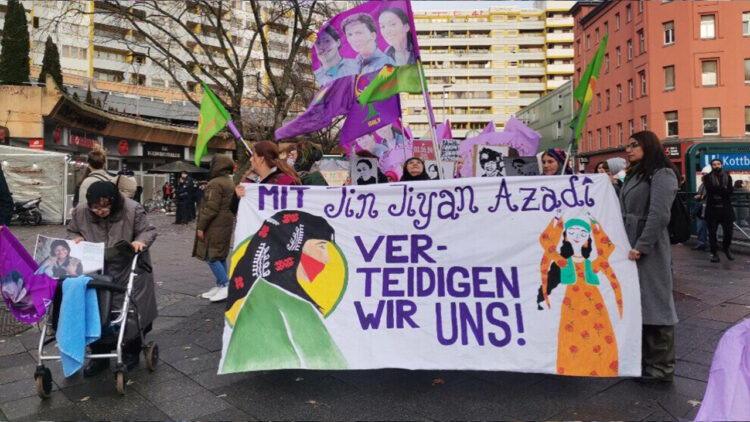
Thousands of people took to the streets in European cities over the weekend and on 25 November to raise their voices against gender-based violence on the International Day for the Elimination of Violence against Women. Among the most prominent participants were Kurdish women, whose slogan Jin, Jiyan, Azadî (Woman, Life, Freedom) echoed powerfully in cities such as Marseille, Bern, Paris and Düsseldorf.
In France, thousands of women took part in marches in Marseille and Paris. In Marseille, the Kurdish women’s association Arin Mirkan, with the support of French women’s organisations, led a large march against male and state violence. In Paris, an estimated 80,000 women took part in a demonstration organised by 76 women’s organisations and trade unions. The Kurdish Women’s Movement in France (TJK-F) played a key role, with Kurdish women marching under banners promoting women’s liberation and resistance.
There were also marches in Germany’s Düsseldorf, Frankfurt and Berlin. In Düsseldorf, the Kurdish Women’s Association in Germany (YJK-E) organised a march where women gathered outside the city’s main railway station with banners that read “Your war, our blood” and “We will defend ourselves with the philosophy of Jin, Jiyan, Azadî. The march brought together women of different nationalities who emphasised solidarity through speeches and chanting slogans against feminicide.
In Frankfurt, women carried banners on gender-based violence and displayed illuminated photographs of women killed by male/state violence. Women Defend Rojava, Jin Jiyan Azadî Coalition and ADKH (European Democratic Women’s Movement) participated in the event. In Berlin, women protested against violence against women and demanded the freedom of Abdullah Öcalan, focusing on resisting femicide and strengthening the struggle for women’s rights.
In Switzerland, a large march took place in Bern, where thousands gathered in the Schützenmatteplatz and marched to the Federal Parliament. The protest was organised by over 250 groups, including feminist movements, Kurdish women’s organisations and political parties such as the Swiss Socialist Party and the Green Party. The slogan Jin, Jiyan, Azadî echoed throughout the march, and attention was on Kurdish women in particular with their slogans and banners.
The United Nations has designated 25 November as the International Day for the Elimination of Violence against Women to raise awareness of the widespread violence women face, much of which remains hidden due to stigma and systemic impunity. According to the UN, one in three women worldwide will experience physical or sexual violence in her lifetime, making violence against women one of the most widespread human rights violations.
Gender-based violence remains a widespread and entrenched problem in Turkey. According to official statistics, Turkey has one of the highest rates of femicide among OECD countries, with thousands of women killed in recent years, often by intimate partners or family members. Violence against women has increased since Turkey withdrew in 2021 from the Istanbul Convention, which aims to prevent violence and protect victims. The repeal of this important treaty has made women more vulnerable, sparking protests and calls for accountability. The Kurdish slogan Jin, Jiyan, Azadî is associated by the authorities with political dissent, and they try to suppress it, further silencing women’s voices.
Kurdish women have long championed the slogan Jin, Jiyan, Azadî as a philosophy of liberation. This year, their active participation in European cities highlighted their leading role in uniting different groups against violence and promoting solidarity. Despite the Governor of Diyarbakır banning the slogan in that city, its message echoed across Europe, symbolising resistance, freedom and the ongoing struggle for gender equality.