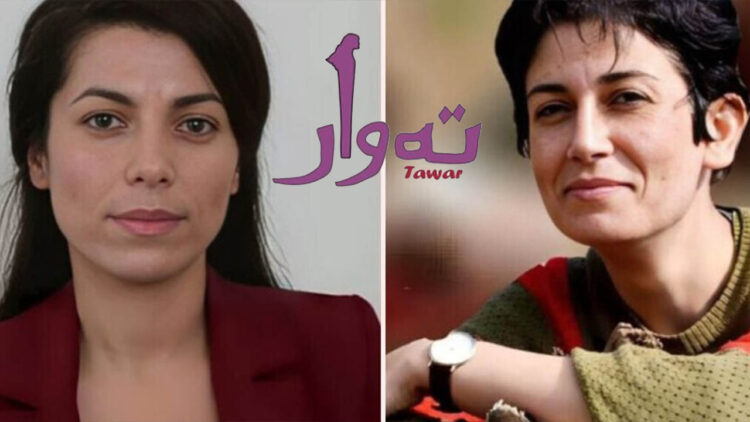
While there has been a recent increase in the number of executions of women prisoners in Iran, with at least 24 women executed in Iran in 2024, according to recent data from the Iran Human Rights Network, these executions are just the tip of the iceberg of violence against women in Iran. In order to explore the social and systemic background to the increase in violence against women in general and Kurdish women in particular in Iran, and to highlight the resistance of Kurdish prisoners Warisheh Moradi and Pakhshan Azizi, both of whom are on death row, we are republishing an analysis provided to us by the Tawar Feminist Collective, originally published in Persian and translated into English by Kawe Fatehi.
The Tawar Feminist Collective is an independent group of leftist Kurdish feminist women in the diaspora, who describe their origins as “born out of years of witnessing suffering and resistance”. It was founded after the uprisings in Iran following the death of Kurdish woman Jina Amini in 2022 “to amplify progressive voices and challenge patriarchal structures” and to “shed light on the pain and resilience of women and queer individuals in Kurdistan and advocate for liberation that transcends political and social boundaries”. Their name is inspired by Mastoureh Shahsavari, known by her codename Tawar, who was executed in Sanandaj prison in 1980, at the age of just 19 years old.
Enjoy reading the full analysis, slightly edited for clarity, below:
Introduction
Violence against women in Iran is a product of structural oppression intersecting with gender, ethnicity, class, politics, religion, and other forms of discrimination. However, the pattern of violence against Kurdish women, particularly in Kurdistan—a region historically at odds with the legitimacy of ruling regimes—reveals notable differences, especially in the treatment of female political activists. According to available data, at least 95 Kurdish women have been executed for political activities since the 1979 revolution.
One such case is Mastura Shahsavari, known as Tawar (Political Organisation Code), a member of the Komala Organization for Equality. She was executed by firing squad in Sanandaj (Sinê) prison on 3 June 1980, at the age of 19 for her political affiliations. More recent examples include the execution of Shirin Alamholi, the life sentence of Zeynab Jalalian—the longest-serving female political prisoner in Iran—and the recent death sentences of Pakhshan Azizi and Warisheh Moradi. These cases exemplify the distinct approach of the Islamic Republic of Iran towards Kurdish women activists, rooted in the historical conflict between the state and the Kurdish people. A feminist understanding of executions and violence against Kurdish women highlights the intersection of systemic gendered and political oppression in this context.
A unique political landscape in Kurdistan
The distinct political and activist landscape of Kurdistan stems from the Kurdish people’s stateless nationhood and their resistance against occupation. Since the mid-20th century, this resistance has manifested in liberation movements striving for political and economic self-determination, encompassing various forms of struggle. Kurdish political parties and organisations have played a pivotal role in these movements, fostering collective identity and organising individual resistance into broader collective action, including armed struggle.
This mass organisation has turned historical moments into bastions of resistance, passing down the legacy of pre- and post-1979 revolutionary struggles to newer generations. Kurdish women have significantly contributed to these movements, participating independently or within political parties, democratising and broadening their reach. Their activism demonstrates that feminism transcends merely challenging gender roles; it seeks to eradicate all forms of oppression and exploitation disproportionately targeting women.
However, this dynamic clashes with a regime intent on depoliticising and assimilating society into its value system. A common charge against Kurdish women activists—many of whom face execution—is their affiliation with Kurdish opposition parties. While political activism is a fundamental right in modern society, such activities are criminalised and harshly punished under the Islamic Republic, often with deliberate silence from segments of the opposition.
A feminist understanding of executions and violence
Execution, the severest form of state violence, represents a patriarchal response by authoritarian regimes to threats against their power structures. From a feminist perspective, the criminalisation and violent suppression of Kurdish women activists are political and structural tools to maintain dominance and suppress conscious struggles.
By condemning Kurdish women to execution, the state perpetuates a cycle of pervasive violence against women. It uses institutionalised and state-sanctioned patriarchal violence to silence their voices and weaken broader feminist and political movements. This underscores the intersection of gender and political violence in patriarchal systems.
For Kurdish women, violence is both gendered and political, aimed not only at silencing their struggles but also at reinforcing authoritarian and patriarchal control within society. Punishing them signals the state’s war against Kurdish women’s movements, using extreme measures to maintain and reproduce male-dominated power structures while targeting women fighting for justice and self-determination.
The patriarchal nature of such punishments is evident in the targeting of Kurdish women, which not only seeks to suppress their radical resistance but also reinforces a culture of violence against women.
Pakhshan Azizi: A symbol of resistance
Pakhshan Azizi, born in 1984 in Mahabad and a graduate in social work from Allameh Tabataba’i University in Tehran, was sentenced to death and four years of imprisonment on 24 August 2024, on charges of “rebellion” (1) and “membership in opposition groups”. The indictment alleged her participation in armed activities in Iraq and Syria, involvement in Syria’s civil war, and returning to Iran to incite unrest by connecting with families of those killed during the 2022 protests.
Pakhshan represents the unyielding spirit of women who resist despite enduring intersecting oppressions. Her activism transcended geographical and cultural boundaries, advocating for women’s and Kurdish rights as part of a broader fight for human freedom. Previously detained in 2009 for protesting Ehsan Fattahian’s execution, Pakhshan was imprisoned in Tehran’s Evin Prison, where she strengthened her resolve in solidarity with fellow activist Shirin Alamholi, who inscribed the slogan ‘Jin, Jiyan, Azadi’ (‘Woman, Life, Freedom’) on the prison walls.
After her release, Pakhshan travelled to Rojava (North and East Syria), where she joined the fight against ISIS and supported women and children in refugee camps in Sinjar (Şengal), Afrin (Efrîn), and Kobani (Kobanê). In a letter from prison, Pakhshan emphasised her commitment to serving humanity beyond artificial borders, asserting that ‘democratising a society occurs outside the confines of nation-states.’
Following her year-long imprisonment and enduring torture, she now faces execution. However, her resistance, expressed through writing and activism, remains a beacon of hope and courage. As she wrote, ‘Free life begins when women live with such dignity and honour that they embrace death for the sake of freedom.’
Warisheh Moradi: Defiance amidst repression
Warisheh Moradi, born in 1985 in Sanandaj (Sinê) and a member of the Free Women’s Society of Eastern Kurdistan (KJAR), has been an active participant in various social initiatives for women, children, and marginalised communities. In 2010, she relocated to Southern Kurdistan (Iraqi Kurdistan), and after the ISIS invasion of Rojava (North East Syria) in 2014, she joined Kurdish women’s forces in their fight against ISIS, sustaining injuries during the conflict.
Arrested in August 2023, Warisheh endured four months of physical and psychological torture in solitary confinement in Sanandaj and Tehran’s Evin Prison. Currently imprisoned in Evin, she was sentenced to death in November 2024 for ‘rebellion’. (1) Despite her imprisonment, Warisheh remains defiant, staging a 20-day hunger strike in poor health to protest death sentences in Iran.
In a letter from prison, Warisheh questioned the equivalence of fighting ISIS and opposing the Islamic Republic, sarcastically remarking: ‘Why is combating a terrorist group like ISIS equated with opposing the Islamic Republic? ISIS beheaded us, and the Islamic Republic hangs us. No political or legal framework can resolve this paradox.’
Warisheh has highlighted systemic national, gendered, and religious discrimination, emphasising that her activism stems from a commitment to her community. She continues to support the vision of a democratic society and the principles of ‘Jin, Jiyan, Azadi.’
Resistance is life
In the face of widespread oppression, Kurdish women like Warisheh Moradi and Pakhshan Azizi exemplify resistance, defying both patriarchal and state violence. Their activism is rooted in the feminist and transnational ethos of collective organization and intersectional struggle, challenging intertwined systems of patriarchy and state repression.
Despite enduring relentless state violence, these women have turned their imprisonment into spaces of resistance, engaging in hunger strikes and refusing to comply with unjust rulings. Their struggle embodies a feminist movement transcending borders, advocating collective action within popular and women’s movements, and persisting in the fight against entrenched systems of domination.
Kurdish women’s activism, embodied in the slogan ‘Jin, Jiyan, Azadi,’ remains a rallying cry for justice, dignity, and freedom. Through their unyielding commitment, women like Warisheh Moradi and Pakhshan Azizi inspire ongoing resistance against oppression, illuminating the path toward a more just and liberated society.
Footnotes:
(1) Islamic contexts, ‘Baghi” (بغی) can refer to rebellion or insurrection, particularly in the sense of rising against legitimate authority. In some interpretations, it also implies waging rebellion against God’s commands or authority, as represented by Islamic law or an established religious governance system. This term is used in jurisprudential discussions in Islamic law to describe acts of rebellion or sedition. It often carries a severe connotation, and the consequences for such actions depend on the context and the legal framework of the governing system.