

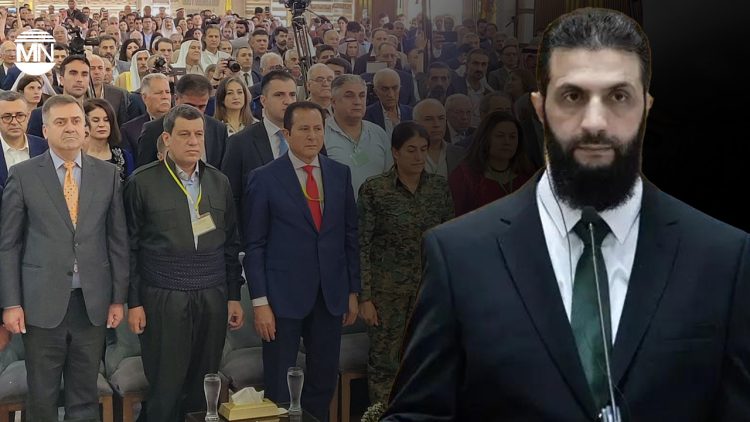
The Syrian Presidency in Damascus accused the Kurdish-led Syrian Democratic Forces (SDF) on 27 April of violating their 10 March national integration agreement, deepening tensions over governance models and minority rights across northeastern Syria.
The accusation followed the Kurdish Unity Conference in Qamishli (Qamişlo), where political groups reaffirmed a pluralistic vision under the Autonomous Administration of North and East Syria (AANES). Participants advocated for expanded inter-ethnic cooperation and inclusive representation.
On 26 April, over 400 delegates from Kurdish regions in Syria, Iraq, and Turkey convened at the conference to coordinate Kurdish efforts towards a decentralised, democratic Syria. A declaration issued at the event called for constitutional guarantees of Kurdish rights, women’s freedoms, and multi-ethnic governance within a pluralistic framework. It also announced the formation of a joint delegation to engage in dialogue with Damascus.
In its statement, the Syrian Presidency alleged that recent SDF actions — particularly efforts to promote federalism — constituted a “clear violation” of the landmark 10 March agreement and threatened Syria’s territorial integrity. It warned against the creation of “separate entities” under banners such as federalism or autonomous administration.
“The leadership of the SDF cannot monopolise decision-making in northeastern Syria, where authentic communities — Arabs, Kurds, Christians, and others — have long coexisted,” the Presidency stated.
However, critics have highlighted discrepancies between the transitional government’s rhetoric and its practices. The National Dialogue Committee, tasked with drafting Syria’s political future, has faced international criticism for excluding representatives of minority groups, including Alawites, Christians and Kurds. Meanwhile, the government’s inaction regarding recent attacks on Alawite communities in coastal regions has further undermined its claims to inclusivity.
The debate over minority rights and governance in Syria is increasingly seen as part of a broader regional power struggle. Observers suggest that the Syrian Presidency’s criticisms are strategically motivated, intended to appease Turkey — a key regional actor that supports anti-Assad opposition groups — while consolidating the influence of Islamist factions such as Hay’at Tahrir al-Sham (HTS) in opposition-held areas.
Turkey’s stance was reiterated on 27 April, when Turkish Foreign Minister Hakan Fidan declared in Doha that Ankara would not accept any arrangement sustaining Kurdish armed groups in Syria. Referring specifically to the SDF and its alleged ties to the militant Kurdistan Workers’ Party (PKK), Fidan warned that the PKK would be removed from Syria’s political landscape “peacefully or otherwise”.
Despite these challenges, the governance structures under AANES remain notably inclusive, featuring Arabs, Kurds, Syriacs, Assyrians, Armenians, Circassians and Turkmens. Women’s political participation is institutionalised at every level, in sharp contrast to the male-dominated and exclusionary structures of many Syrian transitional bodies.
The competing models — a centralised, Islamist-influenced transitional government versus a decentralised, multi-ethnic Kurdish-led administration — reflect deeper regional divisions over Syria’s future governance and the role of minority rights in post-conflict reconstruction.


