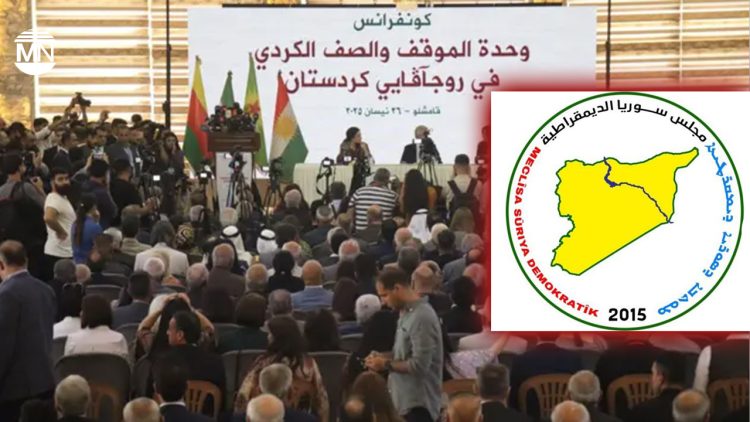
The Syrian Democratic Council (SDC) has described Saturday’s Rojava Kurdish Unity and Common Stance Conference as a “historic step” that embodies the spirit of collective resistance against marginalisation and denial.
In a written statement issued late on Saturday, the SDC praised the conference, held in Qamishli (Qamişlo), North and East Syria, as an expression of the Kurdish people’s enduring will to live and their resistance against attempts to erase their identity.
Highlighting the long history of oppression faced by Kurds in Syria, the SDC said Kurdish communities had been doubly victimised—as part of the wider Syrian struggle for freedom and dignity as well as through targeted national repression. “Their existence and natural rights were attacked, they were subjected to arrests and displacement, and they were among the first to pay the price for a democratic Syria,” the statement read.
The Council underlined its support for efforts to strengthen Kurdish national unity within the broader vision for a democratic Syria, asserting that the Kurdish question is not a localised issue but a genuinely national matter tied to the Syrian people’s wider struggle for freedom and justice.
Calling the Qamishli conference a “source of hope for national consensus”, the SDC emphasised that Kurdish unity forms the basis for the rebuilding of Syria’s national unity. It noted that the Kurds “have endured the same hardships, struggles and injustices that have affected the rest of the nation”, and that they are now equally part of its journey towards a future based on freedom, democracy, diversity and decentralisation.
The SDC also expressed gratitude to the preparatory committee and the participants of the conference, stressing that the event embodied the collective energy and will needed to build a free, democratic, pluralistic and decentralised Syria, where equality among all communities is guaranteed.
The Rojava Kurdish Unity and Common Stance Conference brought together over 400 delegates from Syria, Iraq and Turkey, marking a rare and significant moment of Kurdish political cooperation amid Syria’s evolving political landscape.