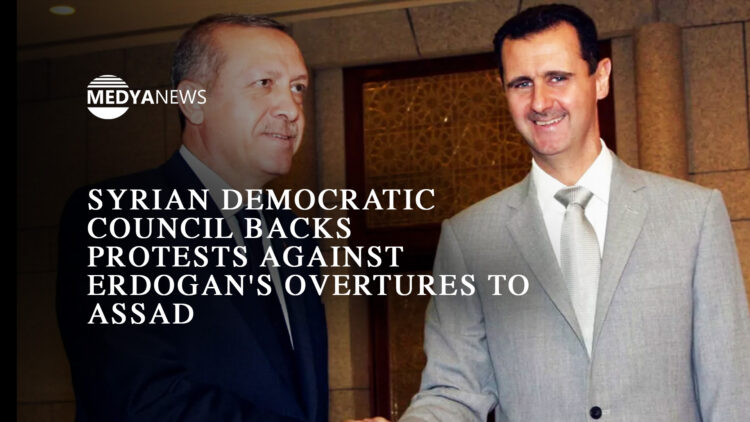
The Syrian Democratic Council (SDC), which governs the northern and eastern regions of Syria, has released a statement endorsing the protests against Turkish President Recep Tayyip Erdoğan’s recent overtures towards Syrian President Bashar al-Assad. “We salute the steadfastness and uprising of Syrians everywhere. Their legitimate goals and demands are guiding principles for our struggle and political actions,” the SDC declared.
The SDC criticised Turkey’s normalisation efforts with Damascus, accusing it of disregarding the aspirations and sacrifices of the Syrian people. “Turkey’s efforts highlight that the Syrians’ salvation lies in unity, cooperation, and overcoming their differences for a unified Syrian national project,” the statement read. The council stressed the need for a national dialogue among Syrian political actors and emphasised that any resolution to the Syrian crisis must consider the rights and aspirations of the Syrian people to be successful.
The general commander of the Syrian Democratic Forces, Mazloum Abdi, issued a statement on his official Twitter account. Abdi emphasised the unifying aspect of the movements that began against the Turkish occupation of Syria, saying: “In northern and eastern Syria, we continue to welcome every patriotic Syrian to his land among his brothers and we extend our hand to all Syrians to save our country and our people.
Following Erdoğan’s remarks, protests erupted in Turkish-controlled northern Syrian cities, including Afrin (Efrîn), al-Bab, Azaz, al-Rai, and Jarablus, all in Aleppo Governorate. The London-based Syrian Observatory for Human Rights (SOHR) reported that at least 4 people were killed and 20 injured in the clashes between protestors and Turkish forces. In Afrin, three people were killed, while another fatality occurred in Jarablus, where the Turkish flag was torn down.
Videos on social media showed Free Syrian Army (FSA) members chanting anti-Turkish slogans around the Turkish-established governorate building in Afrin. In Jarablus, the Turkish flag was removed and destroyed at an FSA station. Additionally, armed groups stormed Turkish Post and Telecommunications (PTT) buildings in Azaz and al-Bab, and Turkish trucks were set ablaze in Mare, also in Aleppo.
Erdoğan recently expressed openness to reestablishing relations with Syria, stating, “There is no reason for it not to happen. Just as we kept our ties very lively in the past – Mr Assad and even held talks between our families – it is certainly not impossible (to say) this will not happen again in the future, it can happen.” Erdoğan stressed that Turkey had no intention of interfering in Syria’s internal affairs.
Syrian President Bashar al-Assad, during a meeting with Russia’s special envoy for Syria, Aleksandr Lavrentiev, also indicated a willingness to normalise relations with Turkey, provided that Syria’s sovereignty is respected. Assad stated that any effort to improve ties must be based on mutual respect for Syria’s territorial integrity.
Turkey severed ties with Syria following the onset of the Syrian civil war in 2011, supporting rebel factions against Assad. Turkish forces have conducted several cross-border operations and established a “safe zone” in northern Syria, where Turkish troops are stationed.
Turkey’s recent regional diplomatic efforts include attempts to restore ties with Gulf countries and potentially Syria. These efforts are predicated on progress in counter-terrorism, the safe return of refugees, and certain political processes.
The protests in northern Syria highlight the contentious nature of Turkey’s potential normalisation with Assad’s regime. The support for the protestors from the SDC highlights the deep divisions and ongoing complexities in the region, reflecting broader geopolitical dynamics and the aspirations of the Syrian people.