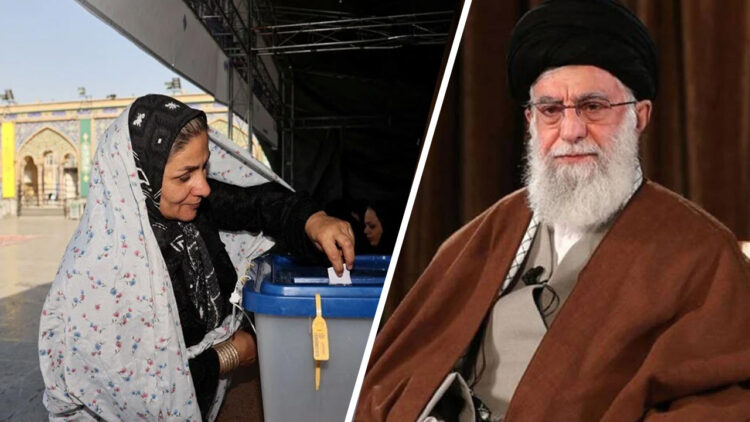
Supreme Leader Ali Khamenei has attributed the low turnout in the first round of presidential elections to the people’s “preoccupations and troubles”, failing to acknowledge reasons given by citizens and political groups for the widespread boycott, and calling for participation in the second round.
Despite the strong support from reformists and moderates for Massoud Pezeshkian, Kurds and Iranian citizens boycotted the first round in an unprecedented manner. Khamenei, for the first time in the history of the Islamic Republic of Iran, did not issue a message of congratulations and thanks to the Iranian people after an election.
However, on the eve of the second round of presidential elections, scheduled for 5 July, he acknowledged the historically low voter turnout, citing “wrong predictions” and a “lower-than-anticipated turnout”. More than 60% of people failed to vote.
However, on the eve of the second round of presidential elections, scheduled for 5 July, he acknowledged the historically low voter turnout, citing “wrong predictions” and a “lower-than-anticipated turnout”. More than 60% of people failed to vote.
Prior the 2001 election, which had a 67% turnout, Khamenei had remarked that a participation rate of 35% or 40% would be shameful, contrasting it with the low turnout often seen in Western countries. He suggested that such low participation reflects a lack of trust and disappointment in the political systems of those countries.
Former Iranian President Mohammad Khatami described the public boycott of last week’s elections as “unprecedented since the revolution”. He interpreted the low turnout as a clear sign of the people’s dissatisfaction with the current state of society and “the majority’s anger with the ruling system”. Nevertheless, he urged participation.
The reformist leaders’ call for public participation in the second round of presidential election, coincides with General Hajizadeh’s statement that voting in elections is akin to ‘providing ammunition to the armed forces’.
Internal reports from Iran indicate expectations of another significant boycott in the upcoming second round. Families who lost loved ones during the country’s Jin, Jiyan Azadi (women, life, freedom) uprising, after the police murder of Jîna (Mahsa) Amini, have taken to social media, urging others to join them in boycotting the polls once again.