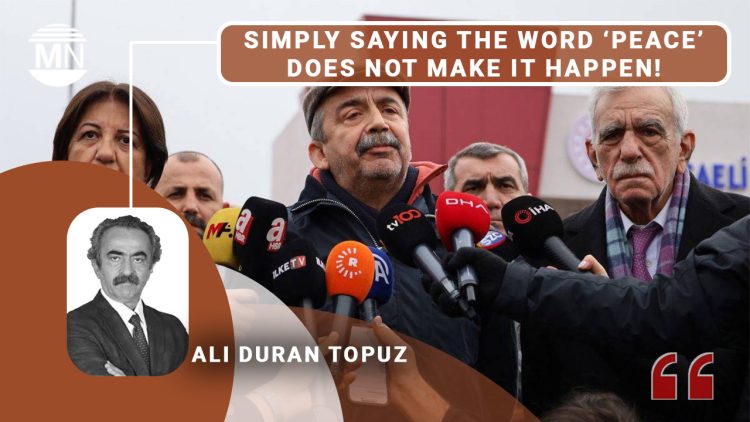
In recent years, Turkey has faced escalating political repression, undermining hopes for democratic reform and peace. The government’s crackdown on opposition parties, journalists, lawyers, and civil society figures has intensified, with widespread arrests, media censorship, and judicial manipulation. Kurdish politicians and activists, in particular, face systemic persecution through legal and administrative means, including the dismissal of elected officials and criminalisation of dissent. This article, penned by Ali Duran Topuz and first published in Artı Gerçek on 31 January, critiques the Turkish state’s narrative of pursuing “peace”, arguing that genuine peace cannot be built on a foundation of injustice, repression, and the erosion of democratic freedoms.
Ali Duran Topuz
There is a story from the Kochgiri tribe, based on a conversation between a hungry boy and his mother:
“Mum, I’m hungry!” (Dayê birçî me!)
“Son, don’t die! Your father has gone to sow seeds in the field.” (Biko memir! Bavê te çûye zeviyê toxim daviye.)
We are hungry. Literally—biological hunger grips vast populations. But not only that; we are hungry for freedom, law, and justice. After all, if these existed, it would not be so easy to condemn people to starvation, nor would millions be left to starve simply to enrich a few.
We are hungry, but we are told, “Be patient.” We are told, “Peace will come. Your father-state has changed its paradigm; the foundations of peace are being laid.”
Let peace come, of course—but at this rate, even if it does, it will find nowhere to stand, let alone settle. It may be called peace, but in practice, it will be a prison camp, where everyone is captive and silenced.
Fire at home
The past month’s events make one thing clear: what the father-state claims to be building is anything but peace.
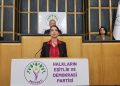
Judicial, police, and administrative attacks on the People’s Equality and Democracy (DEM) Party continue, while the will of the voters is repeatedly overturned with the appointment of trustee after trustee.
– Six more Kurdish journalists have been imprisoned on “terrorism” charges.
– Lawyer and Istanbul Bar Association board member Fırat Epözdemir was arrested on a previously dismissed case and remanded without evidence. The Bar Association itself is now a target, as its president, İbrahim Kaboğlu, was elected through an alliance with Kurdish lawyers.
– Main opposition mayors, including Istanbul Metropolitan Municipality Mayor Ekrem İmamoğlu, are under ostensibly legal political fire, like targets at a shooting range. İmamoğlu has even been investigated simply for stating, “The expert is impartial.”
– The editor-in-chief of a major television channel for an act that did not constitute an offence.
– A row caused by “monopolisation” hype in the TV series and film industry was turned into a political case with Ayşe Barım arrested under “attempting to abolish the government” charges. Actors Halit Ergenç and Rıza, who defended her, are now under investigation for “false witness”. “We went to the Gezi protests ourselves, Ayşe Barım did not direct them,” they said.
While all this was happening, a disaster occurred that perfectly illustrated the character of the regime and the social conditions it enforces: seventy-nine people died in a hotel fire [at a ski resort in Bolu, Turkey], the direct result of the regime’s callous negligence, which is driven by a system designed solely to enrich those who already have money. The latest “expert” issue has turned into yet another legal and journalistic disaster.
Invention of the worst of the worst
It could be said that the situations we are accustomed to continue as normal, but this “normality” is not routine; there are qualitative changes. In the “experts” case, both in terms of journalistic understanding and the law, and in the cases of Ayşe Barım and Fırat Epözdemir, “unprecedented” events have occurred. Just when we think it can’t get any worse, the phrase “There can be worse than worse” proves true once again. Now, having addressed these two issues, I will return to the matter of “peace”. I’ll start at the end, with the litany: “What they do is not journalism; unauthorised recording is a crime.”
Are the identities of experts confidential?
It was Istanbul Metropolitan Municipality (IMM) Mayor Ekrem İmamoğlu who first brought the issue of experts to the agenda during a press conference. He asked whether the expert Satılmış Büyükcanayakın had been tried for giving false reports (at the heavy penalty [court]), adding: “If this issue concerns IMM and Ekrem İmamoğlu, and if prosecutors wish to link the matter to us, know that expert witness Satılmış Bey will also be included in that casefile.”
The next day, Büyükcanayakın responded (through Yeni Şafak, one of the government’s media outlets), stating he would only write a report based on the documents and do whatever the law required. While these answers might have been understandable, he went further, saying: “He who is injured takes offence. In 2010, I also produced negative reports about the AK [Justice and Development] Party and MHP [Nationalist Movement Party] municipalities. However, no one made a sound. Their injury is great. They are showing an iron hand in a velvet glove.”
This response clearly showed that we were not dealing with an ordinary expert, not someone like an “impartial scientist” or an “impartial expert”. He was speaking like a party that does not hide its prejudice, like a politician.
The Istanbul Chief Prosecutor’s Office immediately issued a statement: “An ex officio inquiry has been launched in accordance with Articles 277 and 288 of the Turkish Penal Code, as it has been determined that he [İmamoğlu] attempted to influence the individual, who is one of the experts assigned to some of the investigations and public cases carried out by our Chief State Prosecutor’s Office, by publicly targeting him, and also to the same end revealing the name of the judicial officer, in order to cause a decision to be made for an outcome in favour of the suspects under investigation.”
Let’s take a breather here: Experts are people who assist the judiciary by presenting their scientific armoury for discussion in legal and criminal cases. They are assumed to be neutral. If someone comes forward and says they are not neutral, and presents evidence to support that claim, the appropriate response is to investigate whether the claim is true. If the allegations are proven, the expert should be removed, but even if they are not, the claimants should not face accusations of “targeting experts” or “influencing experts”. This is similar to when judges are asked to recuse themselves from a case due to claims of bias. The identity of expert witnesses cannot be “confidential”, and for their names to be “exposed” should not be considered an offence.
If there are no threats, bribery, or blackmail, an allegation of “influence” cannot be substantiated by simply mentioning a name. What Ekrem İmamoğlu is saying is that the expert is not impartial, and he has valid reasons to assert this. The rule of law is one thing; the initiative of the prosecutor’s office is quite another. The prosecutor’s initiative implies an order not to discuss those active in the judiciary, including the expert, under any circumstances.
Judgements are meant to be made publicly. While investigations are confidential, once the case reaches prosecution, it is essential that it is open to the public. However, the “essential” nature of this transparency is increasingly being undermined. We are gradually moving towards “secret” trials. The use of “secret witnesses”, which has left its mark in recent years, appeared legally justifiable at the time, but now it has evolved further, with the concept of “secret experts” being established. This uproar is being created to protect the interests of confidential and biased experts, ensuring their influence remains intact.
Suat Toktaş was imprisoned for nothing
The second aspect of this issue revolves around Halk TV. Barış Pehlivan speaks to the expert, who does not refuse to answer but responds to the allegations. Since the expert is involved in a case of public interest and has been clearly accused, there is a public right to ask questions, gather opinions, and share them. Moreover, the expert did not object to the publication of what he said.
Now, apparently, permission is required to record these conversations and to publish them separately. While it is indeed an offence to record and publish someone’s speech without their consent, this rule applies to a private individual, not to a public figure involved in a public case. The expert’s role is a public duty, and a journalist’s role is also a public duty. Thus, there can be no crime in recording and publishing the opinions of an expert who has been publicly accused, particularly when the expert has no objection to the publication.
This situation seems to create a “tension” or “contradiction” between the principles of protecting personal data and privacy, and the public’s right to be informed, to receive and impart the news. Some so-called opposition journalists, as well as media affiliates aligned with the government, have argued, “This is an offence. Naturally, they will be detained and imprisoned.” Others claim, “Imprisonment is disproportionate, but a crime is a crime.” However, imprisonment is not just disproportionate—it directly violates the law. Even if an offence had been committed, imprisonment is not warranted. But this regime makes the impossible possible. In fact, no offence has been committed, as both the recording and publication were in full legal compliance.
Seizure of legislative power
Have you ever seen a law that hasn’t been passed being enforced? I certainly hadn’t—until now, thank goodness! I’m referring to the case of Ayşe Barım, who was initially accused of “creating a monopoly in the cinema/soap opera sector,” then charged and remanded in custody for “ [attempting to] abolish the government” by claiming she was “one of the organisers of the Gezi protests”. The prosecution even referred to her as an “agent of influence”— you know, that term linked to a bill that was introduced in parliament but later withdrawn. In other words, the prosecutor accused Barım of actions covered by a law that hadn’t even been passed.
Mehmet Y. Yılmaz described this as a form of retroactive legislation—a law that is effective in the past. In criminal law, such retroactive laws are forbidden because they would allow a law to turn what wasn’t a crime yesterday into one today, and put anyone you wanted in jail at once. But this case goes beyond retroactive legislation—if a law that has not yet been passed is being implemented, it goes beyond, far, far beyond it. I’m not saying that Mehmet Yılmaz is wrong—one aspect of this issue is the “law effective in the past.” However, the other side of the matter goes far beyond this. It means that part of the judiciary is usurping the legislative power of the plaintiff. It is as if the prosecutor has taken credit from the future of the legislature, becoming a legislative authority worth 600 deputies, all by themselves.
An unprecedented oddity within the same investigation, an inquiry for “false testimony” was launched against two actors who stated, “We participated in Gezi voluntarily. Ayşe Barım did not direct us.” The constitution states, “No one shall be compelled to give evidence against himself,” but it seems that prosecutors, now holding legislative power, are operating under a version of the constitution we don’t recognise.
Conclusion
Now, let’s go back to the beginning: How can all of this be reconciled with the “peace” we are told to expect in February? Abdullah Öcalan described the issue as “moving from the ground of conflict and violence to the ground of law and politics,” saying he could do this “if the conditions are created.” But if the ground of “law” has been turned into a ground of conflict, as we’ve witnessed this month, can there still be “peace”?
Let’s assume Öcalan calls on the PKK to lay down its arms and disband the organisation, and that this happens. What will occur if the government does not abandon the concept of law I’ve outlined above—anti-law—if the nonsense of trusteeship doesn’t end, if the repression against opposition parties and individuals continues, if freedoms of association, expression, and the press are not restored, and if democratisation processes are not strengthened? When all signs point to the government increasing repression to its fullest, who will believe in peace?
I began with a story of the Koçgiri tribe, so let me end with one: When the 1921 Constitution was being prepared, the Koçgiri people sought to exercise the “autonomy” written into it. The response came from the army of Sakallı Nurettin Pasha and the gangs of Topal Osman. Since then, Kurdish demands have never been addressed through “politics”; the “field of conflict” has always been the choice. With no signs of change, they want us to believe the situation will improve.
When it comes to peace, “the crazy heart will not give up on its beloved,” but with “promises like these and paths like these”, it is hard to remain hopeful. Still, it’s not without hope, let us see what the next month reveals.