

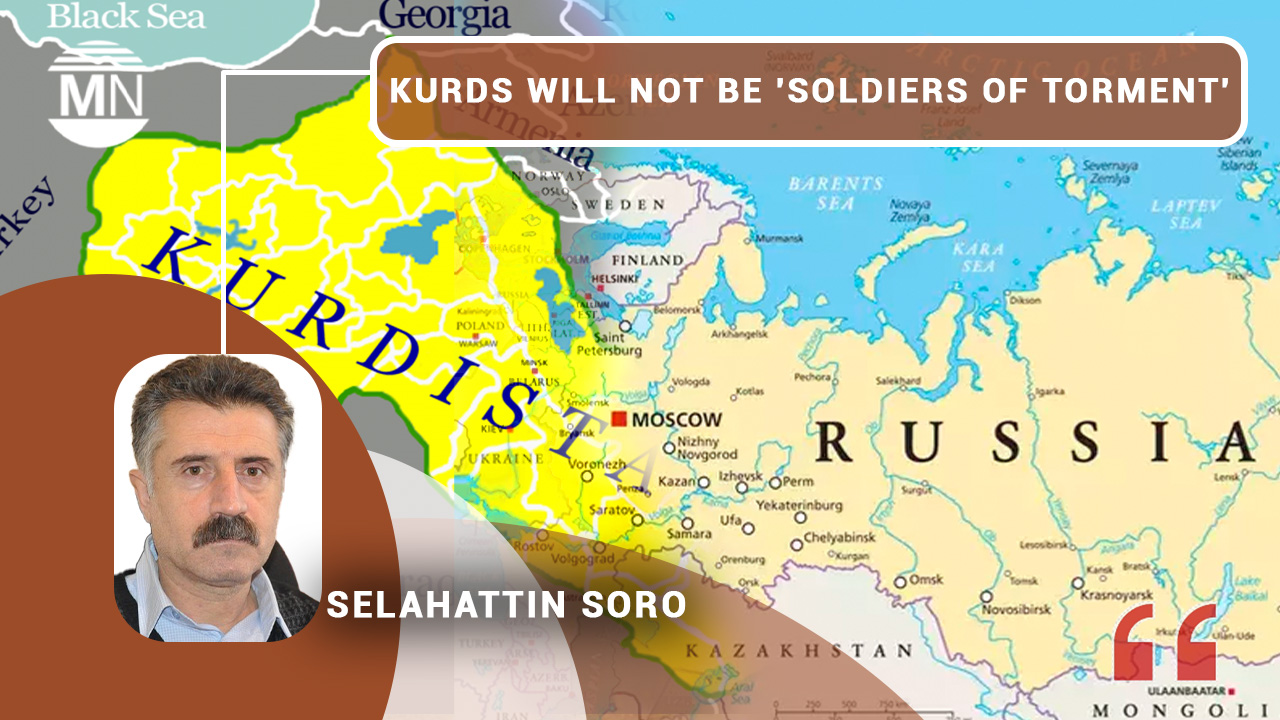
Selahattin Soro has published an important article on the historical relationship between Russia and the Kurds. Originally published on PolitikArt.net, the article examines Russia’s strategic policy in the Middle East, its approach to Kurdish aspirations, and the pragmatic dynamics underlying this long-standing intertwined history. Soro highlights the interplay of geopolitics, realpolitik and historical lessons that shape Kurdish strategies today. As Soro asserts, “We act based on what happens, not what is said.” In the Middle East, actions speak louder than words, and the Kurdish people have learned to navigate these realities with a pragmatic realism.
by Selahattin Soro
The relationship between Russia and the Kurdish people goes back centuries. Beginning in the 19th century, Tsarist Russia began documenting Kurdish affairs and entering into agreements with Kurdish groups. Over time, Kurdology emerged as a discipline influenced not only by academic curiosity but also by realpolitik considerations. In the last 50 years in particular, Russian-Kurdish relations have been marked by wars, peace efforts, alliances, contradictions and shared goals. The lessons of history have shaped Kurdish perspectives on politics and alliances
In the early 19th century, Russia, as a neighbour of Kurdistan, was deeply involved in the Kurdish question. Tsarist Russia’s main effort in the region was the establishment of Kurdology, with early Kurdologists such as Java, Basil Nikitin and Minorsky becoming prominent figures. This academic focus reflected Russia’s wider strategic interests.
Earlier insight from Selahattin Soro:
Rojava’s resistance: A defence of humanity
Russia has always played a central role in global politics, driven by its vast territories, rich resources and strategic ambitions, particularly with regard to access to the Mediterranean and Black Seas. These ambitions remain central to Russia’s geopolitical strategy, with key locations such as Sevastopol and the Syrian port of Tartus highlighting the importance of the Black Sea-Mediterranean axis.
The defeat of the Syrian regime and the Ba’ath Party on 8 December [2024] was a major setback for Russia and its ally Bashar al-Assad. This loss has thrown into uncertainty Russia’s long-standing strategy of securing access to the Mediterranean.
Today, the dynamics of the region resemble the post-World War I environment, with powers openly negotiating new arrangements similar to the Sykes-Picot agreement. As conflicts unfold in the Black Sea-Crimea-Ukraine axis, Turkey is pursuing its neo-Ottoman ambitions in both the Mediterranean and the Levant, positioning itself as a leader in the Muslim world.
Over the past 30 years, Russia’s engagement with the Kurdish movement has been partly in response to the rise of Turanism [The idea of political unity between Turkic, Mongolic, Tungusic, and Uralic peoples]. Russia’s historical engagement with the Kurds includes involvement in events such as the Bitlis uprising of 1914 [in Southeast Turkey], the Mahabad Republic [a Kurdish uprising which took place in 1946 in Iran], [Iraqi Kurdish leader] Mustafa Barzani’s migration to the Soviet Union, and Abdullah Öcalan’s exile from Syria and brief stay in Russia.
After the dissolution of the Soviet Union, the Russian Federation faced significant threats from NATO expansion and the spread of political Islam and Turanism. To counter these challenges, Russia saw the Kurdish issue as a strategic balancing tool. Between 1990 and 1998, Russia’s interest in Kurdish movements served as a counterweight to Turanist policies.
This interest waned after Öcalan’s forced departure from the Middle East under international pressure and his brief refuge in Russia. Öcalan’s plight became a key moment for Kurds to reassess international politics and adopt a more pragmatic outlook.
Kurdistan and its people have been integral to Russia’s strategic interests in the Middle East and Eastern Mediterranean. However, Russia’s approach has been primarily pragmatic, often sacrificing Kurdish interests for its geopolitical goals. This pattern is well remembered in Kurdish political and social memory.
During the Soviet era, Kurds in the Caucasus and Central Asia benefited in part from Soviet policies that promoted cultural and linguistic development. In Armenia, for example, Kurdish-language education and broadcasting by Yerevan Radio helped preserve Kurdish identity. Figures such as Qanatê Kurdo, Ordixanê Celil and Qarapetê Xaço emerged as key contributors to Kurdish cultural development. However, since the collapse of the Soviet Union, Kurdish communities in the region have faced significant challenges, including assimilation and displacement.
The Russian Federation has used Kurdish communities within its borders as a balancing element in regions such as Adygea, Krasnodar, Saratov and Tambov, in some cases granting them cultural autonomy. Despite these measures, Kurds in Russia lack political representation and face significant restrictions in pursuing policies consistent with their ethnic identity.
Russia’s relations with Kurdish political movements have been pragmatic. While Moscow has had indirect contact with the PKK, these interactions have not developed into strategic alliances. Relations with parties such as the KDP and PUK in Iraqi Kurdistan have been largely transactional, focusing on energy and trade. Moscow has avoided supporting Kurdish independence aspirations, as evidenced by its opposition to the 2017 Kurdish independence referendum.
Russia’s decision not to designate the PKK as a terrorist organisation distinguishes it from the West. This stance reflects Russia’s interest in using the Kurdish issue for geopolitical purposes and as a bargaining tool with Turkey. However, this relationship remains limited to tactical cooperation.
In Syria, Russia’s Kurdish policy aligns with its alliance with the Assad regime. The 2016 opening of a Syrian Kurdish office in Moscow demonstrated that Russia’s relationship with Kurds is not entirely disconnected. However, Moscow has pressured Kurds to integrate with the regime, as articulated by Foreign Minister Sergey Lavrov: “Kurdish future lies in a united Syria. The Kurds must negotiate with the Syrian government and align their rights as a national minority.”
Russia’s Kurdish policy in Syria aims to counterbalance Western influence, particularly that of the United States. While Moscow could have facilitated a federal agreement between Assad and the Kurds, it prioritised its strategic interests over stabilising the region.
Kurdish communities in Russia, including those from Rojava, add a humanitarian dimension to this relationship. However, this dynamic is unlikely to influence Moscow’s overarching geopolitical strategies significantly.
Russia prioritises state-centric foreign policy, often viewing Kurds as secondary actors. This approach could shift if regimes change, and the increasing political agency of Kurds in Rojava, Rojhilat, Başur, and Bakur Kurdistan may lead to more active engagement with Moscow. However, any such changes will be shaped by Russian interests.
Selahattin Soro is a Kurdish journalist, intellectual, and advocate for democracy and human rights. Known for his incisive political analysis, he has focused on Kurdish struggles, the Rojava Revolution, and Middle Eastern geopolitics. He frequently writes on the intersections of resistance, autonomy, and international solidarity. Soro’s work reflects a commitment to Kurdish self-determination and the defence of democratic values.


