

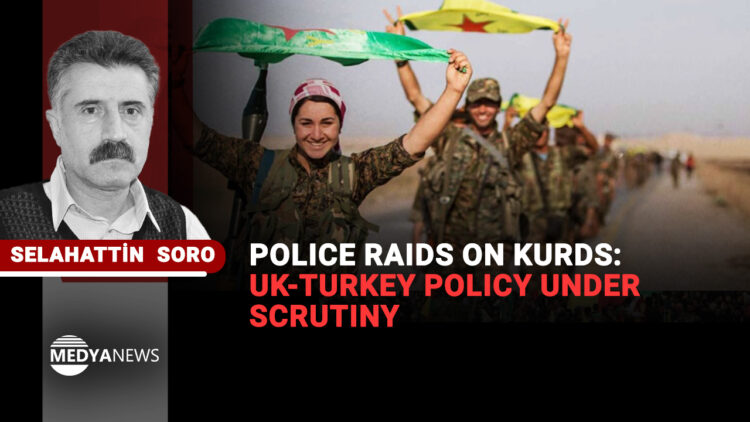
Selahattin Soro
On 14 November, UK Defence Minister John Healey visited Ankara and met with Yaşar Güler while touring the Turkish Aerospace Industries (TUSAŞ), where Turkey is a significant partner. On 25 November, NATO’s new Secretary General Mark Rutte followed suit, also choosing TUSAŞ as a key location to visit.
Meanwhile, on 18 November, Ronen Bar, the head of Israel’s internal intelligence agency Shin Bet, held a secret meeting with Turkey’s intelligence chief, İbrahim Kalın. This series of diplomatic activities, in my opinion, provides crucial insights and hints about the developments unfolding in the region.
Crackdowns amid Kurdish celebrations
While Kurds and their allies around the world celebrated the 46th anniversary of the Kurdistan Workers’ Party (PKK) with great enthusiasm, Kurdish patriots in London faced a starkly different reality. In the early hours of 27 November, around 03:00, British police raided Kurdish homes, workplaces, and organisations that have long operated within the framework of UK law. The crackdown, which continues, has resulted in detentions. Those arrested maintain their resistance from within, while Kurds and their allies protest outside.
The strategic threat of HTS and Turkish proxies
Another crucial development involves Hay’at Tahrir al-Sham (HTS), previously known as Al-Nusra Front and an offshoot of Al-Qaeda, under the leadership of Mohammed al-Jolani. This Idlib-based terrorist organisation launched a sudden offensive against Aleppo, followed by new and critical escalations across Syria.
As we know, “political and fundamental Islam” was a creation of British intelligence. In the context of the Green Belt Project, designed to counter the Soviet Union, groups such as Al-Qaeda were nurtured in Afghanistan, Turkey, and Pakistan. After the Soviet Union’s collapse, these movements rebranded and continue to operate effectively. HTS represents the latest radical offshoot of the Muslim Brotherhood in Syria’s Idlib region, operating under Turkish oversight as a quasi-Islamic emirate. Idlib and neighbouring areas have essentially become a “mini-Afghanistan” facilitated by Turkey.
Turkey has not limited its ambitions to Idlib. It has occupied Afrin (Efrîn), Azaz, al-Bab, Jarabulus (Cerablûs), Ras al-Ayn (Serê Kaniyê), and Tel Abyad (Girê Spî), using the so-called Syrian National Army (SNA), a coalition of terrorist elements under Turkish control, to wage a relentless war against the Autonomous Administration of North and East Syria (AANES). Since 2018, Turkey and its proxies have systematically launched genocidal attacks, employing advanced war technologies to destroy Kurdish life in the region.
Rojava and Syria: A red line for the Kurds
At a time when Turkey is preparing a comprehensive genocidal assault on the AANES, HTS launched a major attack on Aleppo (Heleb) on 27 November. Simultaneously, SNA factions targeted the Shahba (Şehba)-Tel Rifaat (Til Rifat) line. Following the Syrian Army’s unopposed withdrawal from Aleppo, HTS expanded its sights to Hama and Homs. Meanwhile, Turkish-backed SNA forces unleashed brutal attacks on Shahba, Sheikh Maqsoud, Ashrafiyya (Eşrefiye), and Manbij (Minbic).
These attacks cannot be dismissed as isolated or localised incidents. For Kurds, Rojava and Syria are red lines. They must be protected at all costs. This pivotal moment is as vital and transformative as the Arab Spring of 2010. The HTS manoeuvres, while ostensibly aimed at dismantling the Assad regime, primarily seek to destroy Rojava’s autonomy and Kurdish achievements—a campaign orchestrated by Turkey’s authoritarian Justice and Development Party (AKP) and Nationalist Movement Party (MHP) regime.
A broader geopolitical game
Undoubtedly, powers such as Iran, Russia, the United States, and the European Union will leverage these developments to serve their own interests. Terrorist groups, meanwhile, see this as an opportunity to fulfil the unfinished goals of the Islamic State (ISIS). Just as the ISIS war evolved into a revolutionary victory centred in Rojava, the current crisis has the potential to spark an even greater revolution and gains for the people.
However, the danger is immense. Without effective resistance and strategic action, the revolutionary values hard-won through significant sacrifices could be lost to Turkey’s fascist aggression.
A call to action
Defending these values is the fundamental responsibility of the AANES. Yet, it is also the duty of all Kurds, particularly the diaspora in Europe. Kurdish youth and communities must mobilise en masse to join the Rojava resistance and play their part in this historic struggle.
This is no ordinary battle. On 9 October 1998, Abdullah Öcalan was forcibly removed from Syria in a conspiracy aimed at eradicating the Kurdish movement and people. The Kurdish response was the historic Rojava Revolution, which brought a new spring of hope for the region’s peoples. Today, the same revolution, rooted in Öcalan’s paradigm and the Democratic Autonomy system, faces the threat of annihilation, alongside the resumption of Kurdish genocide.
Every Kurd and ally must actively participate in this mobilisation to resist this genocidal campaign with the spirit of solidarity and determination.
Defending Rojava means defending humanity
Defending Rojava means defending Kurdistan.
Defending Rojava means defending women’s freedom.
Defending Rojava means defending humanity.
Selahattin Soro is a Kurdish journalist, intellectual, and advocate for democracy and human rights. Known for his incisive political analysis, he has focused on Kurdish struggles, the Rojava Revolution, and Middle Eastern geopolitics. He frequently writes on the intersections of resistance, autonomy, and international solidarity. Soro’s work reflects a commitment to Kurdish self-determination and the defence of democratic values.


