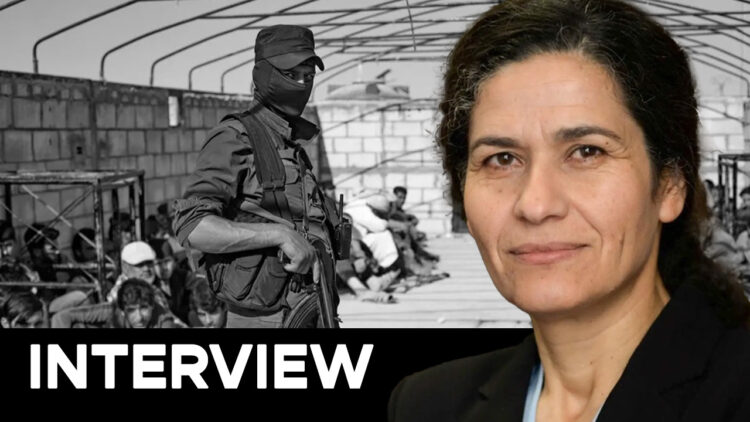
In a detailed interview with ZEIT Online, Ehmed outlined the ongoing threats posed by Islamic State (IS), the challenges faced by the Kurdish-led self-administration, and the broader implications of international policy decisions regarding Syria.
“The attack in Solingen and other similar incidents demonstrate that IS remains a formidable threat,” Ahmed said, referencing the recent terrorist attack in Germany that has reignited concerns about the resilience of ISIS. She pointed out that, despite the territorial defeat of ISIS in 2019 by the Syrian Democratic Forces (SDF), the group continues to maintain an organisational structure and active cells capable of carrying out attacks both in Syria and abroad.
Ahmed explained that regions like Deir ez-Zor, which were under ISIS control for an extended period, are still particularly susceptible to extremist influence. She highlighted the ongoing threats posed by Turkish military operations and Syrian regime attacks in these areas, which, according to her, undermine the stability of the region and inadvertently pave the way for an ISIS resurgence. “Turkey’s attacks on our territories are a major threat to the fight against IS,” she warned, adding that such actions are creating the conditions for ISIS to regain a foothold in these vulnerable areas.
The foreign relations official detailed the comprehensive approach that Rojava’s self-administration is taking to combat ISIS. This strategy includes the deployment of specialised units to target ISIS cells, intelligence-sharing with international partners, and a significant emphasis on education as a tool to counter radicalisation. “We believe that educating society is the most effective means of combating fundamentalism,” Ahmed emphasised. She noted that efforts are being made to promote a version of Islam that is moderate and inclusive, in stark contrast to the violent ideology propagated by ISIS.
However, Ahmed expressed deep concern about the thousands of ISIS supporters, including foreign fighters, who are currently detained in Rojava’s prisons and camps. She warned that these facilities could become breeding grounds for a new generation of extremists if the international community does not take action. “Our self-administration lacks the resources to properly deradicalise these individuals due to their sheer numbers,” she explained, stressing the urgent need for international cooperation in addressing this issue.
Ahmed also criticised the potential deportation of Islamist suspects to Syria by foreign governments, arguing that such actions could lead to their release or even recruitment by the Assad regime. She pointed out that the Syrian regime has a history of using Islamist militants to serve its own interests, as seen in the early stages of the Syrian conflict. “Repatriation alone will not solve the problems,” she cautioned, underscoring the complexity of the situation and the potential risks involved in negotiating with the Assad regime.
In the broader context, Ahmed called for constitutional reform in Syria, asserting that the current regime still refuses to acknowledge the rights and existence of the Kurdish people, as well as other ethnic groups in the region. She advocated for a pluralistic, decentralised system as the best way forward for Syria’s future. “Short-term solutions are doomed to failure,” she warned, arguing that only a truly democratic and inclusive system can ensure long-term stability and prevent the resurgence of extremist ideologies.
Ahmed concluded by urging the international community to support Rojava’s democratic system, which she described as a crucial bulwark against fundamentalism and a model for the rest of Syria. “Our system, despite its flaws, represents a future for Syria that is pluralistic, decentralised, and democratic,” she stated. “If we receive the necessary support, we can form a strong line of defence against extremism and safeguard human dignity in the region.”
The interview was conducted by ZEIT Online.