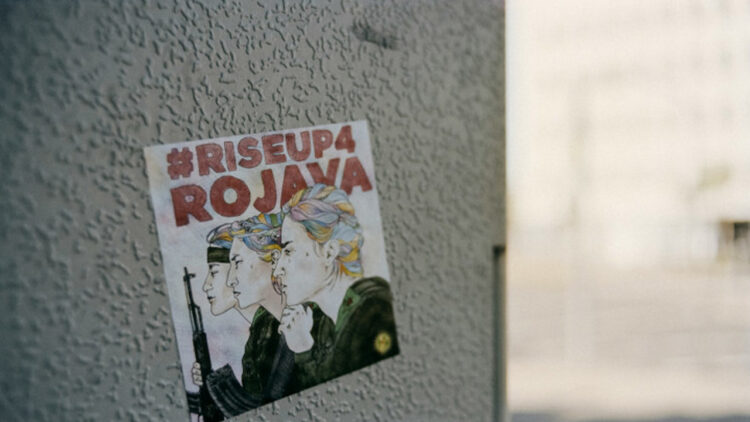
Resilience magazine has republished Arthur Pye’s evocative article about North and East Syria’s Rojava revolution, as part of its ‘Democracy rising’ blog post series.
‘Democracy Rising’ focuses on ‘deliberative democracy’, a form of democracy where deliberation and discussion are central to decision making. Resilience’s series highlights “what it is, why it’s powerful, why the time is right for it, how it works, and how to get it going in your community”. The Rojava revolution is a powerful example of radical democracy in practice, and Pye’s account is a valuable first-hand experience of it.
“Amid the seemingly senseless chaos of the Syrian Civil War, the most important social revolution of the twenty-first century was taking place,” Pye said, adding, “As the country descended into sectarian violence, Kurdish revolutionaries had stepped into a power vacuum left by the government’s retreat, building a radical new grassroots democracy in its place. Guided by a revolutionary political program known as democratic confederalism, the movement began organizing local communities not only to defend themselves, but to govern themselves.”
Pye had been inspired to travel to Rojava after discussing the revolution with activists in the US. He said that, as an organiser in the US, revolution often felt far away, and that hearing about what was happening in Syria reminded him of what was possible. Pye set about reading about Kurdish revolutionaries.
“It wasn’t their apparent readiness to face death that struck me the most, but how full of life they seemed,” he said. “They looked like they knew what they were fighting for. They may have been thrust into combat by necessity, but they weren’t fighting to defend what existed before. They were fighting for the chance to build something new.”
He set about trying to learn as much as he could about the revolution that was taking place. He wrote:
“I would travel to villages and refugee camps across the region, to neighborhood communes, worker cooperatives, community centers, and autonomous women’s structures, as well as military positions on the frontlines with the fascist Turkish army and its Islamist proxies. I would spend time with committed revolutionaries (seasoned fighters, community organizers, movement leaders), as well everyday people from all walks of life. By any practical measure it was a year rich in experiences. But Rojava had a way of leaving me with more questions than answers. It was a place where no assumption went unchallenged and the more I learned, the less I seemed to know.”
Describing the origins of the Rojava revolution, Pye highlights how it “was hardly a spontaneous affair. Their new revolutionary political system was the culmination of a decades-long struggle waged by the Kurdish freedom movement. Its origins date back to the 1970s, with the founding of the Kurdistan Workers’ Party (PKK) in Turkey.”
Highlighting someone of the challenges he uncovered with grassroots democracy, Pye said “One of the most striking problems I encountered was the uneven development of public consciousness and participation. One often flowed from the other. Forming structures of local self-governance was one thing. But getting people to see themselves as responsible for their own community, and for the revolution, proved another thing altogether. In most communities, the speed of structural change had far outpaced changes in public consciousness.”
Also, “the conditions of endless war and economic embargo created a climate of fear, mistrust, and material insecurity contributing to a slow attrition of public engagement,” he said.
In his conclusion, Pye states, “Rojava has much to teach us, if we only open ourselves to its complexity. I went there in search of a real-life libertarian socialist revolution. What I found was different from what I read about in books; it was messier and more human than I ever imagined. Like the people who gave it reality, it was flawed, but it was also alive.”
Pye’s full article can be found here.