

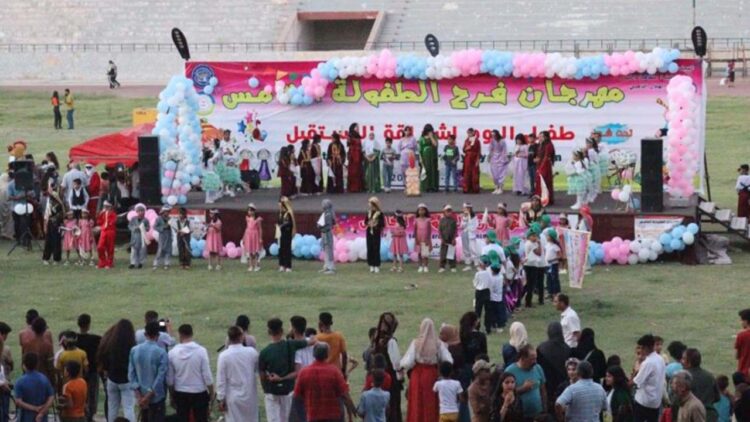
The city of Raqqa in north-eastern Syria was liberated from ISIS rule on 17 October 2017 and has since undergone a profound transformation. While it suffered marginalisation and looting under ISIS and before that under the Assad regime, the model of a democratic nation has allowed the city to flourish and its different ethnic groups to live together in harmony and justice.
Raqqa under the Assad regime and the ISIS caliphate
The city of Raqqa became known as the ‘capital’ of ISIS’ caliphate, during its expansion in Iraq and Syria. Despite this notoriety, Raqqa is, in fact, an ancient and historic city with many monuments and a large archaeological world heritage site. It’s situated on the banks of the Euphrates in Mesopotamia, the so-called ‘cradle of humanity’, where civilisation is thought to first have flourished.
During the Assad regime, Raqqa was subjected to a policy of isolation and economic deprivation, which led to its marginalisation. Assad’s policies also exploited the presence of different ethnic groups in the city – such as Arabs, Kurds and Turkmen – for its own power interests, undermining the city’s peace. After the Arab Spring in 2011, Raqqa rose up against the Assad regime and control of the city was soon taken by the so-called Free Syrian Army (FSA) in 2013. A year later, ISIS mercenaries entered the city. From 2013 until the liberation of the city in 2017, there was little information about what was happening inside Raqqa. During these years, however, the FSA and later ISIS gangs committed all kinds of injustices and atrocities against the population.
The liberation and the reconstruction
The efforts to liberate Raqqa were launched by the Syrian Democratic Forces (SDF) on 6 November 2016. The campaign was launched with the declaration: “Raqqa will be liberated by the hands of its sons and factions, by Arabs, Kurds and Turkmen, the heroes united under the banner of the Syrian Democratic Forces”. In about a year, the SDF’s trained forces liberated the outskirts and centre of Raqqa. The city was finally reclaimed on 17 October 2017.
Even before the full liberation of the city, efforts were made to rebuild its administration and civic life. The displaced residents of Raqqa began to organise themselves by forming the Raqqa Civil Council in the city of Ain Issa on 18 April 2017, in order to provide services and solve the problems faced by residents. The Council moved to Raqqa on 4 April 2018 to facilitate organisation and coordination. The establishment of the Raqqa Civil Council was a strong signal of the willingness of the people of Raqqa to rebuild and reorganise the city after the dark times they’d experienced.
The era of freedom
After the liberation of Raqqa, the city entered a new era, described by its residents as the era of freedom, in which work began on establishing a decentralised democratic system based on the ideology of ‘democratic nation’ and the ideas of PKK leader Abdullah Öcalan.
A number of institutions and councils were established to allow residents to organise their lives on the basis of democratic principles of inclusion and self-governance. One of the biggest problems under the Assad regime has been the conflicts between different ethnic-religious groups. These tensions were often fuelled by the regime on the basis of extremist and radical ideas, but did not achieve any other result than creating violence, suffering and injustice for the people.
Since the liberation of the city, however, the conflicts have begun to be resolved. “With the liberation of the city and the entry of the SDF into the Raqqa region and the return of the residents, the ideas of the democratic nation and the culture of accepting others and the diversity of components and ethnicities began to spread,” explains Hassan Al-Mustafa, a member of the Democratic Autonomous Administration of Raqqa. The credit for this goes to the thought and philosophy of the leader, Abdullah Ocalan, who advocated equality, freedom for peoples and solidarity and cooperation between all components.
The battle to liberate Raqqa resulted in the destruction of 80% of buildings and infrastructure, some of which was damaged by ISIS to make access to the city more difficult. As part of the reconstruction efforts, the important Al-Rashid Bridge, destroyed by ISIS, was rebuilt in less than two years and opened to the public on 7 June 2023.
A future on the path of the democratic nation
On the 7th anniversary of the city’s liberation, it is clear how much progress has been made in resurrecting Raqqa from its darkest days. Like other cities in northeastern Syria liberated from ISIS occupation, such as Manbij (Minbic) Raqqa is undergoing a deep process of democratisation and inclusion. Despite the presence of ISIS cells in the region, which often provoke clashes with SDF security forces, the influence of PKK leader Abdullah Öcalan’s model of a democratic state is driving the city’s transformation.
The city of Raqqa, which was occupied by ISIS, marginalised during the rule of the Damascus government and plundered during the rule of the so-called Free Syrian Army, has become a centre for spreading the philosophy and idea of acceptance of the other and coexistence based on the principles of equality and social justice.


