

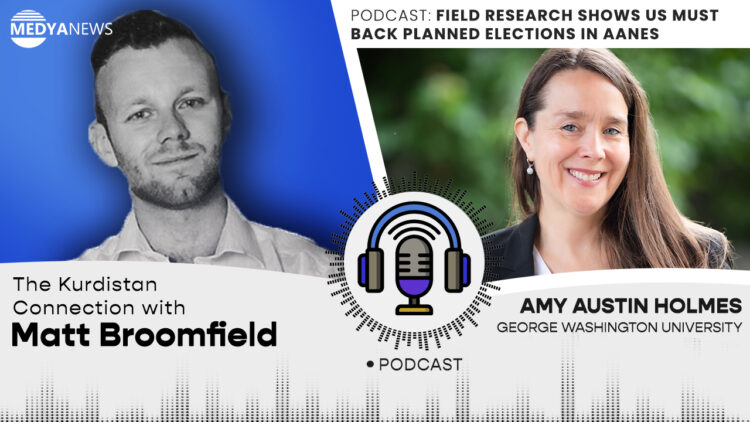
Academic Amy Austin Holmes has just published ‘Statelet of Survivors – the making of a semi-autonomous region in north-east Syria’. Based on seven years’ field research on the achievements gained and challenges faced by the Kurdish-led Autonomous Administration of North and East Syria (AANES) and its military wing in the Syrian Democratic Forces (SDF), the book offers novel insights on how regional minorities have collaborated to ensure their survival in the face of atrocities at the hands of Turkey, ISIS, and the Assad regime.
Medya News’ Matt Broomfield spoke to Dr. Holmes to discuss her field research, her perspective on the AANES’ achievements and survival, and why the US should rethink its approach to the region, in particular backing municipal elections recently postponed following US opposition and Turkish threats.
🎙️ #PODCAST | Dr. Amy Austin Holmes (@AmyAustinHolmes) has released a new book detailing seven years of field research on the Kurdish-led AANES.
📍Learn about the region’s struggles and triumphs: (https://t.co/is1vCkV5oq)@MattBroomfield1#AANES | #Syria | #Podcast | #MedyaNews… pic.twitter.com/AaPxvX4436— MedyaNews (@medyanews_) July 8, 2024
Selected highlights follow, the full interview is above, and Dr. Holmes’ book can be purchased here.
What contribution did you hope to make to research on North and East Syria (NES)?
(01:50) I wrote the book because, even before the United States had gotten involved in supporting the SDF in 2015, the Kurds in the north-east, Assyrians and Syriac Christians had already joined forces to combat the al-Qaeda offshoot that was spreading in the north-east. So this was also before the ISIS caliphate had been officially declared. Within a few years, this non-state actor, this militia that didn’t even have uniforms, evolved into a multi-ethnic, multi-religious force which defeated ISIS.
(02:36) The question I think many people haven’t asked is why? Why did Kurds, Christians, Assyrians and Armenians join forces back then? I think this has often been overlooked, though it was a key turning-point. A lot of the analyses that refer to this region as Rojava, but if you simply see it as a Kurdish region or movement, that’s too narrowly focused to understand the complexity of the present and past of the semi-autonomous region.
What was unique about your research methods?
(09:57) I travelled to SDF bases and I handed out a paper survey. At some point I used tablets, but over 400 men and women took my survey, and that was the original data that I collected, plus interviews with over 100 officials in the administration. Because the other thing I realised was that as territory was liberated by ISIS, governing structures were set up. I think that’s still a mis-understood aspect of this revolution, something people outside Syria, including here in the USA and in Europe, don’t fully understand.
What message does this research send to US and other policy-makers?
(14.00) I gave this example of the UN’s Women, Peace and Security agenda that was declared in the year 2000, when the United Nations committed to increasing the number of women in specifically security forces, plus other organisations and bodies. Yet the UN didn’t live up to their own goal they set for themselves, whereas the SDF actually exceeded that goal by having approximately 30 percent of women, and now between 40 and in some cases 50 percent in AANES governing structures, depending on the region and institution! So I find it ironic that the UN, this big, powerful organisation which has the resources to do so, has failed to meet the standards they set themselves, whereas this non-state actor in a poor region in a poor country managed to do this. We have to ask ourselves why – and also why, if the SDF and AANES are living up to this expectation of promoting women both in military and political structures, why are they excluded from the talks in Geneva that are supposed to resolve this conflict?
What are the implications of your research for the proposed elections in NES, postponed following US opposition?
(18:58) I think Egypt’s [2013] elections happened too quickly, because the youth and young people who went out and demonstrated in their millions didn’t have time to form a political party. It was an election between the Muslim Brotherhood and the old Mubarak regime. But now, in Syria, it’s been five years since they defeated ISIS as a caliphate… 12 years since the Assad regime withdrew. So I think they have gained the necessary experience to start to try to understand, how do we form political parties, how do we go about holding elections?
If we tell them now, it’s not the right time to hold elections – when will it be the right time? The timing of elections in countries transitioning from authoritarian rule is really important. They shouldn’t happen too quickly, nor be delayed indefinitely. i think it was a mistake to tell them not to hold elections.
I understand there are concerns about threats from Turkey and a need to focus on basic services, so people have water and electricity, especially after civilian infrastructure has been destroyed by Turkish airstrikes. But holding elections is also an important part of a transition process! Having elections that will be monitored by international observers would be really important, to have access to polling stations, to be able to write reports and say – what did they do right, what did they do wrong, what should they do better? That’s a normal process for countries going through democratic transitions we should allow to take place.


