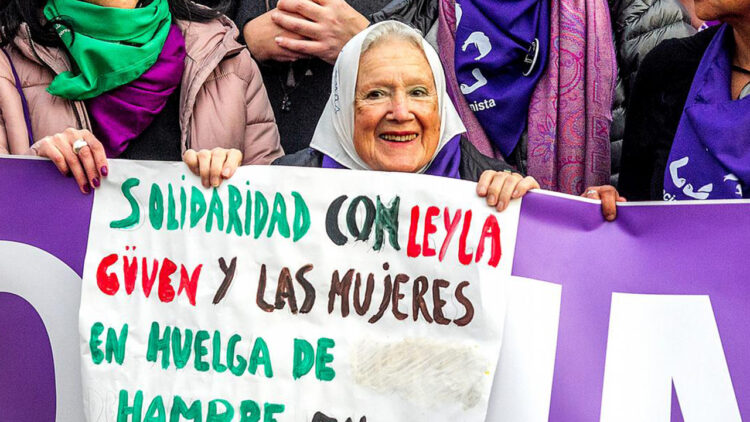
Nora Cortiñas, a lifelong campaigner for peace and justice, passed away on Thursday 31 May at the age of 94. Cortiñas was part of the ‘Mothers of the Plaza de Mayo’ in Buenos Aires. Cortiñas’ personal connection to the movement began when her son Gustavo Cortiñas was disappeared by the dictatorship in 1977, the same year the organisation was founded. The ‘Mothers’ began their now-famous weekly marches in Plaza de Mayo, demanding answers about the fates of those who vanished during Argentina’s military dictatorship.
“With deep pain, we bid farewell to our sister in the fight, Nora Cortiñas, an undisputed pillar of the human rights movement in Argentina,” the Grandmothers of the Plaza de Mayo, a sister organisation which emerged from the original ‘Mothers’ group, comprising women who discovered that their abducted daughters had given birth in captivity, announced on social media.
The ‘Mothers’ group was formed on 30 April 1977, by 14 women who had lost their children to political repression. They gathered in front of the presidential palace in Buenos Aires to protest the military regime that took power in a coup the previous year. These women bravely confronted the dictatorship during a period of intense repression, risking their own safety to demand justice for their children, who had been abducted, tortured, and often killed.
Cortiñas’ son Gustavo, a 24-year-old member of the leftist Peronist Youth group, was kidnapped by soldiers and never seen again. She described his disappearance as akin to “having an arm amputated”.
Human rights organisations estimate that about 30,000 people were disappeared during the dictatorship from 1976 to 1983.
Cortiñas, known for her white headscarf and tireless energy, was a social psychologist and mother of two. As one of the founders of the ‘Mothers’, she rarely missed the weekly Thursday marches in Plaza de Mayo, except when she travelled internationally to advocate for their cause.
In later years, Cortiñas expanded her activism to include support for indigenous people, workers’ rights, victims of gender-based violence, and women’s access to abortion. She was a vocal critic of Javier Milei, the current president of Argentina. Milei has sought to cast doubt on the number of people disappeared during the dictatorship.