On 20 January, Kurdistan Free Life Party (PJAK) commemorated the anniversary of the establishment of the Republic of Kurdistan, a short-lived Kurdish state established in 1946 in the city of Mahabad, located in the northwest of Iran. The milestone is symbolic of the on-going Kurdish resistance, PJAK said, while also commemorating a decade since the establishment of the Autonomous Administration of North and East Syria (AANES) in Jazira (Cizîrê) canton as a beacon of hope in the fight for freedom and democracy.
“The establishment of the Republic of Kurdistan, 79 years ago, marked the dawn of a new era—one that continues to illuminate the fundamental paths to democracy. The Republic’s national-democratic foundation, built on peaceful coexistence with neighbouring nationalities, remains a cornerstone of our values. These principles pave the way to freedom and democracy for the Kurdish people and beyond,” PJAK said, in an official statement.
The party drew parallels between the Republic of Kurdistan and the AANES, a pioneering socio-political movement in Kurdish-led northern Syria known as Rojava. They emphasise that the Republic’s legacy is being realised in Rojava, marking a significant step toward freedom. PJAK expresses optimism that the democratic principles envisioned by the Republic of Kurdistan will inspire genuine democracy and the liberation of Kurds across all four parts of Kurdistan.
Voicing this hope, Munira Qazi, daughter of Qazi Mohammad, the esteemed president of the Republic of Kurdistan, released a video message on the anniversary of the Republic’s founding. “My father’s dreams will be realised in Rojava,” she declared.
Simultaneously, the Kurdistan Democratic Party (KDP) conveyed its heartfelt congratulations to the Kurdish people, marking the occasion of the republic’s establishment. Their statement underscored the enduring relevance of the republic’s core values, reaffirming their continuity and vital importance.
In commemoration of the anniversary, Kurds across multiple cities in Iranian Kurdistan (Rojhilat), undeterred by intense security crackdowns, rallied to protest the ongoing repression faced by Kurds under the Islamic Republic of Iran. Despite the heavy security presence, they also engaged in various propaganda activities to highlight the historical significance of this pivotal day.
The Balochistan People’s Party (BAP) issued a statement extending their congratulations to the Kurdish people on the anniversary. The party vehemently condemned the continuation of Iran’s assimilationist policies, calling for the peaceful coexistence of all nations within the political framework of Iran.
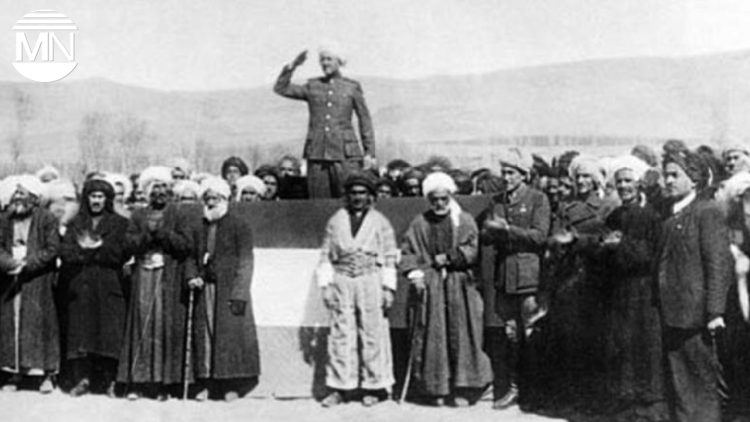
The Republic of Kurdistan was established on 22 January 1946 in Iranian Kurdistan under the leadership of Qazi Muhammad. This historic event came at a time when World War II had reshaped the Middle East, with British and Soviet powers carving up spheres of influence. The Kurdish republic emerged as a beacon of Kurdish aspirations for self-rule and autonomy amid these shifting geopolitical tides.
Qazi Muhammad, born in 1900 in Mahabad, was a highly educated Kurdish leader dedicated to combating poverty, illiteracy, and injustice in his homeland. In 1945, he co-founded the KDP, advocating for a decentralised, democratic Iran and Kurdish autonomy. On 22 January 1946, the Republic of Mahabad was declared, with Qazi Muhammad as president.
Despite its promising start, the republic faced immediate threats from neighbouring states, and Tehran’s refusal to negotiate sealed its fate. Soviet support dwindled by late 1946, and on 15 December 1947, after 11 months, Iranian forces, backed by Western powers, invaded Mahabad. The republic fell quickly, and on 31 March 1947, Qazi Muhammad was executed.
Though short-lived, the legacy of the Republic of Kurdistan endures, inspiring Kurdish political memory and the ongoing struggle for liberation, cultural rights, and political recognition across Kurdistan in the Middle East.