

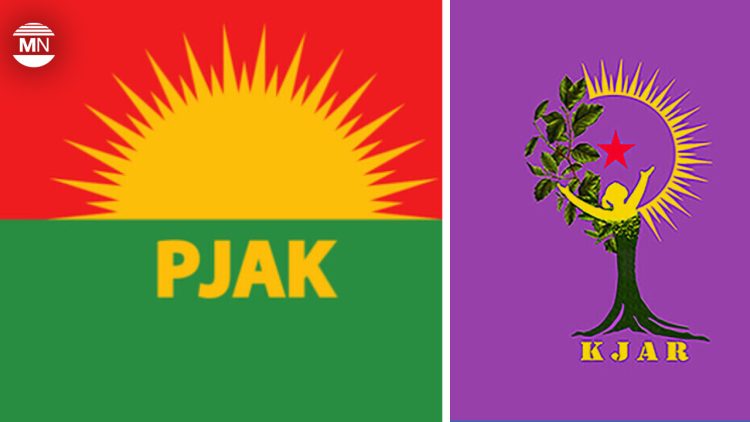
Following last week’s statement by the Kurdistan Free Life Party (PJAK) titled ‘Iran’s future depends on democratic struggle, not war’, the party reiterated its non-alignment stance in the Iran-Israel conflict. The statement emphasised that neither war nor authoritarian rule can bring lasting freedom. Calling for local organising, social solidarity and community defence, the statement read: “Freedom for Iran will come through the people’s democratic struggle and the “Jin, Jiyan, Azadî” [Women, Life, Freedom] revolution.”
Related Article:
PJAK urged all communities to establish grassroots organisations, emergency response networks and local governance structures while maintaining a clear distance from state-aligned forces. Highlighting that “there are options beyond war and dictatorship”, PJAK’s statement called for civilian-led structures to protect society and lay the foundation for a democratic future. However, Turkish pro-government media misrepresented PJAK’s stance, falsely portraying it as a call for escalation. Much of the disinformation stemmed from a deliberate campaign that conflated PJAK’s position with statements issued by the breakaway nationalist Kurdistan Freedom Party (PAK), which is an entirely separate organisation with no ties to PJAK.
Expanding on PJAK’s stance, Siyamend Mûînî, a member of the PJAK Executive Council, spoke with ANF News on 19 June to analyse the impact of the Iran-Israel war. “The crisis in the Middle East has entered a new phase with the Iran-Israel war. At the root of this war are the policies of the nation-state system, which deny and aim to annihilate peoples and their differences,” he said. Mûînî argued that the war does not serve the interests of the people, but rather advances the power ambitions of Iran and Israel.
Mûînî reaffirmed PJAK’s commitment to protecting the Kurdish population in Rojhilat (Eastern Kurdistan) from the devastating consequences of the conflict, and emphasised the need for unity and organisation among all communities facing repression. He warned that, without adequate preparation, the Iranian regime’s fascist oppression could target the Kurdish people again. “It is our most basic duty to defend and protect our people. If there is any tendency threatening our people, we are prepared to intervene in any way necessary,” he said.
Mûînî called on all Kurdish political forces in Iran to act collectively, regardless of their ideological or political differences.
“In this historic process, Kurdish forces must unite ideologically, politically and militarily on the same front, with the primary goal of protecting our people’s interests against the regime.”
His remarks closely align with an earlier statement delivered on 17 June by PJAK Foreign Relations Officer Zegrus Enderyarî. Enderyarî stated that PJAK would not participate in the Iran-Israel war, but would continue to advocate for a ‘third way’ in the Middle East — outside the frameworks of state violence and geopolitical rivalry. He emphasised the importance of unity and social defence in Rojhilat, warning that the Iranian regime could exploit the conflict to intensify its crackdown on political prisoners, activists and women’s movements.
This ‘third way’ approach has also been framed as a new phase of the Jin, Jiyan, Azadî revolution, with PJAK presenting itself as a means of achieving democratic autonomy, women’s liberation, and pluralistic governance in Iran. In a recent statement, PJAK Co-Chair Peyman Viyan emphasised that the Iranian regime has been weakened by growing internal repression, economic collapse, and military escalation. She urged the Iranian people to resist authoritarian rule by organising in a decentralised manner, and reiterated PJAK’s support for civil society initiatives in Eastern Kurdistan.
Related Article:
Hopes rise for ‘Jin, Jiyan, Azadî’ renewal as Iran’s regime falters
Viyan also warned of worsening state violence targeting Kurdish women and political prisoners. She drew attention to the cases of Warisheh Moradi, Pakhshan Azizi and Sharif Mohammadi — three Kurdish women who have been sentenced to death in Iran on charges relating to PJAK. According to Viyan, they were denied fair trials and subjected to torture while in detention. PJAK has reiterated its call for these sentences to be revoked immediately as part of its broader campaign for justice and human rights.
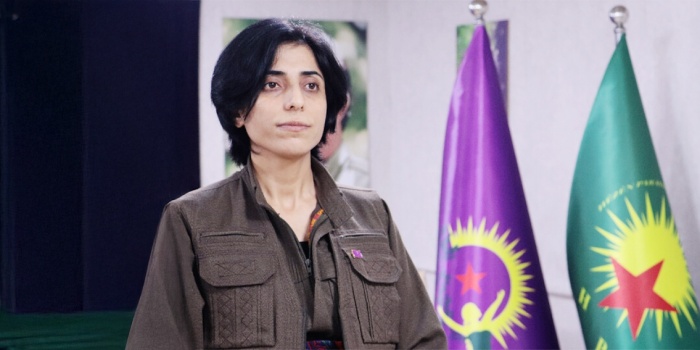
PJAK supports the campaign led by the East Kurdistan Free Women’s Society (KJAR) titled ‘No to Execution, Yes to Free Life’, which defends women political prisoners and advocates democratic transformation in Iran. In a statement issued on 17 June, KJAR also warned that wars between nation-states are part of a capitalist agenda that exacerbates patriarchal violence and authoritarian control. KJAR denounced both the Iran-Israel war and the Islamic Republic’s long-standing oppression of women through executions, poverty and systemic marginalisation.
“In wars between nation-states, it is societies, and particularly women and children, that pay the heaviest price. The conflict between Israel and Iran is no exception. However, it is important to remember that the Islamic Republic has been waging war against its own society, particularly women, for years through executions, femicides, and the spread of poverty and unemployment. The core rupture between the Islamic Republic and society, particularly women, occurred long ago, and this war will only make that divide more visible and pronounced.”
KJAR stressed that slogans like ‘Jin, Jiyan, Azadî’ should not be exploited by state actors, but should remain rooted in women’s lived experiences of resistance. The organisation called for the establishment of grassroots committees, trans-party alliances and women-led democratic structures in both Kurdistan and Iran, emphasising that a free and just society cannot be realised without women’s leadership.
The slogan ‘Jin, Jiyan, Azadî’ (Woman, Life, Freedom), which notably emerged as the rallying cry of the large-scale Iranian protests in 2022, was originally conceptualised by the imprisoned Kurdish leader Abdullah Öcalan. Öcalan, through his libertarian paradigm and ideological analyses, emphasised that women’s liberation is inherently intertwined with life and freedom, and thus coined this powerful motto as a foundational expression of his feminist philosophy, originally named jineology. This slogan has since transcended its Kurdish origins, becoming widely adopted and emblematic within feminist and liberation movements, especially highlighted during the widespread feminist uprisings across Iran, reinforcing its global resonance and historical roots in Öcalan’s ideological framework.
Related Article:
‘Jin, Jîyan, Azadî’ in the words of their creators: Öcalan and Kurdish women
PJAK and KJAR are two grassroots Kurdish organisations operating predominantly in the Kurdish regions of western Iran. Both emerged as expressions of political resistance and societal transformation, drawing profound inspiration from the ideological framework of Abdullah Öcalan. PJAK positions itself as a political and militant organisation advocating for the self-determination and cultural rights of Kurds in Iran, while KJAR functions as a women-led movement committed to advancing gender liberation and democratic self-organisation. Central to both is Öcalan’s paradigm of democratic confederalism, which foregrounds grassroots democracy, gender equality, and ecological sustainability. KJAR, in particular, embodies Öcalan’s insistence that the liberation of society is impossible without the liberation of women, placing feminist struggle at the core of its political vision. Together, PJAK and KJAR represent a transformative model of resistance rooted in collective empowerment and non-state democratic structures within a repressive state context.
Despite the escalation of military activity, the intensification of repression and the economic marginalisation of Kurdish regions, PJAK and KJAR view the convergence of political crisis, social unrest and international conflict as an urgent opportunity for inclusive, democratic renewal. Rejecting separatism and external intervention as solutions, both organisations are calling for a nationwide effort rooted in grassroots mobilisation, democratic participation and women-led organising. PJAK and KJAR affirm that unity among Iran’s diverse peoples — Kurds, Persians, Baluchis, Azeris and others — based on shared principles of justice, decentralisation and equality is the path forward. According to their vision, a democratic and pluralistic Iran can only be achieved through solidarity, civic empowerment, and the collective agency of all its communities.


