

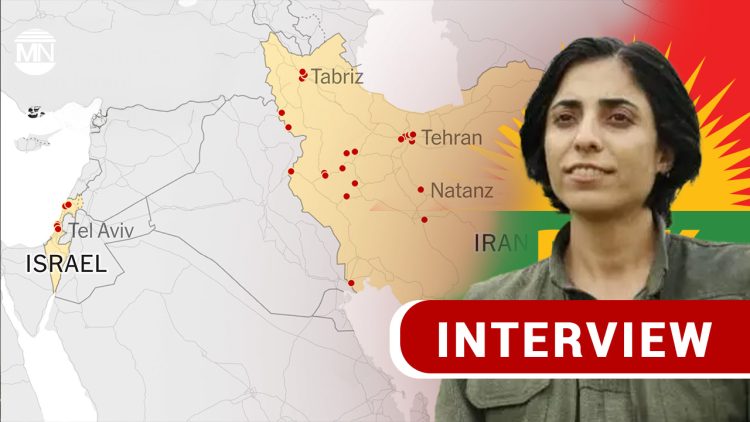
As conflict intensifies between Iran and Israel, the Kurdistan Free Life Party (PJAK) has called on all peoples in Iran to organise for democratic self-governance and resist the regime’s “dictatorial” rule. PJAK Co-Chair Peyman Viyan warned, during an interview on Monday with the pro-Kurdish outlet Yeni Özgür Politika, that Iran’s internal repression and regional missteps have left it vulnerable to deeper instability.
In a dramatic escalation, Israeli airstrikes on the night of 13 June targeted multiple Iranian provinces—Tehran, Kermanshah, Tabriz, Qom, Lorestan, and Hamadan—hitting nuclear and military sites. Among those reportedly killed were top officials, including Chief of Staff Mohammad Bagheri and Revolutionary Guard Corps Commander Hossein Salami. Iran retaliated with ballistic missile strikes, and cross-border attacks between the two countries remain ongoing.
As Iran’s leadership reels, military deployments have increased in the western Kurdish-majority regions, known as Iranian Kurdistan or Rojhilat. PJAK, an armed Kurdish opposition group based in the Qandil (Qendîl) Mountains and fighting for Kurdish rights in Iran, claims the state is now “striking its internal arms one by one” after losing regional influence.
“We call on all peoples to mobilise to build a democratic society that governs itself,” Viyan said, reiterating PJAK’s support for a decentralised, democratic model of governance. She highlighted the growing influence of the ‘Jin, Jiyan, Azadî’ (Woman, Life, Freedom) revolution, which gained global visibility during the mass protests sparked by the death of Jina (Mahsa) Amini in 2022.
Viyan also warned of worsening state violence against Kurdish women and political prisoners. Three women—Warishe Moradi and Pakhshan Azizi, and Sharif Mohammadi—have been sentenced to death in Iran for alleged ties to PJAK. According to Viyan, these women were denied fair trials and subjected to torture. A global campaign titled ‘No to Execution, Yes to Free Life’, launched by the Kurdish women’s movement KJAR, has gained traction in recent weeks.
“There is a special war being waged against women in Iranian prisons,” Viyan said. “Most of those executed were either political activists or victims of systemic gender-based violence.” She noted that 31 women have been executed in 2024 alone, many after being accused of resisting male violence or participating in protests.
While Iran faces external attacks and internal turmoil, Turkey is also pressuring PJAK to disarm. Viyan dismissed this as interference. “PJAK fights for the rights of Kurds in Iran. The Turkish state should resolve its own issues before targeting us,” she said.
The interview comes as Tehran grapples with an economic crisis, drought-driven internal displacement, and rising public anger. “Iran is entering a new phase,” Viyan stated. “The solution is not more war or executions—it’s democratic autonomy and recognising Kurdish rights.”
PJAK urged the international community to monitor Iran’s human rights abuses and support grassroots movements advocating for change. “Whatever the circumstances, we will continue our struggle for freedom,” Viyan concluded.


