

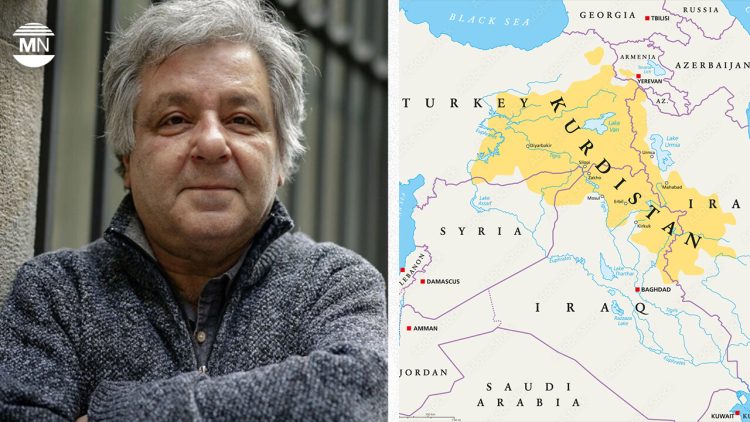
Prof. Dr. Hamit Bozarslan of the École des Hautes Études en Sciences Sociales (EHESS) in Paris has shed light on the historical roots of the Kurdish question, describing it as a longstanding “matter of denial” that has shaped the politics of several Middle Eastern states. His remarks, made in an interview with ANF, also address PKK leader Abdullah Öcalan’s recent call for change.
"The Kurdish question is first and foremost a question of denial. Kurdistan has existed as a geography for more than a thousand years".
Bozarslan emphasised how Arab and Persian sources have historically referred to the region. According to him, the problem began when newly formed nation-states adopted radical nationalist policies, refused to recognise Kurdish identity and forcibly assimilated Kurdish populations.
Bozarslan traced the development of the Kurdish struggle through the collapse of the Kurdish emirates in the 19th century and the sweeping changes under new regimes in Iran, Iraq, Syria and Turkey. He argued that “the Kurdish question is not solely linked to violence, nor is it the result of imperialist intervention”, but rather a deep-rooted social, political and historical struggle for Kurdish self-definition.
Turning to the Turkish experience, Bozarslan pointed out that “Kemalism reneged on its promises to the Kurds in the mid-1920s, sparking armed uprisings in places like Dersim and Koçgiri”. He noted that similar patterns of denial have occurred in neighbouring states, with Kurdish rights often seen as a threat to dominant nationalist frameworks.
RELATED ARTICLES
A black page in Turkey’s history: The Dersim Genocide 87 years ago

A visual journey through Kurdish history

Turkish state’s ‘history of massacres’ denounced by Kurdish umbrella org
Asked about key turning points, Bozarslan emphasised how regional developments – from the collapse of the Barzani movement in Iraq in 1975 to the emergence of a radicalised Kurdish youth in the 1970s – contributed to the creation of the PKK. “The rise of the PKK was shaped by historical conditions, but also by a new sociological context, especially in the 1970s,” he explained, highlighting the role of economic crises and a growing sense of disenfranchisement among Kurdish communities.
Source: Bakur, documentary
Assessing the PKK’s half-century of struggle, Bozarslan noted that the movement had significantly changed Kurdish society. “One of the biggest changes is the rise of a Kurdish political class, intellectual life and cultural awakening,” he said, noting the parallel growth of a strong women’s movement.
"It is clear that the regime has had to re-legitimise Öcalan in this change. It is clear to all that there is a strong link between Öcalan and the Kurdish issue. In his first statements, Öcalan was expected to say 'I founded and dissolved this terrorist organisation' and not to mention the Kurdish issue. However, his statements clearly indicate that he is discussing the centuries-old Kurdish issue and does not view the PKK's guerrilla war as a terrorist phenomenon, but rather as a manifestation of violence that can be explained within its historical context."
Bozarslan also addressed Öcalan’s recent call for change within the PKK, explaining that while this was not entirely new, “new conditions on the ground make any change in strategy potentially significant”. But he warned that recognition of the Kurdish question was far from guaranteed: “Kurdish society is now out in the open, albeit under constant threat of repression, but the state’s acceptance of a legitimate Kurdish cause is not fully established”.
Bozarslan ended on a note of cautious optimism, suggesting that any successful solution would require real institutional change and recognition of Kurdish identity in all relevant states: “For a long-term solution, new approaches need to be legitimised, not only in Turkey but across the Middle East.”


