Sarah Glynn
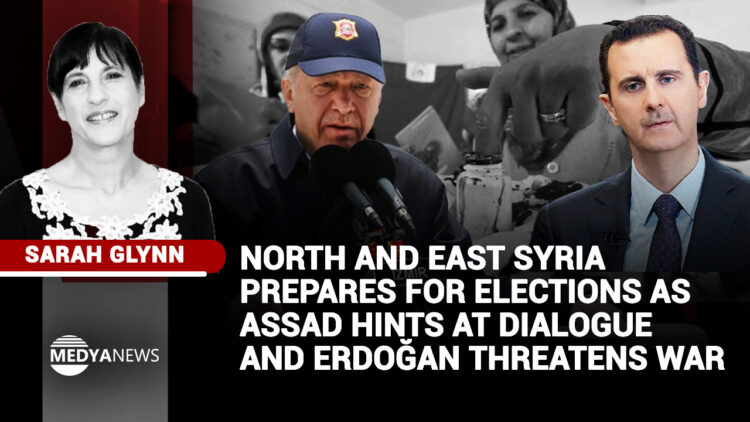
The Autonomous Administration of North and East Syria has been preparing for long-anticipated elections against the backdrop of Turkish bombardments and renewed threats of invasion. These threats have only been reinforced by a new regulation that gives the Turkish president power to declare military mobilisation; but a glimmer of hope has been provided by a report on President Assad’s speech to a meeting of his Arab Socialist Ba’ath Party at the beginning of the month. Independent Arabia’s source revealed that Assad told his party that his government intended to reach a political settlement with the Autonomous Administration within a few months, and that there would be no “military solution” in North and East Syria. This clearly came as a surprise to the Autonomous Administration. Elhan Ahmad, co-chair of External Relations, told Independent Arabia that there were currently no discussions regarding such a dialogue and that Damascus still has an unrealistic reading of the situation in Syria. But messages are still being exchanged, and she also expressed hope that “positive results will be received in the near future”, repeating the Administration’s constant readiness for dialogue and their commitment to Syria as a whole.
President Assad and the Autonomous Administration of North and East Syria
Russian military support allowed Assad to abandon his initial conciliatory approach towards the Autonomous Administration, and joint statements by Syria, Russia, Turkey, and Iran have condemned the Administration as a separatist project. However, while Russia has tried to broker normalisation between Syria and Turkey, Assad has always made it clear that Turkey must end their occupation of Syria first. His reported statement to his party should dampen any residual Turkish hopes for a joint attack against the Kurds, but it hasn’t prevented Devlet Bahçeli, leader of Erdoğan’s far-right partners, the Nationalist Movement Party (MHP), from calling for just such a joint military operation as a response to the Autonomous Administration’s election plans.
An important consideration for Damascus, and also for their Iranian partners, is the removal of American forces. An agreement with the Autonomous Administration could facilitate that. The United States would not be happy to lose this strategic foothold against Iran, or to see Assad regain access to the oil in Deir ez-Zor, but there is also a strong pull to get out of a difficult situation.
The Autonomous Administration is, of course, acutely aware of the dangers facing it on all sides. They know that, in the current situation, the presence of US forces prevents Turkey from carrying out a land invasion, and also that, despite promises, they will stay only so long as suits American interests, and could be quickly withdrawn in the event of a Trump presidency; and they have found, to their cost, that the US will provide no protection against Turkish air attacks. They want to make an agreement with Damascus, but an agreement that does not destroy all the freedoms that they have built up over nearly twelve years of autonomous control, and that they have defended with the loss of 12,000 lives. They have also called on Arab countries and the Arab League for support in negotiating a future Syria that allows a devolved democracy. Syria would gain a large and well-trained military force; however, the Autonomous Administration is insistent that their Syrian Democratic Forces (SDF) would not simply merge into the Syrian Army.
At the same time, the Autonomous Administration has been working with the region’s tribal leaders. Last Saturday, around 5,000 “community and religious figures, sheikhs and tribal notables” took part in a forum in al-Hasakah (Hesekê) entitled “Dialogue, Safety, Construction for Unified Decentralized Syria”. A gathering of tribal leaders can’t claim to be an example of Öcalan’s grassroots democracy, but the final joint statement committed participants to “rejecting discrimination on national, religious and gender grounds” and to “belief in democratic values, human rights and citizen freedom”. Mazloum Abdi, Commander-in-Chief of the SDF, told the forum that they were in favour of de-escalation with all parties, including Turkey, and that the Turkish occupation of parts of Syria must end.
Election preparations
The upcoming regional elections, to be held on 11 June, are important to the Autonomous Administration’s claim to democratic legitimacy. The elections will be run according to the new Social Contract, agreed at the end of last year, and will elect councils for newly agreed administrative divisions. The region has been divided into seven cantons, and these have been divided up into divisions of decreasing size, with the smallest unit not exceeding 100 people.
Looking forward to the future, the new administrative divisions include all areas currently occupied by Turkey – and not only those captured from the Autonomous Administration. This is because – as explained to the Rojava Information Centre – they aim to “liberate all this land that Turkey has seized”. Of course, there are no plans for elections to be held in the occupied areas this time. Nevertheless, the militias that Turkey has put in daily charge of the places they have occupied have called for protests against the elections, and will pay people to take part.
Municipalities will be directly elected on very short two-year terms, and, besides the normal monthly meetings, they will hold public meetings every three months. They will form federations at both canton and regional levels, and the latter will distribute the budget to municipal councils according to need, size, and geography. While most of the listed municipal duties are familiar, they also include developing the community economy and opening public stores, and municipalities are expected to carry out the construction of their own projects wherever feasible.
Over 5,300 candidates have registered for the elections, in two main alliances, and also three separate parties. The Peoples’ and Women’s Alliance for Freedom consists of 22 parties. These include the dominant Democratic Union Party (PYD); Kongra Star, the women’s umbrella organisation; Zenûbiya, an umbrella organisation founded by Arab women; and the Future Syria Party, founded in 2018, whose original Secretary-General, Hevrin Khalaf, was brutally murdered by Turkish-backed militants in 2019. The Green Party-led Together for Better Service Alliance consists of five parties. The elections are being boycotted by the Kurdish National Council (ENKS), which is affiliated to the pro-Turkish Kurdistan Democratic Party (KDP) in the Kurdistan Region of Iraq. The ENKS does not recognise the Autonomous Administration, and attempts to undermine it.
The Autonomous Administration is trying to make North and East Syria as fair and democratic as possible, and has invited international governmental and non-governmental organisations to monitor the elections. However, the United States, which claims to support democracy and has a tactical alliance with the SDF, has stated, unhelpfully, that they do not think the conditions are in place for elections at the present time. This is in line with US refusal to give any official recognition to the Autonomous Administration so as not to upset Turkey.
Turkish aggression
Turkey is using the elections to again accuse the Autonomous Administration of separatism – to which the Autonomous Administration has responded that Turkey’s National Security Council “turns the facts upside down”. They point out that, while the Autonomous Administration has always advocated for Syrian unity, Turkey has occupied Syrian land, carrying out genocide and Turkification.
For Erdoğan, even democratic elections can be transformed into a casus belli. He has claimed that the elections are part of a PKK plan to set up a “terroristan” on Turkey’s border, and has made clear that he will “not hesitate” to carry out further cross-border actions – while posing as “on the side of peace and cooperation”.
Irrespective of the elections, Erdoğan has already spoken many times about his plans for a summer offensive and his vision of controlling a 30-40km strip of land along the northern borders of both Syria and Iraq. And, thanks to a new regulation signed into place by Erdoğan on 22 May, the president now has personal authority to declare military mobilisation – an authority that previously rested with the Council of Ministers.
This latest step towards dictatorship allows the president to declare mobilisation “in case a situation that requires war arises, an uprising occurs, or a strong and active uprising against the homeland or the Republic occurs, or in the event of behaviour that endangers the indivisibility of the country and nation internally or externally.”
Süleyman Bülbül MP, spokesperson on Justice for the Republican People’s Party (CHP), observed that the regulation “will pave the way for the authoritarian government to label organised peaceful protests as rebellion”. From the DEM party, Deputy Leader Sezai Temelli described the regulation as “an extension of the State of Emergency”; and Veysel Keser, an exiled former co-mayor, commented to Medya Haber, “The normal principle of the separation of powers – legislative, executive and judiciary – has already been delegated to the one-man regime… [but this was not enough] so he once again uses his own signature to transfer the power to declare mobilisation and a state of war to himself… What does this imply?.. Serious war plans are being drawn up. A regional war is being mooted.”
Even as the region braces in anticipation of Turkey’s next big offensive, Turkey’s military actions against North and East Syria have never let up. Shelling from Turkey and Turkish backed militias is turning the region’s harvest-ready fields into a wall of fire. These illegal attacks happen every year, and this time the Autonomous Administration has estimated that 500 hectares of grain and 18,000 olive trees have been destroyed in the last few weeks.
Two weeks ago, two boys were wounded in the shelling, one fatally, and a few days later a woman was killed when a rocket hit her home. As I write this on Friday, reports are coming through of a series of Turkish drone strikes. One killed two SDF fighters at a military post. Another hit a car, and a third hit the ambulance that came to help.
In a primary school near the Turkish border, a teacher told Rojava Information Centre “Kids listen to parents talking, they know about the threats from Turkey. They know the danger here. It impacts their psychology. They get scared. Sometimes they don’t sleep well. They ask me: ‘When will Erdoğan come here? He came to Serê Kaniyê and he wants to come here too.’”
In the Kurdistan Region of Iraq
At the same time, this is the third year of Turkey’s relentless military operation in the Kurdistan Region of Iraq. They have established a growing network of military bases, but have been unable to take full occupation of the land and to quell the tenacious resistance of the PKK, who operate semi-mobile teams from tunnels dug deep into the mountains. PKK Executive Committee member Murat Karayılan told Dengê Gel Radio about Turkey’s relentless bombardments, with massive explosions and chemical weapons, and about his expectations of further invasive actions.
The PKK have published yet more evidence of Turkey’s illegal use of chemicals and also a film of a Turkish drone being brought down by their guerrillas.
Before leaving the Kurdistan Region of Iraq, I should note that discussions are still ongoing over the region’s much-postponed elections. Iraq’s Supreme Judicial Council has agreed a compromise of five seats to be reserved for minorities – not none as they had ruled earlier, but not the original eleven. These eleven seats were effectively under the influence of the KDP, and the party had used their loss as a reason to boycott the elections. Now the High Electoral Commission has suggested a new election date of 5 September.
Also in the region, Roj News journalist, Süleyman Ahmet, has finally been allowed to meet with his lawyer after being held incommunicado for 211 days. Ahmet was arrested by security forces attached to the KDP when he was returning from a visit to North and East Syria last September.
In Turkey
Looking further at Turkey, we find that the Turkish army has also carried out a fatal military operation inside the country. For four hours last Friday night, the military laid siege to a house in Lice in Diyarbakir. At the end, a father of four was dead. The government claimed to have killed a “terrorist”, but that is an accusation easily made, and the dead man cannot defend himself in court.
The Turkish authorities have also been implicated in the deaths of two Kurdish political prisoners who died this month in suspicious circumstances. Both were said to have committed suicide, but there are reports of ill-treatment. It has been noted that the two prisons where the deaths occurred were both included in the recent inspection visit by the European Committee for the Prevention of Torture (CPT), raising questions about the efficacy of such inspections.
In other judicial news: Turkey’s Constitutional Court has dismissed applications concerning official liability in the devastating 2015 ISIS attack on a peace march next to Ankara Station.
Istanbul’s Chief Public Prosecutor is demanding long prison sentences for 42 people arrested for attempting to protest at Taksim Square on 1 May.
A man who, in 2017, was president of the fascist Grey Wolves for his university faculty, and was pictured with a knife during two days of violent attacks against leftist students, has been appointed Public Prosecutor for Adana Ceyhan.
104 people have been violently detained in a Kurdish neighbourhood of Istanbul as they protested the demolition of their homes. Before the recent local elections, the local mayor, who is from Erdoğan’s Justice and Development Party (AKP), had promised that the long-established informal settlement would be legalised; but proximity to a new airport has made the land valuable. Fifty homes have already been destroyed, and residents say many more are threatened. They are even being charged for the demolition costs.
A man who set up a Kurdish-speaking café in the Kurdish city of Diyarbakir has seen his café raided by the police and been detained for “operating a café in the Kurdish language”. This, as the former Chair of the Diyarbakır Bar Association has pointed out, is not a recognised crime.
And, in a reminder that oppression and persecution in Turkey has a long history, the Saturday Mothers marked their thousandth protest demanding justice for family members who have been disappeared since the 1990s. The anniversary was highlighted by supporting protests in numerous European cities.
This week also saw the official approval of Turkey’s new widely-criticised school curriculum, which has been designed to mould a conservative and religious generation.
Meanwhile, the hypocrisy of Erdoğan’s claims to international Muslim leadership continues to be exposed in reports of ongoing trade with Israel despite his public announcement of a ban and of continued export of Azerbaijani oil to Israel via the Turkish port of Ceyhan, which supplies 40% of Israel’s oil needs. In a report for Al Monitor, Amberin Zaman observes how people in Palestine have lost faith in the man they had once regarded as a hero.
In Iran
In Iran, although many celebrated the death of President Raisi, who was responsible for the deaths of so many of Iran’s citizens, this is not expected to bring major political change.
Many people have been sharing Amnesty International’s statistic that Iran was responsible for 74% of the executions that took place in 2023 – outwith China for which figures are not published. What is less well known is that 23% of Iran’s executions were carried out on Baloch and 18% on Kurds.
In Europe
For Kurds critical of the Turkish state, leaving the country may not be enough to escape its clutches. As I write, fears are growing for the life of Ecevit Piroğlu, a Kurdish socialist activist for over three decades, who took part in the Gezi protests and fought ISIS in Rojava. In 2021 Piroğlu went to Serbia, but was arrested at Belgrade airport on a Turkish Interpol notice. He has now been detained in Serbia for almost three years, and although the extradition claim has been rejected by Serbia’s highest court, the authorities refuse to release him, and Serbia’s Minister of Justice claims the case is not over. Now, 111 days into his second hunger strike in protest against his situation, Piroğlu’s health is failing, just as international law is failing him. Demonstrations of support have been held in various countries.
Countries that might not extradite people to Turkey, will extradite to Germany, which is increasingly acting as Turkey’s policeman and imprisoning Kurdish activists on accusations of working for the PKK. Over the last year and a half, activists have been extradited from a range of European countries, including one from Belgium, where the courts have ruled that the PKK is not a terrorist organisation. The latest person to be detained for potential extradition to Germany is Kurdish journalist Serdar Karakoç, who has been living in the Netherlands since 2021, and was awarded refugee status by the Dutch authorities.
Europe’s cynical approach to Turkey was further underlined this week by revelations that European Union money has been given to foundations closely linked to Erdoğan and his AKP.
As in so many other areas, we are being let down by our governments, but European civil society – and a few principled politicians – is speaking out. An international letter to the European Committee for the Prevention of Torture, written in support of Kurdish leader Abdullah Öcalan, has been gathering signatures from trade unionists, academics, writers, and even politicians. The letter asks the CPT to send a delegation immediately to meet with Öcalan, who is being held in isolation in a Turkish prison, and to encourage Turkey to comply with their obligations as a member of the Council of Europe and allow visits from his family and lawyers. So far, versions have been sent from the UK, Italy, Spain, Norway, and Switzerland. The letter explains that this “could also renew the spirit of reconciliation, which is urgently needed to find a peaceful solution to the Kurdish issue in Turkey.”
Sarah Glynn is a writer and activist – check her website and follow her on Twitter