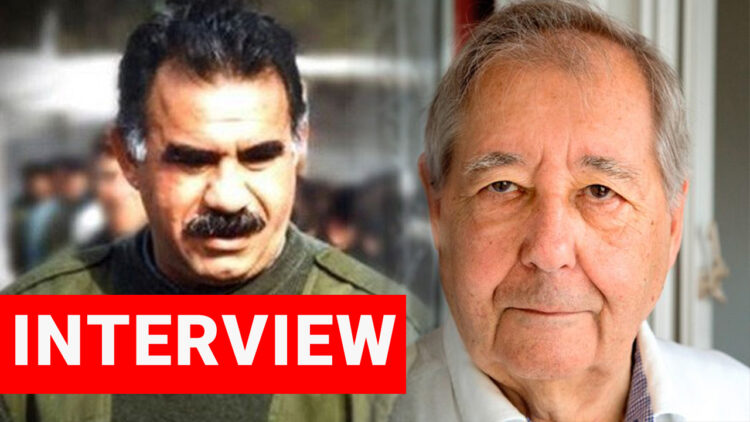
Nils Andersson, a prominent French philosopher and human rights advocate, has described Abdullah Öcalan’s prolonged imprisonment as a reflection of the West’s desire to maintain capitalist dominance. Öcalan, leader of the Kurdistan Workers’ Party (PKK), has been detained on the Turkish high-security prison island of İmralı since 1999, with lawyer and family contact barred for the last 43 months.
The international community’s silence regarding Öcalan’s treatment, Anderson argues, exposes a complicity rooted in the fear of the Kurdish leader’s ideas, which offer a radical critique of capitalism and present a vision for social, political, and ecological transformation. This perspective gained urgency with the launch last year of ‘Freedom for Öcalan, a Political Solution to the Kurdish Question’, a campaign which aims to end the isolation practice and promote Öcalan’s proposals as alternatives to the capitalist system.
In an interview conducted by Serkan Demiral of Fırat News on Sunday, Andersson condemns Öcalan’s imprisonment as a source of shame for both Turkey and the West. He suggests that the West’s complicity stems from its fear of losing its imperial dominance, viewing Öcalan’s ideas as a threat to its capitalist framework.
Read our translation:
Serkan Demiral, Firat News: I would like to start by talking about the isolation conditions that the leader of the Kurdish people, Abdullah Öcalan, is currently facing. Abdullah Öcalan, who has been imprisoned in İmralı Prison for 27 years, has not been heard from for 43 months. His right to meet with his lawyers and family has been abolished, and he is kept in total isolation. How do you assess this system of isolation imposed on İmralı?
Nils Andersson: This isolation, which has been going on for more than four years, specifically since 25 March 2021, is a disgrace. It is our disgrace and the disgrace of the West, which is silent and complicit in this situation. This isolation reflects the law of capitalism, which Abdullah Öcalan condemned clearly and forcefully while he fought relentlessly and effectively against this despicable system.
Abdullah Öcalan’s criticism of the capitalist system is clear. I would like to quote one of his statements: “Liberalism and individualism are often cited as the main ideological axes of capitalism, but the ideological hegemony of capitalism has isolated the individual to an extent that no other system has done.” Öcalan’s observation is very apt. In fact, Öcalan has been isolated and forced into solitude for four years by this capitalist system. We can neither accept such a situation nor close our eyes to it.
You mentioned the West’s responsibility and complicity in Öcalan’s isolation. Why do Western or international authorities remain silent in the face of the torture in İmralı?
Look, the West has experienced either military failures or political and ideological failures in all the wars it has waged to impose its worldview, lifestyle, and way of thinking in places like Kabul, Afghanistan, Libya, and the Sahel.
Today, the world is in a kind of Cold War that has replaced the original Cold War. For the first time in history, the West—be it Europe or the United States—is facing a world that is no longer centred around it, but rather reversed. Social movements are emerging, organising themselves, and clashing with capitalist competition and contradictions. The absolute Western hegemony of the year 2000 is no longer valid. The West is now struggling not only with the fear of losing its hegemony but also with the fear of losing its dominance altogether.
It is defending itself against this loss, and, of course, someone like Abdullah Öcalan, who is fighting powerfully, faithfully, and effectively against the capitalist system from his prison cell, is seen as a threat to the capitalist order. This is one of the reasons for the continuous bombings, massacres, repressions, and arrests against Öcalan and especially against the Kurdish people in Turkey.
With the global freedom campaign, Abdullah Öcalan’s ideas have become more visible. You often emphasise that Öcalan’s paradigm offers solutions to many of today’s problems. Why are Öcalan’s ideas important?
Yes, Öcalan’s ideas offer solutions to many problems. The regional issue has become even more sensitive because of the tragedy, horror, and disgust that Gaza and Lebanon are experiencing today. This region of the world is currently marked by contradictions and the risk of spreading wars and conflicts. Of course, the risks in this region are of great importance both for Western imperialism and for the struggle for a fairer distribution of the world’s resources.
Here, I think we are facing an important aspect of Abdullah Öcalan’s thinking. Allow me to make a brief digression: Öcalan’s thoughts flow through history like the Taurus Mountains or a raging torrent, from the ancient civilisations, especially those of Mesopotamia, through the civilisations of Greece and Rome, to the present day. Abdullah Öcalan’s ideas represent a true sociology of freedom, both in his criticism of capitalism and in the regional context where lessons are drawn from the failure of war plans. He touches on a crucial issue: the inviolability of borders, a principle enshrined as sacrosanct in international law. The ambiguity of borders is one of the main obstacles for the Kurdish people to achieve autonomy within Turkey, or for the people of Rojava to achieve their freedom on their own terms, without external intervention. The existence of borders is a fundamental problem today, and Öcalan, in particular, emphasises this.
Everyone recognises that the world is a mosaic of peoples, cultures, and religions. Every people, every population on every continent has its own history. But the borders, mostly drawn by wars and colonialism, have created limited geographical, cultural, and linguistic areas. That is why Öcalan’s thought is essential for social liberation and emancipation because it grants rights to all these different peoples, especially to the Kurdish people. I would like to point out that the Middle East, where a large part of the Kurdish population lives, is at the centre of this problem. Any solution proposed to resolve this situation must take into account the borders inherited from history, colonialism, and imperialism.
Abdullah Öcalan offers a profound critique of the concept of the nation-state and rejects this system with the social project he proposes. However, today’s systems still try to preserve and maintain nation-state structures. What do you think about Öcalan’s critique of the nation-state?
Nation-states, of course, played a liberating role in the 19th century, freeing us from rulers, emperors, kings, and oligarchic powers. At that time, it was a moment of historical liberation. But today, this is no longer the case. The nation-state has become a straitjacket that does not respect the richness of all the elements that make up the diversity of peoples, cultures, populations, lifestyles, languages, and each individual. This is why we need to go beyond the framework of the nation-state, and this is where Öcalan’s thinking comes into play.
When Öcalan proposes to go beyond the capitalist nation-state, he also proposes to go beyond the socialist nation-state, which has shown its limitations and failures. Ultimately, this brings us to the vision of civilisation that Öcalan advocates and that is being put into practice in Rojava [North and East Syria]. It is clear that Öcalan’s vision for the liberation of peoples is not compatible with capitalism or the nation-state as it exists today. As a result, Öcalan challenges the current problem of the nation-state, which defends itself and refuses to evolve.
However, as Öcalan says, this evolution is inevitable because the history of peoples does not stop. The changes and flows of history may make the moment uncertain, but sooner or later, this evolution will take place. Evolution is inevitable because every power tries to defend itself, to preserve itself, and to maintain its existence. One of the pillars of Abdullah Öcalan’s paradigm is the liberation of women. His ideas in this regard are becoming more influential in different segments of society.
Of course, as Abdullah Öcalan says, to paraphrase: “Without the liberation of women, society and men cannot be liberated. The one cannot be separated from the other.” This is a fundamental principle of Öcalan’s thinking, especially in a world where the liberation of women is of great importance and value. Öcalan strongly defends this principle, arguing that there can be no new society or community without the liberation of women. He claims that the liberation of women also means the liberation of men.
You mentioned the importance of Abdullah Öcalan’s ideas and their role as a significant alternative force against the capitalist system. A leader of such importance is still imprisoned today. What can be done to end the current situation of Abdullah Öcalan?
The treatment of Öcalan is the result of the balance of power between the democratic popular forces and the capitalist and imperialist powers. We have to change this balance of power. As we know, this is not easy; it has been an issue for a long time. But it is a balance of power, and it cannot be changed without action. We have to convince people. How is it possible that people are still imprisoned for their ideas today? Just like Antonio Gramsci was imprisoned, just like [Nelson] Mandela spent 25-30 years in prison, just like Georges Abdallah has been in prison for 40 years in France, Marwan Barghouti in Palestine, and Leonard Peltier among the Native Americans. How is it possible to imprison people like this? How can a problem be solved by imprisoning a person? These questions need to be asked.
Incarceration is not just a democratic or humanitarian issue; it is not just a revolutionary or political issue. Those who consider themselves democrats should demand the release of Abdullah Öcalan and all other political prisoners in Turkey. How can we create democratic feelings? It is not a question of changing the regime but of changing this democratic feeling. How can they still accept the conditions under which Öcalan is being held? An appeal must be made to all governments, to all citizens, to everyone; we must use all the means at our disposal to bring about change without resorting to violence. At the very least, release the prisoners and allow them to express themselves and live.
Abdullah Öcalan is a real role model. He once said: “My comrades and friends think that I am living through a tragedy. But they must understand that without this tragedy, I would never have known what it means to live in freedom.” This statement is full of lessons for us, for our enemies, and for those who can understand its meaning. That is why we must demand the release of Abdullah Öcalan with all our might.
You mentioned the examples of Antonio Gramsci and Nelson Mandela. If we look at history, we see that isolation has been used as a weapon against political prisoners by those in power. What do you think is the basic purpose behind the use of isolation from history to the present day?
The historical purpose of isolation is to break the will of the individual and to defeat them. It’s not just about isolating someone from the rest of the world, nor is it just about preventing their writings from being read or their voice from being heard. The main aim is to break the person’s will; it is an attempt to break the human spirit. But when it comes to Öcalan, we can see that this has been an absolute failure. Öcalan’s will cannot be broken because he has a vision for society and a revolutionary army that defends the freedom and rights of his people. Therefore, Öcalan’s will is unbreakable.
Like torture, isolation is useless. It is said that torture creates fear, but we have never seen torture succeed in defeating a people. The example of Algeria shows this: despite the violence of the colonial system, the Algerian people did not give up their struggle and achieved independence. You cannot break the spirit of a people. Isolation is a myth in the minds of the reactionaries and imperialists, but it is impossible.
Öcalan is an example of this. Despite his isolation, he continues to write and think with extraordinary strength. He continues to develop his ideas with successive successful works under the conditions of his isolation. This clearly shows the failure of his opponents and enemies.
You spoke about the historical purpose of isolation and the resistance of Abdullah Öcalan in İmralı. As you know, Öcalan was captured as a result of an international conspiracy. Considering the resistance he showed in İmralı, is it possible to say that the conspirators did not achieve their goals?
Yes, absolutely. First of all, Abdullah Öcalan’s ideas encompass the history of civilisations. But what is even more extraordinary is that today, in Rojava, these ideas have taken concrete form in a very specific democratic and communalist experiment. Öcalan brings together all the universal and mechanical ideas that have structured societies throughout history. He continues to develop his thinking under the harsh conditions of isolation in his prison cell. I think this is the most remarkable thing about him. Where they tried to break his will, he showed extraordinary strength.
There is a tendency to ignore the history of peoples, to forget and deny the values of civilisations, the richness of cultures, and the specific framework and traditions of each society. But Öcalan constantly reminds us of these values. He emphasises that if we want to build a different society, if we want to go beyond capitalism, we must refer to these values. The fact that he continues to do this under conditions of isolation shows the strength of the human will, the strength of Öcalan, and the strength of the revolutionary spirit.
We’ve seen recently that European left movements are among those inspired by the ideas of Abdullah Öcalan. There is criticism that left movements in Europe, as elsewhere in the world, have not responded adequately to the rise of far-right politics. It’s been pointed out that the European left has been unable to develop policies in the face of the crises. In such a process, how important do you think Öcalan’s ideas are for the European left?
The crisis of the European left is extremely significant because we have to recognise that it is currently in a kind of political deadlock. Reactionary, racist, fascist, and extreme right-wing movements are spreading. Of course, I’m talking about the European left, which is in constant retreat. Left discourse has lost its meaning and effectiveness. The left is entirely to blame for this. Its weakened state, which is a serious handicap for the liberation of peoples and its own liberation, is not the fault of the enemy. I believe we still have a long way to go.
The failure of socialism in the 20th century pushed it out of the balance of power and destabilised it. It has not yet regained the balance of power, nor its capacity for thought, imagination, or organisation. These are qualities that lie at the heart of Öcalan’s thinking, especially the importance of organisation. The European left has not yet rediscovered its strength. This is a complicated path, not an easy one, especially as Europe is going through difficult economic times. Europe has long benefited from the fruits of colonialism and capitalism; its living standards and development have been linked to the exploitation of the rest of the world. But today, this exploitation can no longer be sustained in the same way.
The Global South is gaining strength and demanding power-sharing and the like. In this new world, Europe finds itself weakened and confused. Before 1914-1918, the sun never set on Europe’s colonies. After 1939-1945, it weakened, and today it is even more fragile. The European left must come to terms with this trauma of weakness, which is also linked to the European Union. It is not only in crisis; it is sometimes marginalised on the continent. In the past, everyone looked to Europe, and all revolutionaries came to Europe to learn how to make revolutions.
But today there is no reason for the rest of the world to look to Europe as a revolutionary model. There is no example, no energy, no strength. Therefore, Europe has to rethink itself, and the European left has to redefine itself by standing in solidarity with the Kurds, supporting and fighting for the common project of democratic and communalist experiments, especially the building of a new society through the liberation of women. The ideas and writings of Abdullah Öcalan are the basis and part of this perspective. Therefore, Öcalan’s ideas must be adopted.
Is there anything else you would like to add?
As I said before, the conditions of Abdullah Öcalan’s isolation must end, and he must be released. This shame and disgrace have to end. Öcalan must be free. It is our duty and responsibility to free Öcalan.