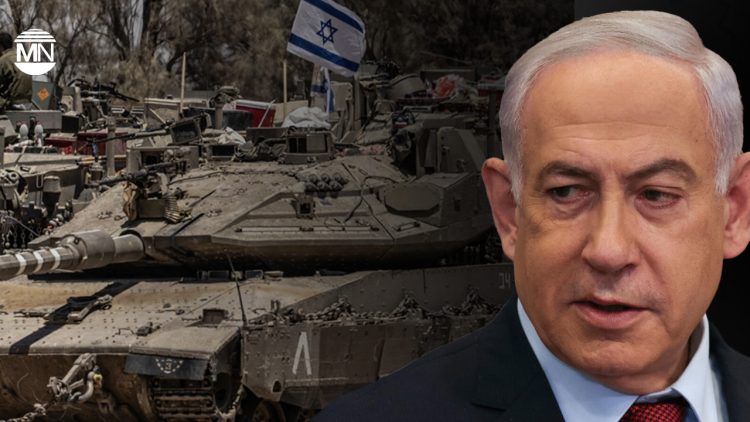
Israeli Prime Minister Benjamin Netanyahu has escalated regional tensions by sending tanks into the West Bank for the first time in more than 20 years, in a move condemned by Palestinian officials as a ‘dangerous escalation’.
In conjunction with the move, Israeli Defence Minister Israel Katz has ordered the military to prepare for an extended stay in the West Bank, hinting at a prolonged operation aimed at dismantling militant infrastructure in refugee camps such as Jenin and Tulkarm. Katz reported that some 40,000 Palestinians had been displaced from these camps, which he described as now empty.
These military actions follow a series of bus explosions near Tel Aviv which, although causing no casualties, have revived memories of past attacks and prompted increased Israeli operations in the region.
Earlier, US President Donald Trump proposed relocating displaced Palestinians from Gaza to Jordan and Egypt, a plan that drew global criticism for its impact on Palestinian rights and regional stability. Following intense international backlash, Trump withdrew the proposal, opting to wait for Arab states to develop their own alternatives.
In addition, a recent hostage exchange between Hamas and Israel has provoked strong reactions. Hamas was condemned for its handling of the remains of Israeli hostage Shiri Bibas, with UN Secretary-General António Guterres criticising the act as a violation of international law and stressing the need for dignified treatment for the deceased and their families.
Related Articles:
Trump proposes US control of Gaza during Netanyahu visit, raising tensions over Israeli-Palestinian conflict

Israel and Hamas agree ceasefire: Hostage and prisoner swaps begin
While Hamas’s actions have drawn global criticism, Israel’s delays and cancellations in repatriating Palestinian prisoners have also fuelled tensions. These failures further erode trust and deepen the humanitarian crisis, as more than 48,000 Palestinians have been killed since the conflict resumed following the Hamas-led attack on 7 October 2023.
In response to these developments, Arab leaders are formulating an alternative strategy. Ministers from Bahrain, Qatar, the United Arab Emirates, Saudi Arabia, Jordan and Egypt met in Riyadh to draw up a counter-proposal. Their plan includes temporary housing for displaced Palestinians within Gaza, a technocrat-led local government and an all-Palestinian security force with no links to Hamas. These discussions highlight growing regional concerns that drastic US proposals and renewed military aggression could further destabilise the region.
As Netanyahu steps up military operations, the region faces an increasingly volatile situation. Calls for restraint, independent investigations and renewed diplomatic efforts are growing as the international community seeks to prevent further civilian suffering and further escalation.