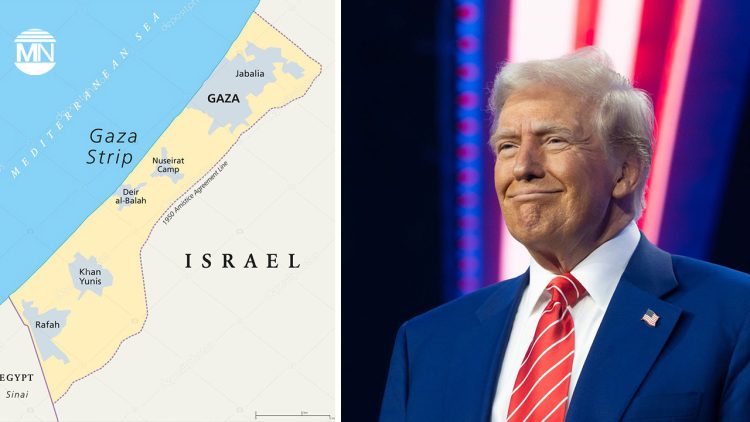
US President Donald Trump has proposed a controversial plan to take control of the Gaza Strip, suggesting that the US could administer the region while relocating Palestinians elsewhere. The statement was made during his high-profile meeting with Israeli Prime Minister Benjamin Netanyahu at the White House. Trump’s plan, which has drawn both support and condemnation, was designed to reshape the geopolitics of the region while securing Israeli interests.
After his re-election as president, Trump addressed the media following a series of meetings with Netanyahu and said that the US would take a more active role in Gaza. He suggested that the Palestinians could be moved out of the region and that Gaza would be governed under US supervision. Trump emphasised that the move would be beneficial to peace and stability, and would allow Israel to focus on its security without worrying about the governance of Gaza. “This is about ending endless conflict and creating a future of peace and security for all,” Trump said in his statement.
Fox News reported that Netanyahu praised Trump’s leadership, calling the plan a historic step towards achieving stability in the region. Netanyahu stressed the importance of US involvement and expressed confidence that it would lead to greater security for Israel. The Israeli Prime Minister also mentioned that Trump’s approach would counter the influence of hostile forces in the region.
The proposal, however, has raised alarm among international organisations and human rights groups. United Nations Secretary-General Antonio Guterres condemned the plan, warning that it could lead to ethnic cleansing, as reported by The Guardian. Guterres stressed that the forcible transfer of Palestinian populations would be a grave violation of international law, and stressed that such actions would be unacceptable under the global human rights framework.
During a parliamentary session on Wednesday, UK Prime Minister Keir Starmer reaffirmed Britain’s commitment to a two-state solution when asked about President Trump’s controversial Gaza proposal. Starmer emphasised that Palestinians in Gaza must be allowed to return home and rebuild.
The backlash has been swift, with several Arab states expressing outrage. Some leaders have warned that the plan could escalate tensions across the Middle East, drawing comparisons with previous forced displacements in other regions. Some pro-Palestinian groups and activists have also expressed concern that such a proposal could exacerbate the humanitarian crisis in Gaza and hinder future peace efforts.
Meanwhile, the Trump administration has sought to defend the plan. In a report published shortly after the statement, Fox News highlighted that senior members of Trump’s administration had expressed support for the move, suggesting it could help stabilise the region. US officials cited Israel’s security concerns and the need to find a lasting solution to the Israeli-Palestinian conflict as reasons for the urgency of the plan.
White House Press Secretary Karoline Leavitt sought to clarify Trump’s remarks, insisting the plan does not involve “boots on the ground in Gaza” and that any relocation of Palestinians would be temporary.
Since Trump’s announcement, discussions have continued in both the Israeli and Palestinian territories, with protests reported in Gaza. While some members of the international community have expressed concern about the long-term implications of the plan, others are calling for continued dialogue and negotiations before a final decision is made.
This development marks a highly contentious moment in Middle East diplomacy, with many observers sceptical about the viability of the proposal and its potential to exacerbate existing tensions. Questions remain as to whether the proposal will be genuinely considered by world leaders, or whether it will simply serve to further entrench political divisions in Gaza and the wider region.