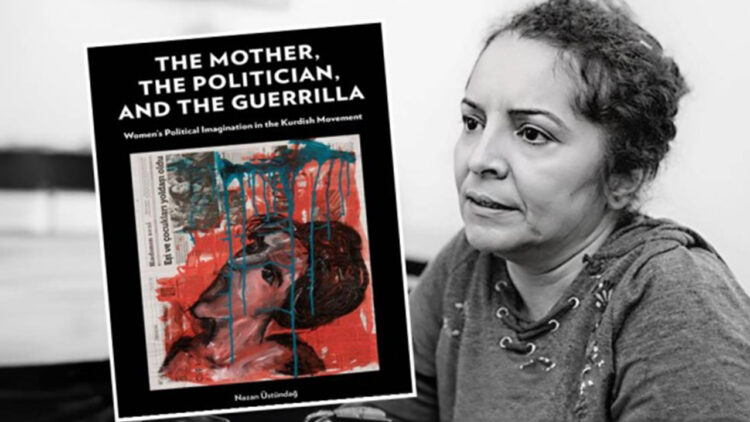
Nazan Üstündağ’s new book ‘The mother, the politician, and the guerrilla: Women’s political imagination in the Kurdish movement’ delves into the powerful role Kurdish women play in shaping the Kurdish liberation movement. The book, which has garnered significant international attention, traces how women—acting as mothers, politicians and guerrilla fighters—redefine the concepts of identity, politics and freedom.
“I was inspired to write this book to explain why the Kurdish liberation movement, and specifically the Kurdish women’s liberation movement, captivates me,” said Üstündağ in an interview with Özgür Politika on Monday.
The work centres on women’s search for meaning through their roles in the movement, illustrating how they challenge social expectations and resist imposed limitations. Üstündağ draws from her own years of research and observation within Kurdish movements, weaving together personal experience and academic theory.
Üstündağ’s exploration also intersects with psychoanalysis, feminist thought, and anti-colonial movements. She explained that translating the ideas of the Kurdish women’s movement into academic discourse took years of work, as she aimed to highlight how the movement “generates life energy” despite state repression.
Her analysis moves beyond the specific Kurdish context to engage with global movements, as she explained: “I tried to connect Kurdish women’s practices and ideas with broader philosophical traditions, such as black feminist and anti-colonial thought, to discuss concepts like freedom, action and existence.”
The book is divided into three main sections, focusing on the figures of the mother, the politician and the guerrilla. In the first section, Üstündağ looks at how Kurdish mothers play a crucial role in resisting cultural erasure and maintaining a distinct Kurdish identity through language and tradition. She explained how Kurdish women act as the “carriers of a voice that resists state suppression.”
In the second section, Üstündağ explores the figure of the politician and how Kurdish leaders embody contradictions in the struggle, often through their personal sacrifices and public roles. She engages with the figure of Antigone from Western feminist theory, highlighting how Kurdish women’s resistance breaks the boundaries of traditional political thought.
The final section, focusing on guerrilla fighters, examines how Kurdish women in the mountains redefine freedom by reclaiming tools of production, self-defence and governance. “Women reclaim what was stolen from them—language, autonomy and meaning—and shape new realities through their collective action,” she said.
Üstündağ’s work not only highlights the struggles of Kurdish women but also situates their actions within a larger framework of resistance movements around the world, offering readers a deeper understanding of how political imagination and resistance are forged in the face of repression.