

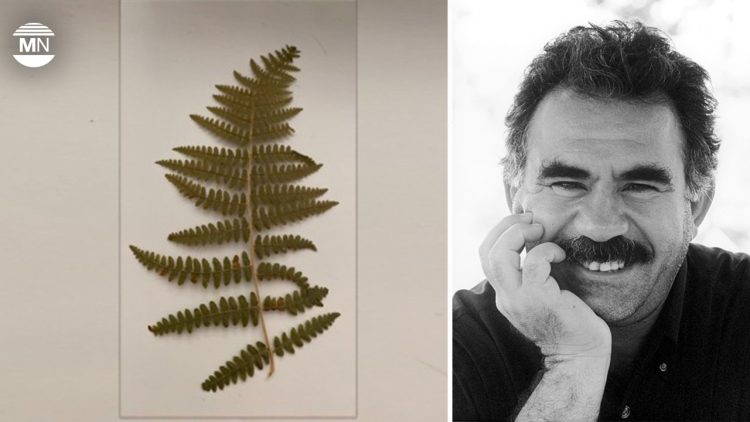
In a letter sent from Turkey’s İmralı Island Prison to the Jineology Academy and made public on Monday, jailed Kurdish leader Abdullah Öcalan described the academy – first proposed upon his imprisonment – and the broader Kurdish women’s movement as the realisation of an “unfinished project”.
The letter, accompanied by a small pressed fern leaf, reflects on Öcalan’s long-standing ideological commitment to women’s liberation and the redefinition of gender roles within both Kurdish society and broader political struggles. He wrote, “When I was first brought to İmralı, I said my work on women was an unfinished project. That work has now progressed through Jineology.”
The Jineology Academy is a grassroots institution established after the first Jineology Conference in 2015, following years of discussion that began in 2011. Its mission is to advance the women-centred social science developed by Öcalan. Derived from the Kurdish words jin (woman) and jiyan (life), jineology translates as “the science of women” and proposes a radical rethinking of knowledge, society and life through the lived experiences and perspectives of women.
The academy was founded in response to the limitations of conventional social sciences and fragmented feminist approaches, particularly their failure to fully account for women’s historical and social roles, especially in the Middle East. It seeks to both reclaim women’s ancient knowledge and rebuild scientific, ethical and social frameworks grounded in women’s liberation, democratic values and ecological awareness.
Operating through a growing network of research and education centres in northeast Syria (also known as Rojava), Belgium and other locations, programmes at the academy include workshops, camps, sociological fieldwork, oral history projects and alternative education focused on women’s economy, ethics, aesthetics, history and self-defence. It publishes the Jineology Journal (launched in 2016) and has supported initiatives such as Jinwar, a women’s village in Rojava.
Jineology embodies the core principle that understanding women is key to understanding society, and that a truly free, democratic and ethical world can only be built by placing women at the centre of the production of knowledge.
“From Marx to Lenin and Mao, their relationships with women reveal the shortcomings of their revolutions,” he said. “The fundamental wound in society is women’s enslavement. Without removing this dagger, no other problem can be solved.”
Öcalan, who has been held in near-total isolation for most of his imprisonment since 1999, also addressed criticism from feminists questioning his leadership role in a women-led movement. “I wish women had taken this initiative themselves,” he wrote, while expressing a desire to be understood as an ally who has worked to reshape masculine identity in ethical and aesthetic terms.
He called on women to play a leading role in the future of the Kurdish political movement, particularly in any renewed peace and democracy processes. “Women have already been responsible for more than half of our achievements,” he wrote, adding, “I believe they will lead what comes next.”
The letter emerged from a rare family visit to Öcalan for Eid al-Adha (Feast of the Sacrifice) on Saturday. While Eid visitation rights apply across the Turkish penal system, this exceptional access highlighted Öcalan’s prolonged incommunicado detention. In an unprecedented move, several family members were permitted to attend; letters and gifts were exchanged, and messages allowed out. Rights groups have repeatedly criticised the Turkish government’s refusal to allow regular legal and family access to Öcalan and the other prisoners on İmralı Island.
In the letter and also in a short message he issued for Eid, Öcalan emphasised a vision of peaceful transformation rooted in ecological and gender justice, reiterating his call to celebrate the holiday symbolically, without killing animals: “I celebrate our people’s Eid without sacrifice,” he said. “Greetings to all our people.”


