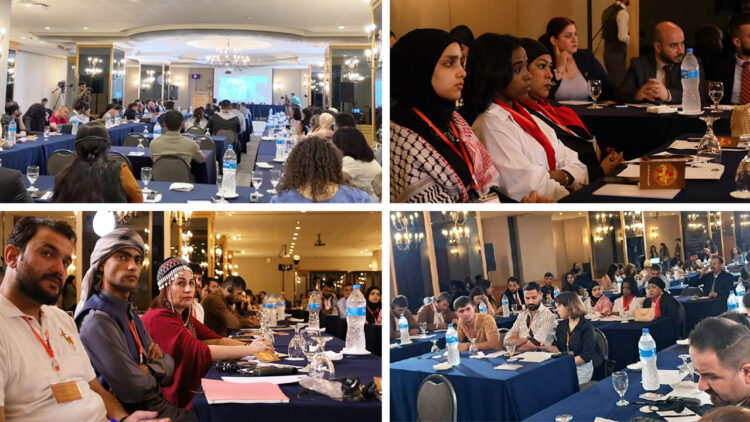
The Middle East and North Africa (MENA) Youth Conference has been held in Beirut, Lebanon, this weekend, 8-9 June, with over 80 delegates from 14 countries discussing issues affecting young people in the region.
The MENA conference is a continuation of the World Youth Conference held in Paris in November 2023 and aims to find collective solutions to the issues young people face in the Middle East and North Africa.
The event started on Saturday with video messages from the Women’s Defence Units (YPJ) from North and East Syria, and from the Revolutionary Association of the Women of Afghanistan (RAWA), who each reported on the state of their struggle and wished success to the conference.
There followed panels on the subjects of “War and crisis in the Middle East and North Africa” and “The crisis of the Middle East, ways and means of women’s struggle”. Day one closed with a cultural programme that included traditional Kurdish Govend dancing.
The conference resumed on day two with workshops based on “The environmental crisis and the destruction of nature”, where topics such as environmental destruction in cities under occupation, environmentally destructive factories and Turkey’s use of chemical weapons in Iraqi Kurdistan and North and East Syria were discussed. Workshops were also held on the subjects of “Education and youth” and “Youth and nationalism, sexism, religion and science”.
Medya Yusif, a member of the organising committee of the conference, spoke, saying that young people in the Middle East and North Africa were faced with various wars and crises and that the aim of the conference was to discuss and find solutions to these issues.
She highlighted the importance of young women in particular coming together to discuss problems they are faced with, such as harassment, female genital mutilation, violence and femicide. She stressed the point that the only way to respond to such problems is to build up defence mechanisms against them.
She concluded with an appeal to all the young people who had taken part in the conference to use the perspectives they had gained there to develop solutions in their own countries, based on democratic confederalism among the youth of the Middle East and North Africa.
Democratic confederalism is a model proposed by the imprisoned Kurdish leader Abdullah Öcalan, which aims to provide a way for peace in the Middle East and North Africa by construction of a system in which different peoples, cultures and religions can live together. The system embraces the diversity of the people of the Middle East and North Africa rather than seeing it as grounds for conflict. It is currently in practice in North and East Syria, where Kurdish, Arab and Assyrian people with various religions are managing to live together in peace and organise the needs of their societies communally, despite being under continual attack from the Turkish state.