

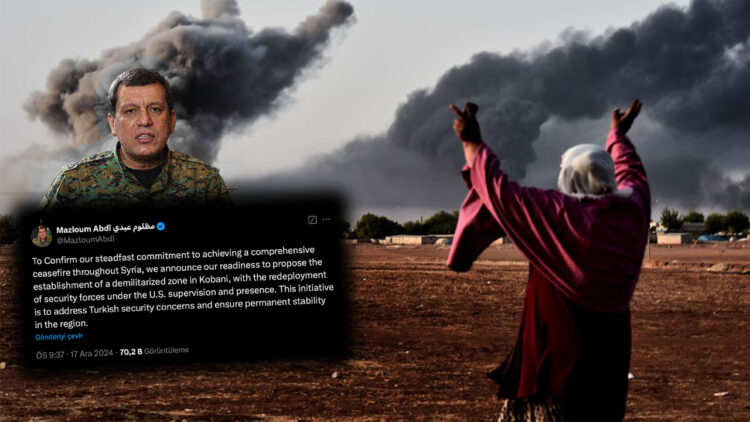
Mazloum Abdi, Commander of the Kurdish-led Syrian Democratic Forces (SDF), reaffirmed commitment to a Syria-wide ceasefire and proposed a demilitarised zone in Kobani (Kobanê) to address Turkish security concerns and foster regional stability, with US oversight.
In a statement on X, formerly Twitter, Abdi said, “To confirm our steadfast commitment to achieving a comprehensive ceasefire throughout Syria, we announce our readiness to propose the establishment of a demilitarised zone in Kobani, with the redeployment of security forces with the presence and supervision of the US.”
He said that the initiative would seek to address Turkey’s security concerns while ensuring permanent stability in northern Syria. The proposal aligns with international calls to reduce tensions in the region, where ongoing conflicts have strained humanitarian conditions and threatened regional peace.
Kobani, a symbol of Kurdish resistance, remains a focal point of political and military dynamics in Syria, making this proposal a critical step toward conflict de-escalation.
The announcement follows the collapse of US-led ceasefire talks on Monday, with unresolved issues such as the return to its original location of the tomb of Suleiman Shah, important to the Turks, and the relocation of fighters from the Kurdish-led Manbij (Minbîc) Military Council stalling progress. According to the SDF, Turkey and its proxy Syrian National Army (SNA) have been undermining truce efforts, escalating clashes in key areas.
Turkey has intensified military operations against SDF-controlled territories in recent weeks, again straining mediation efforts led by Washington. Observers warn that violence in Kobani, Manbij and other strategic areas risks plunging northern Syria into deeper instability, worsening the already dire humanitarian crisis.
Abdi’s proposal, aimed at renewing dialogue and paving the way for a peaceful resolution, chimes with the urgency of international efforts to stabilise the region. However, Turkey’s rejection of key ceasefire conditions casts doubt on the viability of a long-term solution.


