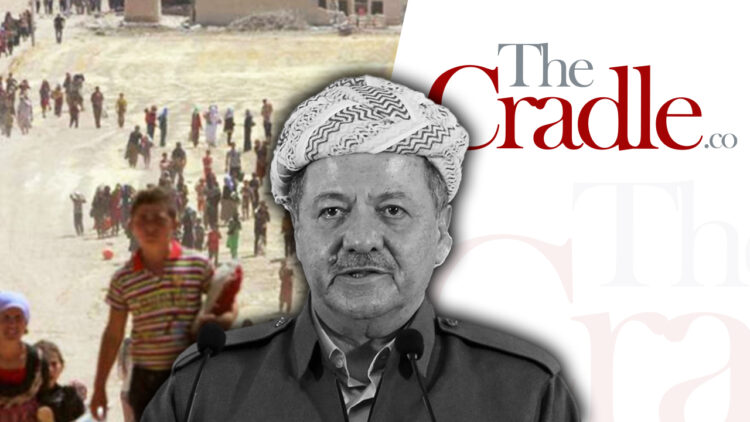
The Cradle published a damning indictment of Masoud Barzani’s role in the Yazidi genocide on Thursday, suggesting that the Peshmerga’s actions were not just failures of protection but deliberate betrayals that facilitated genocide. A US lawsuit accuses the Kurdistan Democratic Party (KDP) leader and his forces of pre-planning the Yazidi genocide in Sinjar (Şengal).
The lawsuit*, filed on behalf of the Kurdistan Victims Fund in the US District Court in Washington, DC, claims Barzani orchestrated the mass slaughter, using ISIS as a proxy to achieve geopolitical goals. Mirza Ismail, Chairman of the Yazidi Human Rights Organization-International, stated, “The Yazidi genocide was pre-planned. Masoud Barzani planned to annihilate the Yazidis in order to create an Islamic state in Kurdistan.”
Testimonies from Yazidi survivors reveal how the Peshmerga forces disarmed them, prevented their escape and withdrew without warning when ISIS attacked on 3 August 2014. “We received orders from Barzani that none of the residents are allowed to flee,” one Yazidi man recounted. “We actually trusted that they would protect us,” another witness added.
Salwa Khalaf Rasho, a Yazidi girl, testified to the UK Parliament that Peshmerga fighters blocked escape routes, allowing ISIS to capture over 1,000 Yazidis. “A checkpoint of Peshmerga stopped us and blocked our way,” she said. Rasho was enslaved and raped by an ISIS commander for eight months before escaping.
The Cradle notes that, contrary to popular belief, Kurdish members also joined ISIS during the attack on Sinjar. “The most dangerous people for Yazidis are Kurds. Kurdish ISIS members killed many Yazidis, not just Arabs,” a Yazidi from Sinjar disclosed. Some Kurdish ISIS members reportedly found refuge in Barzani’s Kurdistan region after the genocide.
Yazidi journalist Berfin Hezil, who documented the Peshmerga’s retreat, highlighted their failure to defend the Yazidis. “KDP forces claimed they would protect us but did not even allow the Yazidis to defend themselves,” she said. Hezil recalled seeing Peshmerga forces fleeing without firing a single shot, leaving Yazidis defenceless. “I asked them why they were running, and they said, ‘The initiative is not with us’.”
Hezil also recounted the role of the Kurdish guerrilla forces, particularly of the Peoples’ Defence Forces (HPG), the armed wing of the Kurdistan Workers’ Party (PKK), in defending Sinjar, contrasting it with Barzani’s stance. After the Iraqi army retreated from Mosul, allowing ISIS to occupy the city, Abdullah Öcalan, the imprisoned leader of the PKK, called for the protection of minorities, including the Yazidis. The KDP, in control of Sinjar at the time, did not heed these calls and did not intervene. The HPG, the Syrian-Kurdish Peoples’ Defence Units (YPG) and the Women’s Defence Units (YPJ), attached to the Syrian Defence Forces (SDF), stepped in, creating a humanitarian corridor that allowed thousands of Yazidis to escape to North and East Syria.
In another piece last year addressing the allegations of Barzani’s involvement, The Cradle pointed to the potential motivation behind the betrayal. As chaos erupted in Mosul, Barzani directed Peshmerga forces to capture Kirkuk, a city rich in oil, symbolising a “Kurdish Jerusalem”. The oil, exported through a pipeline to Turkey, was sold to Israel despite Iraqi opposition. By 2015, Kurdish oil accounted for 77 percent of Israel’s imports.
Currently, the KDP is once again accused of collaborating with Turkish forces to maintain its political dominance in the region. This cooperation involves supporting the ongoing Turkish military operation within the Kurdistan Region of Iraq (KRI), facilitating the movement of Turkish troops and armoured vehicles, and allowing the establishment of Turkish control points. Experts on Kurdish affairs suggest that this alliance is an attempt by the KDP to counterbalance recent shifts in regional power dynamics that have threatened its influence and to delay the Kurdistan regional election. “Knowing they might not achieve their desired outcomes, create crises to block elections. Now, they are leveraging Turkish forces to postpone the elections again,” said Nizar Mahmud, head of the Goran Movement’s Halabja Branch.
The Cradle’s piece underscores the betrayal felt by Yazidi survivors and highlights the ongoing quest for justice. The lawsuit aims to hold Barzani and his top officials accountable for their alleged role in the genocide, offering a glimmer of hope for the Yazidi community’s pursuit of justice and recognition of their suffering.
Masoud Barzani, the leader of the Kurdistan Democratic Party (KDP), served as President of the Kurdistan Region of Iraq from 2005 to 2017. Despite stepping down, he continues to wield significant influence, often referred to as “Kurdistan President”, reflecting his enduring control over Kurdish politics. Critics argue that his persistent authority underscores the concentration of power within the KDP and raises concerns about democratic processes and political pluralism in the region.
(*) The Kurdistan Victims Fund has lodged a formal complaint with the US Federal Court against Masoud Barzani and members of the Barzani family for a series of crimes, including the 2014 Yazidi genocide in Sinjar, Iraq. This legal action is supported by the Free Yazidi Women’s Movement (TAJÊ) through a letter advocating for the Barzani family’s prosecution for their alleged involvement in the Sinjar genocide. On 30 January 2024, the complaint detailed accusations against the Barzanis for murder, corruption, abduction, perjury, genocide, human rights violations, torturing an American citizen, drug trafficking, forcibly displacing people and seizing their properties, and developing ties with organisations on America’s terror list.