

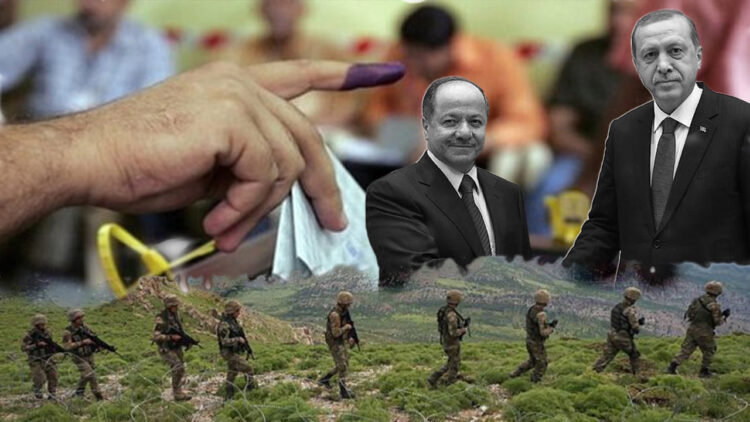
Kurdish political leaders in Halabja argue that Turkey’s intensified military actions are a deliberate attempt to obstruct the parliamentary elections of the Kurdistan Region of Iraq (KRI), currently scheduled for 20 October.
The KRI’s parliamentary elections, which have already been postponed four times, were recently rescheduled by Nechirvan Barzani, the outgoing president. The elections will be conducted by Iraq’s Independent High Electoral Commission, upon a decision by the country’s Federal Supreme Court.
Nizar Mahmud, head of the Goran Movement’s Halabja Branch, expressed concern: “Every government that seeks democracy must hold elections as scheduled. The repeated postponement of elections in the KRI is driven by political interests and weakens the region’s international standing.”
Mahmud further noted that some political factions could prefer the elections to be delayed or cancelled, as they fear losing influence. “Kurdistan is going through a challenging period… Some political groups, knowing they might not achieve their desired outcomes, create crises to obstruct the elections. Now, they are encouraging Turkish forces into the Region, in an attempt to postpone the elections again,” he said.
The ruling Kurdistan Democratic Party (KDP) has previously been accused of collaborating with Turkish forces to maintain its political dominance in the region. Experts on Kurdish affairs suggest that this cooperation aims to counterbalance recent shifts in regional power dynamics that have disadvantaged the KDP.
Abdullah Ahmad, a member of the Kurdistan Communist Party in Halabja, also commented on the issue. He pointed out that internal divisions among Kurdish groups facilitate Turkey’s interference. “As long as regional leaders prioritise their own and their parties’ interests over those of the people, we risk losing our achievements to date,” Ahmad stated.
He concluded by criticising the lack of genuine democratic processes: “What is happening in the region does not represent democratic elections that reflect the will of the people. If the ruling powers mismanage the country, the people should penalise them through elections, but here, the ruling powers do not believe in the judgement of the people.”


