

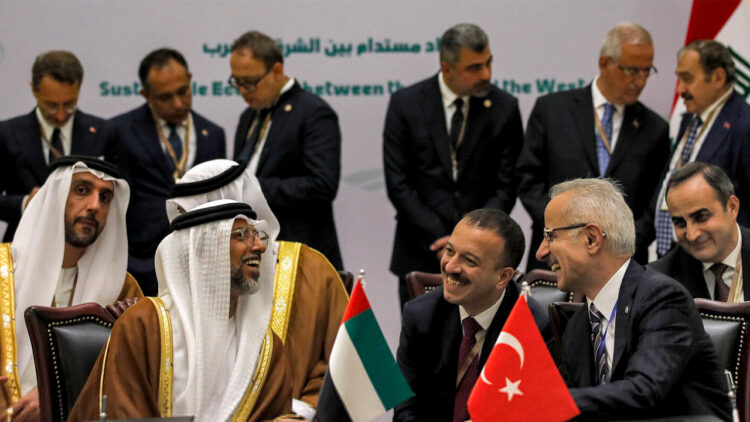
Turkey will host a four-way summit with Iraq, Qatar, and the United Arab Emirates on 29 August to discuss the Development Road project, an ambitious $20 billion initiative to link Basra to Turkey and beyond.
This summit, to be held at Dolmabahçe Palace in Istanbul, is expected to make “significant decisions” regarding the project, which aims to create a major trade corridor between Asia and Europe.
While the summit underscores Turkey’s efforts to position itself as a crucial transit hub, the Development Road has sparked considerable concern among Kurdish groups and regional analysts. Critics argue that the project, which bypasses the Kurdistan Region of Iraq (KRI), could marginalise Kurdish interests and further destabilise the region.
Kurdish opposition to the Development Road
The Kurdish argument against the Development Road project centres on several key concerns:
Increased Turkish military presence
The project involves significant military operations aimed at securing the route, particularly against the Kurdistan Workers’ Party (PKK) in northern Iraq. Kurdish groups fear this could lead to an expanded Turkish military presence in Iraqi Kurdistan, potentially resulting in the occupation of Kurdish territories and undermining their autonomy.
Marginalisation of the Kurdistan Region
The Development Road largely bypasses the Kurdistan Region of Iraq (KRI), which Kurdish leaders see as a deliberate attempt to sideline them economically and politically. They argue that this exclusion could weaken the region’s economic prospects and diminish its strategic importance.
Exploitation of local resources
Kurdish groups argue that Turkey’s primary aim is to exploit Iraq’s and Kurdistan’s resources rather than foster genuine development. They claim that the project will benefit Turkey by allowing it to dominate trade routes and flood Iraq with Turkish goods, at the expense of the local economy.
Geopolitical concerns
Kurdish groups are also concerned that the project could shift the regional balance of power, reducing Kurdish influence while enhancing Turkish control over key trade routes and resources. This could have long-term consequences for Kurdish aspirations for greater autonomy or independence.
Despite these concerns, Turkey is pushing forward with the project, which was formalised during President Recep Tayyip Erdogan’s visit to Baghdad in April. The summit will bring together relevant ministers from Iraq, Qatar and the UAE, both potential investors in the project. The Development Road is designed to significantly reduce transit times for goods traveling between Asia and Europe, creating a new trade route that could rival the Suez Canal.
However, the project faces competition from other regional initiatives, such as China’s Belt and Road Initiative and the US-supported India-Middle East-Europe Economic Corridor. Additionally, scepticism remains about the feasibility of the project, particularly given the history of unfulfilled agreements between Turkey and Iraq and the complex regional dynamics.


