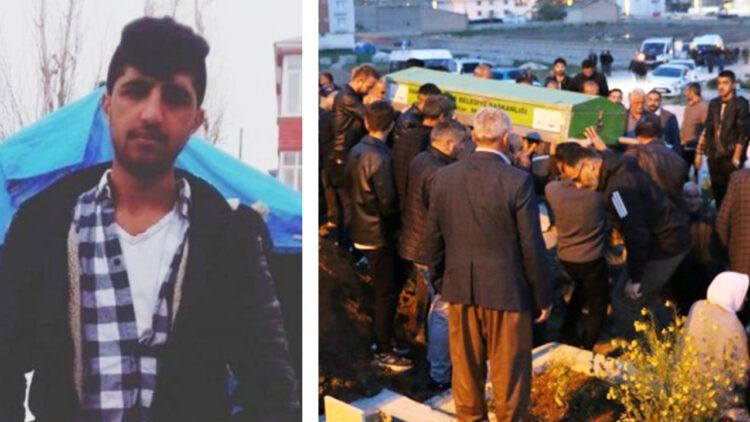
Kurdish political prisoner Reber Soydan, who was held in solitary confinement, died in suspicious circumstances at a Turkish F-Type High Security Prison in Van (Wan). The authorities claim that he committed suicide on Sunday.
Officials informed Soydan’s father, Mehmet Selim Soydan, in the early hours that his son had hanged himself in his cell. An autopsy was conducted at Van’s Yüzüncü Yıl University.
Reber Soydan was arrested two years ago in the Yüksekova (Gever) district of Hakkari (Colemêrg) and charged with “disrupting the unity and integrity of the state.” He was serving a life sentence with an additional 53 years for related activities. His body has been transported back to his home town of Yüksekova for burial.
Hundreds attended Soydan’s funeral, which was held on the day his body arrived in Yüksekova. The journey was fraught with delays, with his body being held up multiple times at military and police checkpoints. Despite these obstacles, his funeral was attended by relatives, members of the Peoples’ Equality and Democracy (DEM) Party, the Democratic Regions Party (DBP) Yüksekova district branch, the Van branch of the Association for Solidarity and Support of Prisoners’ Families (TUHAY-DER) and hundreds more.
The police prevented the washing of the body at the hospital and mosque before the burial by blocking the hearse at the Yüksekova hospital junction, as a result of which the family had to wash the body themselves at home. “The community’s grief is profound, and condolences will be received at the family home,” stated Ercan Sevmez, co-chair of the Yüksekova district branch of the DEM Party after the burial at Bajêrge Modern Cemetery.
Preventing traditional rites such as the washing and burial of the bodies of deceased dissidents at the appropriate venues is considered a form of psychological torment inflicted not just on the family of the deceased but on the entire community. This widely practiced and unjustifiable discrimination disrupts cultural and religious practices as well as the communal grieving process, compounding the hardship and sorrow of an already painful event.
This incident adds yet one more to the number of deaths in Turkish prisons, which have attracted international concern regarding the conditions and treatment of detainees.
Turkey’s Human Rights Association (IHD) calls Turkish Prisons “human rights violation centres”, describing practices in Turkish prisons that threaten the lives of prisoners. These practices include isolation, torture and ill-treatment, restrictions on social rights, enforced transfers and restrictions of the right of sick prisoners to treatment. There are also frequent deaths in suspicious circumstances in the prisons.