

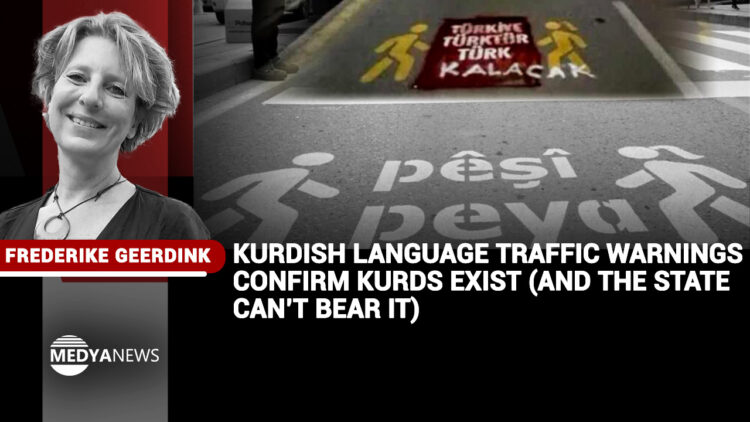
By Frederike Geerdink
The Turkish police in Kurdistan are very busy these days painting over traffic warnings on the streets written in Kurdish and detaining Kurds who dance Kurdish folk dances. This may confuse some people because quite a few media have been telling their readers and viewers that under Turkish President Erdoğan’s reign, Kurds have been granted more rights. How come these rights have been taken away again? Was it all a lie? Yes, it was all a lie, and that was obvious all along.
Kurds have never been given any political or cultural rights in Turkey, not since the day the Republic of Turkey was founded in 1923. Kurds haven’t been allowed to exist since then and this has never changed, including under all kinds of ‘initiatives’ that Erdoğan has taken. To name a few, there was a ‘Kurdish opening’ around 2009, and the Kurdish-language state TV channel TRT6 was launched, the banned letters X, Q and W were ‘freed’, as Erdoğan put it, a few hours of Kurdish-language classes were allowed and, as the ironic icing on the cake, between 2013 and 2015 there was a so-called ‘peace process’. None of them were ever meant to fundamentally change anything.
Constitution
How do we know that? One word: constitution. All these initiatives and ‘freedoms’ were given within the framework of the Turkish constitution and Turkish criminal law. The constitution and criminal law don’t allow any language or culture in Turkey other than the Turkish language and Turkish culture. Exceptions were only made for non-Muslim minorities like Greeks and Armenians, demanded by the UK and France in the negotiations for the Lausanne Treaty of 1923 through which Turkey came into existence.
This means that Erdoğan’s governments in essence only gave verbal permission for a certain degree of free expression and directed the state apparatus to comply. The plan was never to codify these changes. Why not? Because that would mean a fundamental, far-reaching overhaul of the complete judicial system, including the constitution.
Perceptions
Such a radical change would actually solve the Kurdish issue because it would grant Kurds and others, and basically everybody in the country, their inalienable rights. And that was never the intention. The intention was merely to play with public perceptions and boost Kurdish votes for Erdoğan’s Justice and Development Party (AKP). But Kurdish votes have been exchanged for ultra-nationalist votes. The latter are much easier to win because for that, you don’t need to change anything – behaving like the brutal fascist state that you are will suffice.
So look where we are. Kurds can’t even dance the govend – the well-known Kurdish group dance – any more on the streets or at their own weddings, without risking detention. Last week a group of young men and later a group of women were detained for it, and several of them were later officially arrested for ‘making propaganda for a terrorist organisation’. This week, new detentions for dancing followed.
And the last few days, in Van (Wan), Diyarbakır (Amed), Mardin (Mêrdîn) and Dargeçit (Kerboran), they have started to paint over Kurdish-language warnings on roads saying ‘Hêdî’ (Slow) and ‘Pêşî Peya’ (Priority to Pedestrians) – only the warnings written in Turkish remained. The roadmarkings are not new, Diyarbakır Greater Municipality wrote in a statement, but have been there for many years.
Military
Why is this happening now? Well, the state has been waging an all-out war against the Kurdistan Workers’ Party (PKK) and promised to have destroyed the armed movement by this summer. They are not really on schedule to achieve that goal, but what the goal itself shows is that the state persists in treating the Kurdish issue as a military rather than a political one.
In a military sense, Turkey is making progress against the PKK, as it expands its occupation of territory in the mountains in Başur (Kurdistan in Iraq) where the PKK is based. But the state is confronted with what it has been in denial of all this time: military progress doesn’t destroy the PKK, and more importantly, it doesn’t solve the Kurdish issue or annihilate Kurdish aspirations for freedom.
Century
So what do they do? They resort to cracking down against any expression of Kurdish existence as expressed in culture, language and politics. As if they want to force into reality their twisted way of thinking: We are in an all-out war against PKK and in our reality, this roots out your existence too, including your demand for rights. The state is saying: Kurds, listen, we have been saying it for a century now, so when is it finally going to dawn on you: YOU! DON’T! EXIST!
It will backfire. Kurds exist, and will continue to exist with a vengeance, and struggle until they can live freely.
Fréderike Geerdink is an independent journalist. Follow her on Twitter or subscribe to her acclaimed weekly newsletter Expert Kurdistan.


