

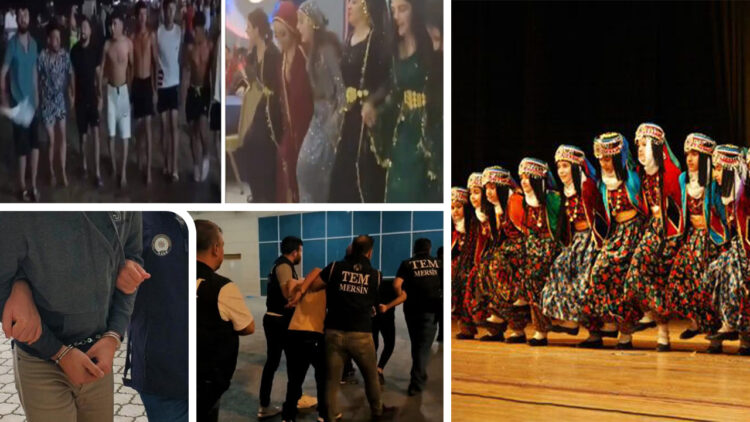
Recent arrests and crackdowns on Kurdish cultural practices in Turkey have sparked widespread condemnation and highlighted the ongoing repression faced by the Kurdish community.
In a series of incidents, Kurdish youths have been detained for participating in traditional Kurdish dances (halay) and sharing videos of these events on social media. This has recalled historical policies targeting Kurdish identity and culture, reminiscent of the 1925 Eastern Reform Plan and 1930 Turkification Directive.
On 22 July, nine Kurdish youths in Mersin were arrested after a video surfaced online showing them dancing to Kurdish songs. Accused of “making terrorist organisation propaganda”, these individuals were subjected to psychological torture, including being forced to listen to the ultra-nationalist song “Ölürüm Türkiyem” (I’d die for you, my Turkey) while in police custody. The youths were formally arrested three days later, on 25 July.
The use of “Ölürüm Türkiyem” in this context is particularly disturbing, given its history as a tool of racist intimidation. On 2 May 2023, Kurdish street musician Cihan Aymaz was stabbed to death in Istanbul for refusing to play this song. The assailant, Mehmet Caymaz, was later sentenced to life imprisonment for the racially motivated murder. The nationalist song is often used in detention centres and jails to oppress dissidents, as reported by human rights organisations. Forcing detained Kurdish youths to listen to this song is thus seen as a deliberate act of psychological intimidation with racist overtones.
In the Doğubayazıt (Bazîd) district of Ağrı (Agirî), police raided a wedding celebration on 25 July, arresting seven individuals, including a musician, for allegedly “making terrorist propaganda”. While four of the seven were released after interrogation, three were sent to court, and the musician was formally arrested and sent to prison.
In Istanbul, police raided homes in Bağcılar, Esenyurt, Sultangazi and Gaziosmanpaşa, arresting 18 individuals for participating in Kurdish dances at various weddings. Of those detained, 11 were formally arrested on charges of “making terrorist organisation propaganda,” while the remaining seven were released under judicial control.
In the Kurtalan (Misirc) district of Siirt (Sêrt), six young women were arrested on 27 July after a video of them dancing at a wedding was shared on racist social media accounts. The women were accused of “making terrorist propaganda” and taken to Siirt Provincial Police Department. Similarly, in Ağrı’s Doğubayazıt district, six people were detained for dancing in traditional Kurdish attire at a wedding, though they were later released.
The current crackdown on Kurdish cultural expression draws disturbing parallels to the historical Eastern Reform Plan (Şark Islahat Planı) of 1925 and the Turkification Directive (Türkleştirme Genelgesi) of 1930. Both these policies were designed to suppress Kurdish identity and promote Turkish assimilation through measures such as martial law, banning the Kurdish language and Kurdish customs, and relocating Kurdish populations.
The Eastern Reform Plan was a significant policy aimed at suppressing Kurdish identity and autonomy within the region of Kurdistan. Its primary objectives included martial law in Kurdish cities, exclusion of Kurdish judges from judicial proceedings and resettlement of ethnic Turks into Kurdish areas. The plan also involved the exile of Kurdish leaders and confiscation of their property, increased military presence in the region and disarmament of the Kurdish population. Additionally, it imposed language restrictions, banning non-Turkish languages in Kurdish-majority areas, and established Turkish institutions such as associations and schools to further integrate and assimilate Kurds into Turkish culture.
The Turkification Directive five years later focused on enforcing Turkish cultural and linguistic dominance over non-Turkish populations. It involved identifying villages where ‘foreign dialects’ were spoken and relocating these villages to areas with Turkish-speaking populations. The directive prohibited the establishment of new non-Turkish-speaking villages and promoted the establishment of Turkish language associations and schools. It aimed to eradicate non-Turkish customs, clothing and traditions, and included measures such as encouraging marriages between Turkish and non-Turkish individuals and relocating non-Turkish women to Turkish households, all in an effort to enforce assimilation and suppress regional identities.
Turkey’s pro-Kurdish Peoples’ Equality and Democracy (DEM) Party condemned the recent actions, calling them part of an organised campaign against Kurdish culture and language. In a statement, the party highlighted the systemic nature of these attacks and called for immediate action from the Turkish government to cease promoting hatred and racism against Kurds. They stressed that Kurdish cultural practices, such as traditional dances and songs, are not crimes, and that criminalising these acts only goes to deepen societal divisions.


