Sütun 1
Sütun 2
Sütun 3
Medya News
Daily News
Breaking News
Subscribe
No Result
View All Result
  • Home
  • All News
  • Opinion
  • Kurdistan
  • Women
  • Politics
  • Human Rights
  • INTERVIEW
  • More
    • SPECIAL REPORTS
    • ECOLOGY
    • WORLD
    • AUDIO ARTICLES
    • JOURNALISM
    • ECONOMY
    • CULTURE & ART
    • LONG READS
    • NEWSLETTER
    • DAILY NEWS
MULTIMEDIA
PODCAST
LIVE BLOG
  • Home
  • All News
  • Opinion
  • Kurdistan
  • Women
  • Politics
  • Human Rights
  • INTERVIEW
  • More
    • SPECIAL REPORTS
    • ECOLOGY
    • WORLD
    • AUDIO ARTICLES
    • JOURNALISM
    • ECONOMY
    • CULTURE & ART
    • LONG READS
    • NEWSLETTER
    • DAILY NEWS
MULTIMEDIA
PODCAST
No Result
View All Result
Medya News

Kurdish language at the forefront of Turkey’s peace process: Recognition demands intensify

On 15 May, Kurdish Language Day prompted widespread demonstrations and declarations across Turkey, as civil society and political actors renewed calls for Kurdish to be recognised as an official and educational language within the framework of an emerging peace process.

7:17 pm 16/05/2025
A A
Share post

https://medyanews.net/wp-content/uploads/2025/05/KURDISH-LANG-DAY-EVENTS.mp4

Kurdish Language Day, observed annually on 15 May, was commemorated throughout Turkey with an array of political, cultural and grassroots events calling for formal recognition of Kurdish in education and public life. The occasion mobilised political parties, human rights organisations and community groups across a wide range of cities, from metropolitan centres to Kurdish-majority regions.

Leading Kurdish organisations described the denial of Kurdish as a form of long-standing cultural genocide and urged the Turkish state to take concrete steps to guarantee linguistic rights.

The central message was clear: Kurdish must be granted official status and incorporated into Turkey’s education system and administrative institutions as part of the broader democratic transformation that is now under discussion following the dissolution of the Kurdistan Workers’ Party (PKK).

Statements released by the Democratic Regions Party (DBP), the Peoples’ Equality and Democracy (DEM) Party, the Human Rights Association (İHD), and the Kurdistan National Congress (KNK) collectively framed the absence of Kurdish in public policy as a legacy of cultural repression. These groups underscored that constitutional reforms should guarantee linguistic rights and reflect the multicultural reality of Turkey.

The DBP characterised state policy as institutionally exclusionary:

“The refusal of education in the mother tongue is the clearest manifestation of this century-long hostility,” the party stated, asserting that linguistic justice is fundamental to democratic life.

Similarly, the DEM Party’s Commission on Language, Culture and Arts cited the imprisoned Kurdish leader Abdullah Öcalan’s writings, which conceptualise language as central to both personal and collective identity.

“Language is not merely a vehicle for expression—it is foundational to the continuity and evolution of a people’s political and cultural existence,” the Commission declared.

From the parliamentary floor, DEM Party Group Deputy Chair Gülistan Kılıç Koçyiğit reinforced this position, pointing to past and present restrictions on the public use of Kurdish. She remarked: “A people’s language is the embodiment of their dignity. Repression of linguistic diversity obstructs democratic development and perpetuates inequality.”

Gülistan Kılıç Koçyiğit: Kürtçeye sahip çıkmak aynı zamanda onurumuza sahip çıkmaktır. Bu dili konuşmaktan, öğretmekten, öğrenmekten ve eşit yurttaşlık temelinde bunu yasal olarak istemekten vazgeçmeyeceğiz. #StatuyaKurdîPerwerdehiyabiKurdî pic.twitter.com/5lLbk0UZEw

— DEM Parti (@DEMGenelMerkezi) May 15, 2025

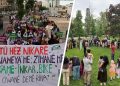
Public commemorations were held in cities including Adana, Diyarbakır (Amed), Iğdır (Idîr), Urfa (Riha), Mersin, Ankara and Istanbul. These events featured speeches, music, community statements and visual displays, with participants carrying banners that read “No life without language” and “Our language is our identity”.

In Diyarbakır (Amed), a notable cultural initiative was unveiled: classical Kurdish poetry by figures such as Melayê Cizîrî and Feqiyê Teyran was inscribed on paving stones along a major thoroughfare. The project, coordinated by the municipality’s Department for Language Protection, was intended to bring Kurdish literature into public view and assert its place in the collective urban landscape.
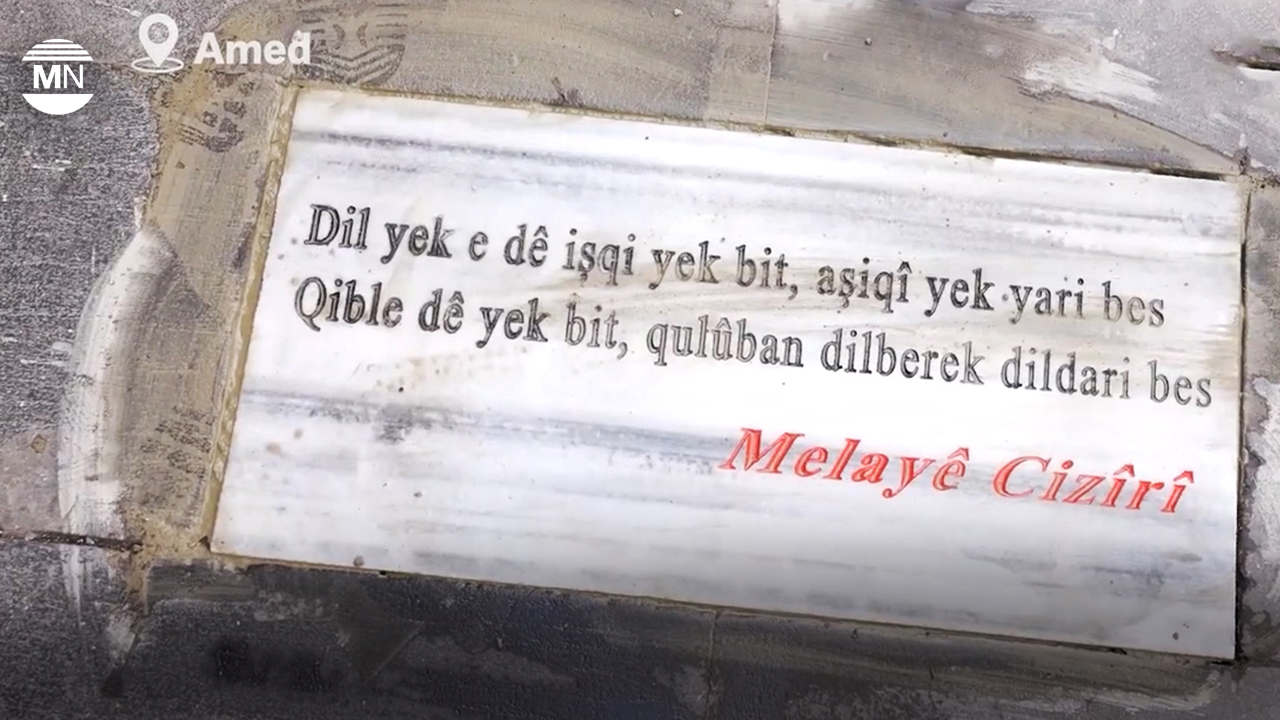
Classical Kurdish poetry of Melayê Cizîrî was inscribed on paving stones along a major thoroughfare in Diyarbakır (Amed) on 15 May.

The Human Rights Association (İHD) marked the day by referencing international human rights standards, asserting that linguistic repression constitutes a violation of cultural rights. In their statement, they recalled the case of Vedat Aydın, a leading Kurdish politician who was assassinated after publicly using his native language, highlighting the risks historically faced by defenders of linguistic freedom.

Kurdish Language Day commemorates the publication of Hawar magazine on 15 May 1932, edited by the Kurdish intellectual Celadet Alî Bedirxan. The magazine marked a pivotal moment in the codification and standardisation of the Kurdish language and helped promote Kurdish as a literary and educational medium. Hawar was the first publication to use a Latin-based alphabet for Kurdish, a decision that played a key role in modernising the language and expanding its use in both cultural and political spheres. The date has since become a symbolic occasion for asserting the linguistic and cultural rights of the Kurdish people. The magazine played a formative role in the standardisation of the Kurdish language, building upon earlier efforts such as the 1898 newspaper Kurdistan. These publications laid the groundwork for a modern Kurdish literary and political consciousness.

Edited by Celadet Alî Bedirxan, a leading figure of modern Kurdish thought and language reform, Hawar (1932) played a foundational role in standardising the Kurdish language.

The 2025 observances took place within a newly developing political context. The PKK declared on 12 May that it would dissolve its armed structures and transition towards non-violent democratic engagement. This historic decision has effectively dismantled one of the Turkish state’s main justifications for restricting Kurdish cultural rights—namely, the association between Kurdish identity and insurgency.

With this pretext removed, Kurdish political actors argue that the continued ban on Kurdish in public education and administration is no longer tenable and must now be seen for what it is: a form of cultural exclusion. Legal recognition of the Kurdish language has since emerged as a central demand within the redefined peace framework, alongside broader calls for structural reform.

Following the PKK’s declaration that it would dissolve its armed structures and seek a democratic resolution, the peace process has become a renewed focus for Kurdish political and civic initiatives. Legal recognition of the Kurdish language has since emerged as one of the central demands accompanying calls for structural reform.

Cities in Turkey’s Kurdish-majority southeast—commonly referred to by Kurds as North Kurdistan (Bakur)—continue to be hubs of cultural production and mobilisation. Local institutions and activists have played a pivotal role in preserving Kurdish heritage and resisting assimilationist policies.

Despite these efforts, Kurdish remains effectively excluded from the formal education system and is not employed in state institutions. While limited elective courses and symbolic acknowledgements exist, the absence of structural guarantees has sustained what many describe as a regime of cultural erasure. Linguists, educators, and community leaders have argued that this undermines linguistic vitality, intergenerational transmission, and collective memory.

Kurdish political actors and civil society organisations are now placing increased pressure on the Turkish government to abandon restrictive policies and embrace a model of inclusive governance. Within the scope of the peace process launched in October 2024, they assert that cultural recognition must be prioritised. For them, recognising Kurdish as a constituent part of the country’s national identity is not only a question of justice but a prerequisite for sustainable peace and coexistence.


Share post
Tags: #CejnaZimanêKurdîPîrozBê#CulturalRights#KurdishLanguageDay#LanguageIsIdentity#PeaceProcess#RightToMotherTongueKurdish language rightsLanguage and identity Kurdish civil societyMinority cultural recognitionPeace process in Turkey

Related Posts

ANNOUNCEMENT: Medya News closes amid shifting political landscape, makes way for reimagined Kurdish media

ANNOUNCEMENT: Medya News closes amid shifting political landscape, makes way for reimagined Kurdish media

June 30, 2025
Turkey’s Pro-Kurdish DEM Party delegation engages US officials on peace, democratic reforms

Turkey’s Pro-Kurdish DEM Party delegation engages US officials on peace, democratic reforms

June 29, 2025
DEM Party delegation discusses Öcalan peace initiative with German and UK officials

DEM Party delegation discusses Öcalan peace initiative with German and UK officials

June 27, 2025
Meetings, talks at İmralı Prison deepen in broader effort to resolve Kurdish question

Meetings, talks at İmralı Prison deepen in broader effort to resolve Kurdish question

June 12, 2025
Kariane Westrheim: PKK’s dissolution “critical opening – not a conclusion”

Kariane Westrheim: PKK’s dissolution “critical opening – not a conclusion”

May 26, 2025
Kurdish Language Day celebrated in İstanbul with calls for official recognition

Kurdish Language Day celebrated in İstanbul with calls for official recognition

May 26, 2025

The news content on our website cannot be quoted without permission, even by citing the source. It cannot be copied or published elsewhere, contrary to the law or without permission.

Follow Medya News

Categories

  • All News
  • Politics
  • Human Rights
  • Opinion
  • Kurdistan
  • Human Rights
  • Interview
  • Women
  • Audio Articles
  • Special Report

Quick Menu

  • Daily News
  • Live Blog
  • Podcast
  • Videos
  • Breaking News

About

Impressum

About us

Privacy Policy

Welcome Back!

Login to your account below

Forgotten Password?

Retrieve your password

Please enter your username or email address to reset your password.

Log In
We use cookies on our website to give you the most relevant experience by remembering your preferences and repeat visits. By clicking “Accept All”, you consent to the use of ALL the cookies. However, you may visit "Cookie Settings" to provide a controlled consent.
Cookie SettingsAccept All
Manage consent

Privacy Overview

This website uses cookies to improve your experience while you navigate through the website. Out of these, the cookies that are categorized as necessary are stored on your browser as they are essential for the working of basic functionalities of the website. We also use third-party cookies that help us analyze and understand how you use this website. These cookies will be stored in your browser only with your consent. You also have the option to opt-out of these cookies. But opting out of some of these cookies may affect your browsing experience.
Necessary
Always Enabled
Necessary cookies are absolutely essential for the website to function properly. These cookies ensure basic functionalities and security features of the website, anonymously.
CookieDurationDescription
cookielawinfo-checkbox-analytics11 monthsThis cookie is set by GDPR Cookie Consent plugin. The cookie is used to store the user consent for the cookies in the category "Analytics".
cookielawinfo-checkbox-functional11 monthsThe cookie is set by GDPR cookie consent to record the user consent for the cookies in the category "Functional".
cookielawinfo-checkbox-necessary11 monthsThis cookie is set by GDPR Cookie Consent plugin. The cookies is used to store the user consent for the cookies in the category "Necessary".
cookielawinfo-checkbox-others11 monthsThis cookie is set by GDPR Cookie Consent plugin. The cookie is used to store the user consent for the cookies in the category "Other.
cookielawinfo-checkbox-performance11 monthsThis cookie is set by GDPR Cookie Consent plugin. The cookie is used to store the user consent for the cookies in the category "Performance".
viewed_cookie_policy11 monthsThe cookie is set by the GDPR Cookie Consent plugin and is used to store whether or not user has consented to the use of cookies. It does not store any personal data.
Functional
Functional cookies help to perform certain functionalities like sharing the content of the website on social media platforms, collect feedbacks, and other third-party features.
Performance
Performance cookies are used to understand and analyze the key performance indexes of the website which helps in delivering a better user experience for the visitors.
Analytics
Analytical cookies are used to understand how visitors interact with the website. These cookies help provide information on metrics the number of visitors, bounce rate, traffic source, etc.
Advertisement
Advertisement cookies are used to provide visitors with relevant ads and marketing campaigns. These cookies track visitors across websites and collect information to provide customized ads.
Others
Other uncategorized cookies are those that are being analyzed and have not been classified into a category as yet.
SAVE & ACCEPT

Add New Playlist

Contact

[contact-form-7 id=”18690″ title=”Contact form 1″]

[email-subscribers-form id=”1″]

No Result
View All Result
  • All News
  • Kurdistan
  • Women
  • Politics
  • Human Rights
  • Interview
  • Long Reads
  • World
  • Journalism
  • Ecology
  • Economy
  • Culture & Art
  • Daily News
  • Breaking News
  • Newsletter
  • Opinion
  • Authors
  • Podcast
  • LIVE BLOG

© 2020 Medyanews. All Rights Reserved