

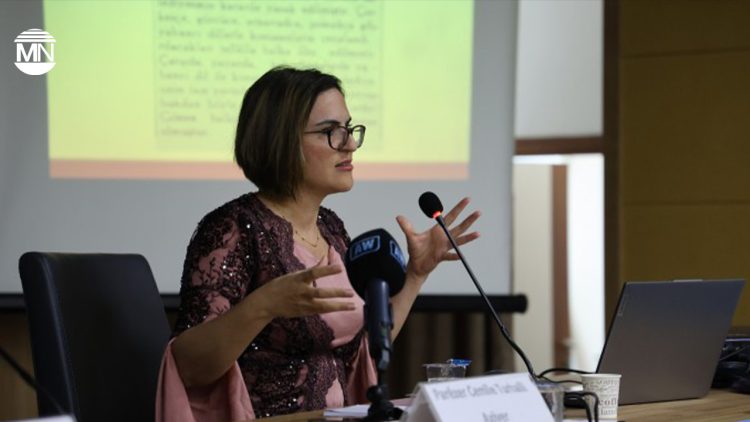
The 2nd Kurdish Language Symposium in Van (Wan), eastern Turkey, held from 17–18 May, is producing renewed calls for Kurdish to be recognised as an official language and a language of education, speakers highlighting shared struggles with other indigenous peoples, including the Sami in Norway, in resisting state-led assimilation.
Organised by the Van branch of Turkey’s Education and Science Workers’ Union (Eğitim-Sen), the symposium brought together scholars, activists and politicians from across the Kurdish regions and Europe to discuss linguistic rights, suppression and survival strategies.
Cemile Turhallı, co-spokesperson for the Language, Culture and Arts Commission of Turkey’s pro-Kurdish Equality and Democracy (DEM) Party, said the century-long efforts of the state to marginalise the Kurdish language continued to threaten its survival.
“Kurdish has come this far under intense pressure. The language is still under threat today,” she said. Turhallı called for a multilingual and multicultural state in which Kurdish would hold official status. “If a language has no recognised status, then its people risk disappearing too.”
The symposium framed these demands within the broader context of both historical and contemporary assimilation. Writer Dilawer Zeraq traced state suppression of Kurdish to the 1920s, when the language was banned, and described how enforced Turkish-only education led many Kurdish families to pull their children out of school.
“Kurds deliberately avoided sending their children to school,” he explained. “They returned to villages and homes to protect the language.”
Despite this, Zeraq added, assimilation has continued. Turkey’s 1982 Constitution still explicitly prohibits Kurdish-language education.
Parallels were drawn with the Sami experience in Norway, where government policies in the 20th century almost eradicated indigenous languages. Norwegian academic Ánne Márjá Guttorm Graven said that only around 20,000 of the estimated 50,000–80,000 Sami people now speak the language.
“We were subjected to fascist tendencies and heavy pressure to forget the Sami languages,” she said, crediting Sami resilience with preserving linguistic identity.
Her remarks highlighted the shared struggles of Kurdish and Sami communities in preserving their languages amid institutional neglect or hostility.
Academic Îsmet Xabur pointed to internal shortcomings, noting that only 13 of 49 universities in the Kurdistan Region of Iraq (Başûr) offer Kurdish language instruction.
“There is no political agenda around the Kurdish language in Kurdistan,” he said.
Dr Kazhal Fedakar from Duhok University added that while Kurdish is socially active in the Sine (Sanandaj) region of Iranian Kurdistan (Rojhilat), its absence in official and academic domains undermines linguistic development. This situation, she noted, is shared across all four parts of Kurdistan.
The symposium built on the momentum of 2024’s Van Language Symposium, which had urged grassroots-led revitalisation initiatives. Speakers at this year’s event stressed the importance of transnational cooperation across the Kurdish regions and strong institutional backing—citing Sweden as a positive example.
Şerefxan Cizîrî observed that “Kurds who emigrated to Europe were able to speak and write more freely in Kurdish—and as a result, developed the language further.”
The event concluded with a call for governments to abandon denial and support linguistic diversity as a foundation for cultural survival. Kurdish and Sami speakers alike stressed that the recognition of indigenous languages is essential to protecting identity, memory and community.


