

Turkey’s pro-Kurdish Peoples’ Equality and Democracy (DEM) Party Language, Culture and Arts Commission Co-Spokesperson Cemile Turhallı has strongly criticised Turkey’s long-standing language policies, describing them as a systematic effort to suppress linguistic diversity. On Wednesday, speaking at an interview with Rukiye Payiz Adıgüzel from Mezopotamya Agency, she called for the legal recognition of the Kurdish language and warned that “no real solution” to the Kurdish question could be reached without addressing the issue of mother tongue.
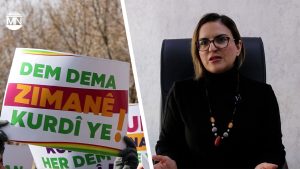
Turhallı said that “language is equally as important for humans” as their very existence, arguing that prohibiting a language is tantamount to “eliminating” the people who speak it. “The history of the Republic of Turkey has turned into a graveyard of languages,” she said, denouncing a century of policies that have prioritised Turkish while undermining other ethnic languages.
“The founding ideology of the Republic prioritised its own language — the language it wanted to give meaning to. This was an ethnic language: Turkish,” Turhallı said, adding that this policy was “designed to suppress other languages, eliminate them and homogenise society through this single language.”
Her remarks come amid renewed debates on cultural rights and minority protections in Turkey, where the use of Kurdish in public spaces, education and government services remains restricted. While the government has taken some steps in recent years, such as allowing limited Kurdish broadcasting, activists argue that these measures fall short of true linguistic equality.
Turhallı stressed that recognition of Kurdish as an official language and its inclusion in education are essential steps towards justice and reconciliation. “If someone says, ‘No, you must speak Turkish; I do not accept Kurdish,’ they are essentially denying your humanity,” she asserted. “The only way for a language to gain true existence is by making it part of the public sphere.”
The politician also linked linguistic rights to broader societal peace, arguing that “there must be language peace for social peace to be achieved and sustained.” She criticised the Turkish state’s “monolingual solution”, wich she said was “not a solution”, but a continuation of historical injustices. “Current global practice shows that multilingualism is not a disadvantage — it is an advantage,” she said, citing examples of multilingual nation-states worldwide.
Turhallı further accused Turkish authorities of deliberately targeting Kurdish cultural expressions, including traditional folk dances. “Why does the state attack govends [Kurdish folk dances]? Because Kurds draw strength from their govends. So what happens? They attack the clothing worn in these dances,” she claimed.
Concluding her speech, Turhallı urged Kurds to resist assimilation efforts by continuing to speak and create in Kurdish. “Assimilation begins with oppression and violence but later continues through consent,” she warned. “Thus, what we must do is struggle. Struggle more.”
Her remarks highlight ongoing tensions in Turkey over linguistic and cultural rights, an issue that remains at the heart of the Kurdish struggle for recognition and equality.


