

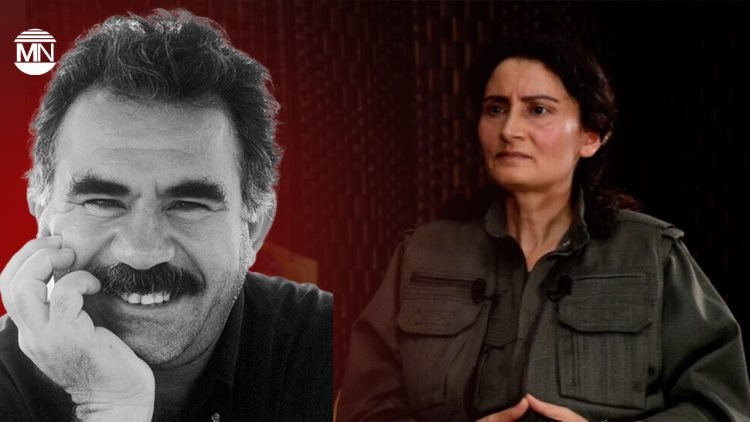
“Only Leader Apo [Abdullah Öcalan] can lead this process — and that is only possible if he is free,” said KCK Executive Council Co-Chair Besê Hozat during a televised interview broadcast on Medya Haber TV on Monday, warning that the Kurdistan Workers’ Party (PKK)’s decision to dissolve itself and cease armed struggle depends entirely on Abdullah Öcalan’s ability to live and act freely.
Hozat evaluated the recent decision of the PKK’s 12th Congress to end its decades-long armed campaign, linking its implementation to a roadmap that must begin with the Turkish government.
“The congress made a clear decision: the PKK ends the armed struggle. But this resolution cannot be implemented unless the conditions for Leader Apo’s freedom are established, and unless the right to democratic politics is recognised and secured through legal and constitutional reforms,” Hozat stated.
The PKK was founded in 1978 and began its insurgency against the Turkish state in 1984. The movement’s imprisoned leader, Abdullah Öcalan, has been held in solitary confinement since 1999 on İmralı Island. Despite his isolation, he has periodically acted as a central interlocutor in past peace initiatives.
Between 5–7 May, during the PKK’s congress, the group declared it would disband and lay down arms — a decision shaped by what Hozat described as Öcalan’s “leadership, direction, and vision” for peace and democratic society. She noted that the congress had only gone ahead because Öcalan’s perspectives had “guided” the movement.
However, Hozat warned that political stalling and lack of government seriousness risk undermining the process. “The Justice and Development Party (AKP) and the ruling bloc are playing for time. There has been no move toward legal reform or recognition of democratic rights,” she said, criticising the government’s focus on disarmament without addressing the prerequisites.
Hozat also emphasised the need for a new “social contract” in the form of a democratic constitution that would guarantee Kurdish rights and political participation. “Without this, there will be no real transition from armed resistance to democratic politics,” she added.
According to Hozat, the path forward is clear: “Only if Öcalan is free and can engage with all parties as a legitimate interlocutor can weapons be laid down. These fighters will not simply vanish or surrender — they must be brought into democratic political life.”
She criticised both state media and the political language dominating public discourse, describing it as “toxic” and inflaming nationalist hostility. “This language poisons society and blocks peace,” she said.
Highlighting international dimensions, Hozat said foreign powers, including Germany, were profiting from the conflict and acting against the peace initiative. She cited the arrest of Kurdish figure Yüksel Koç in Germany as “evidence that Europe does not want this process to succeed”.
Related article
Germany arrests Kurdish politician amid peace process shift
On regional developments, she said Turkey’s role in Syria would be unsustainable if it continued its anti-Kurdish policies. “If Turkey wants to have a future role in Syria, it must make peace with the Kurds,” she stated.
Domestically, Hozat called on opposition parties to take bolder action. She acknowledged that the Republican People’s Party (CHP) had made positive statements but said they remained insufficient. “They must recognise Öcalan as a legitimate actor. Without that, they are not truly participating in this process,” she asserted.
Describing the ongoing military clashes in the Medya Defence Zones as a consequence of continued Turkish aggression, Hozat said the PKK had declared a ceasefire and now left the question of “who wants war, and who wants peace” to public judgment.
“The method of armed struggle has been terminated. But if attacks continue, so will legitimate self-defence,” she warned.
She also called for mass social participation, particularly from women and youth, in what she described as a “democratic society process”. She described it as “a women’s process” and called for Kurdish and Turkish women’s movements to claim ownership of it.
Hozat concluded with a warning: “This process is too valuable to leave in the hands of this government. If we don’t organise and act, it will be squandered. Only through struggle and serious engagement can peace be built.”


