

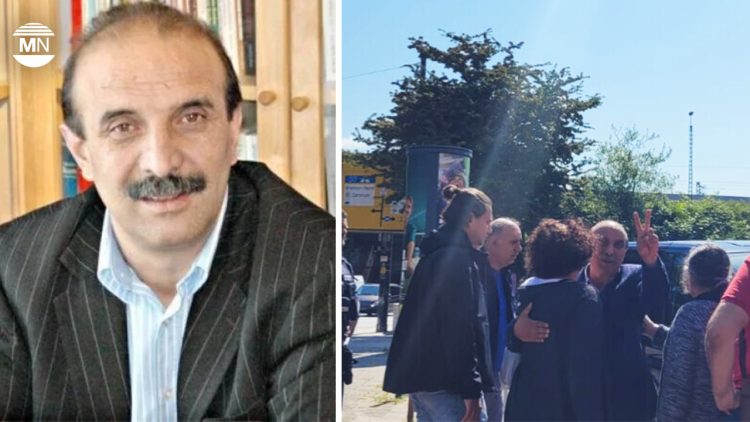
Kurdish politician Yüksel Koç was arrested on Tuesday at his home in Bremen by German police as part of an investigation by the Federal Prosecutor’s Office, prompting criticism from Kurdish organisations and activists who say the move undermines recent peace efforts by the Kurdish movement.
The arrest followed a multi-hour search of Koç’s residence. According to supporters, no search warrant or specific documentation was shown during the operation. Koç, 61, was transferred to Karlsruhe, where he is expected to appear before an investigating judge on Wednesday.
He is being investigated under Section 129b of the German Criminal Code, which relates to membership in a foreign terrorist organisation. The reported basis for the accusation is his previous role as co-chair of the Congress of Democratic Kurdish Communities in Europe (KCDK-E), a diaspora umbrella organisation that he led between 2016 and 2023.
Kurdish groups have strongly criticised the arrest, calling it a politically charged move that contradicts recent developments. On 12 May, the Kurdistan Workers’ Party (PKK) announced at its 12th Congress that it would dissolve its armed structures—an initiative that followed a 27 February statement from imprisoned Kurdish leader Abdullah Öcalan calling for peace and democratisation. The German Foreign Office had publicly welcomed these developments and expressed support for renewed peace efforts.
“Germany’s actions send the wrong signal,” said the KCDK-E in a written statement. “At a time when the Kurdish freedom movement is taking historic steps towards peace, the arrest of Koç shows that criminalisation continues.”
Koç, who has been active in Kurdish diaspora politics for decades, is known for his public work on human rights and democracy. His supporters insist that all his activities were legal and political in nature.
The arrest is the latest in a series of police operations targeting Kurdish structures in Bremen. In April, a meeting at the Kurdish cultural centre Biratî e.V. was raided by police, resulting in over 30 people being detained for several hours. Bremen-based politicians, including Muhlis Kocaağa of The Left Party, described the operation as unjustified and excessive.
In February, far-right intimidation was also reported, with Nazi symbols and bullet casings placed in the mailbox of the same cultural centre. No suspects have been identified.
A protest rally demanding Koç’s release is planned for Wednesday at 2:00 PM (local time GMT+2) in front of the Bremen State Parliament. Organisers include Kurdish groups, solidarity networks, and local political figures, who accuse German authorities of suppressing peaceful Kurdish political activity under outdated legal frameworks.
Germany has banned the PKK since 1993, and prosecutions under anti-terror laws have continued despite repeated calls for reform from civil society and human rights groups.
The Federal Prosecutor’s Office has not commented on the ongoing investigation.
Supporters have also launched a social media campaign using the hashtag #FreiheitFürYükselKoc [freedom for Yüksel Koç], calling for his immediate release and denouncing the criminalisation of Kurdish political activism in Europe. The campaign includes visuals in multiple languages—including Kurdish, German, and English—highlighting Koç’s long-standing commitment to peace and democracy. Activists are urging international solidarity and encouraging public figures, organisations, and ordinary citizens to amplify the message by sharing the hashtag and participating in upcoming protests.


