Jihadist factions, including Hay’at Tahrir al-Sham (HTS) and Turkey-backed groups, have made rapid gains across Syria, seizing key territory in Daraa and Homs provinces. The rapid advances have overwhelmed government forces, leaving President Bashar al-Assad’s regime increasingly vulnerable and raising fears of wider regional consequences.
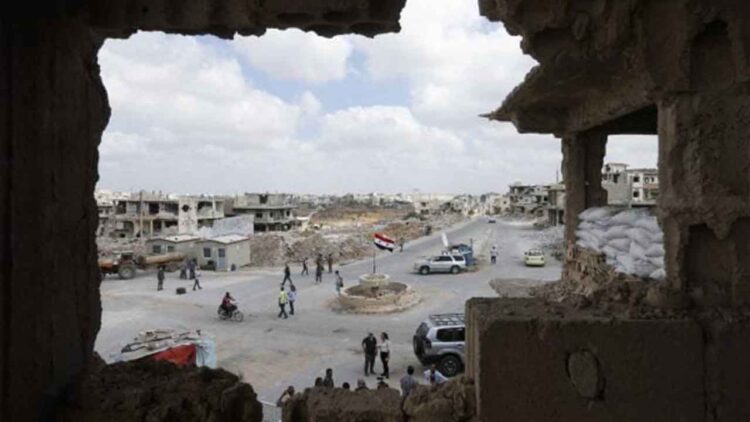
In the southern province of Daraa, jihadist factions now control over 80% of the territory, including major towns such as Nawa, Inkhil and Mahja. Following the withdrawal of regime forces from military checkpoints and bases, government troops have been cornered in Daraa Al-Balad and Ezrae. These developments have emboldened the factions, which have called on regime soldiers to defect and demonstrated their dominance by seizing strategic locations such as Tel Al-Khadr near Daraa city.
Despite these setbacks, the regime retaliated by shelling Da’ael City in central Daraa, although no casualties were reported. The province remains a flashpoint and the situation is evolving rapidly.
Civilians continue to bear the brunt of the escalating violence. Over the past day, three children and a woman were killed in separate incidents in Daraa. Shelling on Jassem city killed a child and damaged houses, while unidentified gunmen shot dead a boy and a girl in the village of Al-Sheikh Saad. Meanwhile, a woman died from injuries sustained in shelling on Ghabaghib, northern Daraa.
According to the Syrian Observatory for Human Rights (SOHR), 323 incidents of violence have been documented in Daraa since the beginning of 2024, resulting in 306 deaths. Of these, 93 were civilians, including 22 children.
In Homs, jihadist factions led by HTS and its allies have made significant advances, capturing Al-Dar Al-Kabeera, a town just one kilometre from the Homs Military Academy, the largest such institution in Syria. The advance forced officers from the 26th Division to withdraw, highlighting the opposition’s momentum in the area.
Regime forces responded with heavy rocket fire, killing 20 civilians, including five members of one family. The victims were killed in Al-Dar Al-Kabeera, while other deaths were reported in Talbiseh and Al-Ghantou. Eleven others were injured in the bombardment.
Homs, a key crossroads linking Damascus to Assad’s coastal strongholds of Tartous and Latakia, is crucial to maintaining the regime’s territorial integrity. Its fall would cut off critical supply routes and isolate the capital from the coast and the Russian naval base.
Jihadist groups are now at the city’s gates, having recently captured Hama. Thousands of civilians have fled towards Latakia and Tartous, fearing an escalation of the conflict as regime forces prepare for a final defence.
The pace of the jihadist advance has exposed significant weaknesses in Assad’s forces. Years of reliance on allies such as Russia and Iran have left the regime ill-prepared to counter such offensives on its own.
Russia’s focus on its war in Ukraine and Hezbollah’s losses in its conflict with Israel have further strained the regime’s support network. While Iranian-backed Iraqi militias are on alert, they have yet to enter Syria in large numbers as Iraq avoids escalating its involvement.
Amid this uncertainty, Russia has advised its citizens to leave Syria and Iran has evacuated the families of its diplomats. Israel, meanwhile, has launched attacks on Syria’s border with Lebanon, targeting potential supply lines for Hezbollah.
The rapid territorial gains by jihadist groups have caused alarm in neighbouring countries and among global powers. Qatar has warned that the escalating violence threatens Syria’s territorial integrity, while Iran, Russia and Turkey are set to meet to discuss the crisis. Iranian Foreign Minister Abbas Araghchi stressed the importance of preserving Syria’s unity, although no concrete plans were announced.
The capture of Daraa and Suweida in the south, coupled with gains in Aleppo, Hama and Deir ez-Zor, suggest that jihadist groups are closing in on Damascus. These developments have further destabilised the region, with observers questioning the regime’s ability to maintain its hold on the country after 13 years of war.