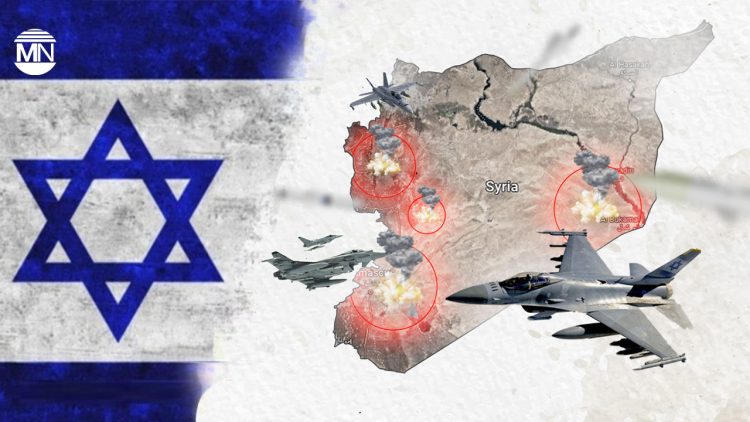
At least four missiles hit the Al-Kiswah area south of Damascus and the town of Izraa in Daraa in southern Syria on Tuesday evening, killing at least two people, according to local reports.
One blast hit an arms depot in Al-Kiswah, causing a fire at the site, and at least two people were killed in strikes on the headquarters of a Syrian military unit southwest of Damascus, the Syrian Observatory for Human Rights said. It was not immediately clear whether the victims were soldiers or civilians. Another strike targeted Tell al-Hara in Daraa, a strategic hilltop near the Israeli-occupied Golan Heights. There was no immediate comment from the Syrian authorities on casualties or damage.
The Israeli army claimed it had hit “military targets in southern Syria, including command centres and several sites containing weapons”, according to a statement released on Tuesday night. Israeli officials said the presence of “hostile forces and equipment” in southern Syria “poses a threat to the citizens of Israel” and vowed to “continue to operate in order to eliminate any threat”.
Israel’s ‘security’ rhetoric
Israel’s defence minister Israel Katz said the operation was part of a new policy to prevent militant entrenchment near the border. “Any attempt by Syrian regime forces and the country’s terrorist organisations to establish themselves in the security zone in southern Syria will be met with fire,” Katz warned, adding that Israel would not allow southern Syria to “become southern Lebanon”. This was an allusion to the presence there of Hezbollah fighters in Southern Syria, which was the Israeli states’s stated reason for its 2024 military assault on Lebanon, which claimed over 3000 civilian lives.
The air strikes come just days after Israeli Prime Minister Benjamin Netanyahu called for the ‘complete demilitarisation of southern Syria’, saying, Israel “will not allow the new Syrian army to move into areas south of Damascus”. Netanyahu’s comments followed the fall of President Bashar al-Assad’s government in Damascus in December.
Prime Minister Benjamin Netanyahu has made Israel’s position clear in recent days. On 23 February, he declared that “we will not allow forces of the HTS organisation or the new Syrian army to enter the area south of Damascus” and called for the “complete demilitarisation of southern Syria, including the provinces of Quneitra, Daraa and As-Suwayda”. This effectively calls for a large buffer zone free of any Syrian military presence, beyond what has been stipulated in previous ceasefire agreements. Netanyahu’s government appears intent on unilaterally imposing its will, under the cover of the chaos created by the massive internal changes going on in Syria.
Israeli Foreign Minister Gideon Sa’ar has also weighed in, suggesting a vision for Syria’s future that is consistent with Israel’s security interests. In a meeting with European officials in Brussels, Sa’ar argued that “a stable Syria can only be a federal Syria”, with autonomous regions for its various communities. He described the new government in Damascus as ‘a jihadist Islamist terrorist group from Idlib that took Damascus by force’, referring to HTS’s leading role in overthrowing Assad. These remarks signal that Israel is positioning itself as an opponent of the new HTS led interim government.
“aggression”, occupation and colonisation
The Syrian interim authorities have categorised Israels’s actions as “aggression”, while allies have called for a reversal of Israel’s moves, including their further expansion into the Golan Heights. In fact, However, Israel’s bellicose security rhetoric may well be a cover to allow it to hold onto its new colonial land grab in the Syrian Golan.
Israel occupied a vast swath of the Syrian Golan in 1967, which it later colonised and annexed to the state of Israel. 140,000 people were displaced and 35 settlements, illegal under international law were established. Since December 2024 it has expanded its occupation further into the Heights, and displaced the population of Al-Hurriya village. Al-Marsad, the Arab Human Rights Centre in the Golan Heights, warns of “a repeat of what the Israeli military did in the Golan following the 1967 Arab-Israeli War, ordering Syrian villagers to leave their homes and resulting in the forcible displacement of 95% of the Syrian population from the Golan.”
Al-Marsad is calling on the international community to ensure that Israel respects international humanitarian law and withdraws. They wrote:
"The recent Israeli aggression is a blatant violation of the principles of international law that prohibit the use of force or the threat of force to occupy and annex the territories of others. It also disregards the Disengagement Agreement, which mandates respect for the land, sea, and air ceasefire. This Agreement is further reinforced by the United Nations Security Council Resolution No. 338, issued on October 22, 1973, which the Israeli actions also violate.

The international community, with the United Nations at its helm, must compel Israeli forces to withdraw immediately from the areas they recently occupied."

Al-Marsad, the Arab Human Rights Centre in the Golan Heights
In addition from withdrawing from its newly occupied territories, Al-Marsad is calling for Israel to withdraw entirely from the Golan Heights, and return to its pre-1967 borders.
The United Nations and several regional powers have also criticised Israel’s military expansion into the demilitarised buffer zone of the Golan Heights in southwest Syria, which followed Assad’s departure.