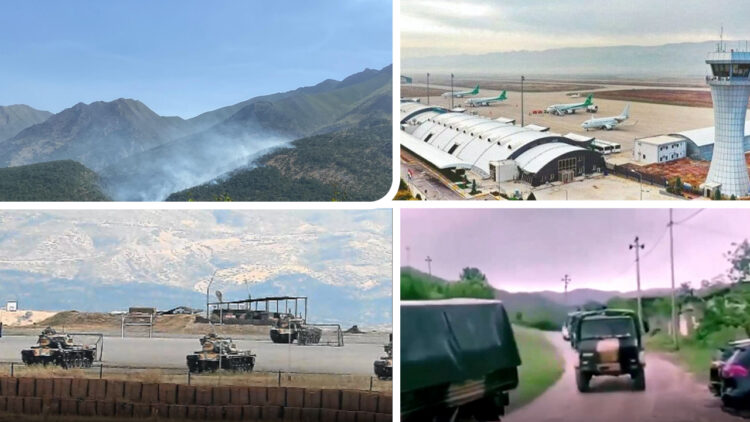
The Turkish Armed Forces’ ongoing military operations in the Kurdistan Region of Iraq (KRI, known as Bashur), supported by one of the regional factions and tacitly approved by the United States, have sparked speculation that these actions might further disrupt the region’s scheduled elections, already delayed by over two years.
The Turkish military occupation recently entered a new intensified phase with increased cooperation from Erbil’s Kurdistan Democratic Party (KDP). The extensive operation aims to establish a security buffer along Turkey’s borders with Iraq and Syria, reaching a depth of 30-40 kilometres, aiming to eliminate the Kurdistan Workers’ Party (PKK) presence.
Additional Turkish forces have recently moved into Bradost, a mountainous district in the KRI’s northeast approximately 50 km from the Turkish border. While details on Turkey’s long-term objectives remain unclear, the freshly stationed forces are expected to conduct operations in areas controlled by the KDP’s rival Patriotic Union of Kurdistan (PUK), such as Rania and Qaladiza. Yeni Şafak, a newspaper close to Turkey’s ruling Justice and Development Party (AKP), suggested that Sulaymaniyah (Silêmanî) airport is also likely to be a target of the KDP-backed Turkish forces.
Experts in Kurdistan and Iraq view Turkey’s incursion into Iraqi Kurdistan as an attempt to influence the region’s upcoming elections. Sarteep Jowhar, an analyst on Kurdish and Iraqi affairs, suggests that with elections scheduled for 20 October, the ongoing Turkish military actions could extend Turkish control to Dohuk, potentially providing a pretext for election delays.
The recent Turkish military incursions have sparked widespread protests among Kurdish civilians. “All of Turkey’s assaults on the Kurdistan Region have occurred under Barzani’s cooperation over the last 30 years. However, Turkey’s recent invasion has alarmed even members of his party. In the past two months, the KDP has been actively working to rebalance power dynamics by strengthening its ties with Iran,” Jowhar said.
Rashad Galali, a member of the PUK based in Erbil (Hewlêr), criticised the KDP in an interview with Roj News: “The Kurdistan Democratic Party cares more about its own interests than promoting democracy. It is collaborating with Turkey to impose its dominance over the region.” Galali highlighted the long-standing alliance between the KDP and Turkey and their joint opposition to democratic processes. Galali also pointed to Turkey’s historical hostility towards Kurds across the Middle East: “Since 1991, Turkey has escalated its attacks on the Kurdistan Region, often in collaboration with the Kurdistan Democratic Party.”
Since the beginning of the latest Turkish military operation, Turkey has carried out 238 airstrikes in Iraqi Kurdistan, primarily targeting the Duhok governorate. Community Peacemaker Teams (CPT) stated that over 20,000 dunams of agricultural land were set on fire by the bombardments.
The increasing cooperation between the KDP and Turkey in the attack on the KRI is viewed as an effort to counterbalance the recent shift in regional power dynamics against the KDP. Many experts on Kurdish Iraqi affairs predict that this could potentially lead to a new civil war in the region. If such a scenario unfolds, the KDP would bear sole responsibility for the consequences.