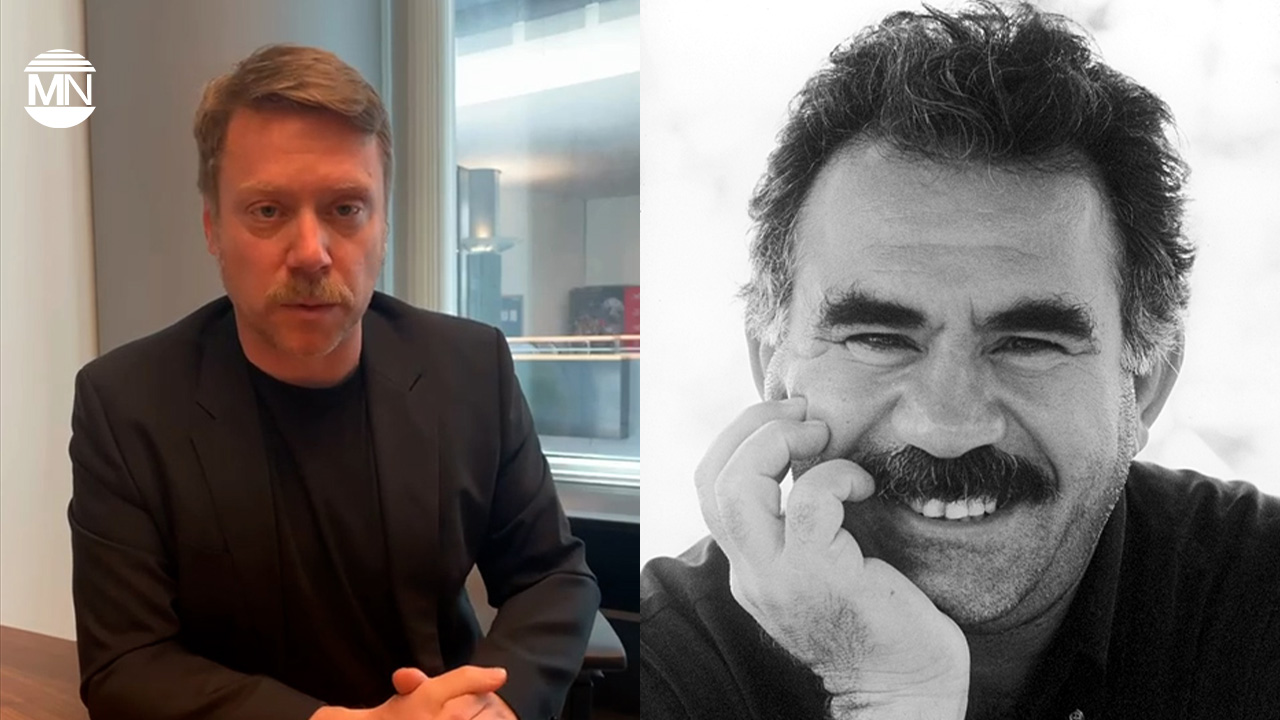
European Parliament Left Group co-chair Martin Schirdewan demanded that Turkey lift its 26-year isolation of imprisoned Kurdish leader Abdullah Öcalan on Tuesday, joining a new global campaign titled “I want to visit Mr Abdullah Öcalan” and calling it a critical step toward a peaceful resolution of the decades-long Kurdish conflict.
Sending message for the ‘Freedom for Öcalan, a Political Solution to the Kurdish Question’ campaign, Schirdewan said Öcalan must be allowed to present his vision for peace publicly, following the Kurdish leader’s February announcement that the Kurdistan Workers’ Party (PKK) would dissolve itself if Turkey agrees to genuine peace talks.
“Abdullah Öcalan has been held in isolation for 26 years by the Turkish state. And despite that, in February this year, he announced that the PKK will lay down its weapons, will dissolve itself if there is a chance for a serious peace process and if there is the will of the Turkish government by the president of Turkey, Erdoğan, to engage in a serious peace process and serious peace negotiations,” Schirdewan said. “I demand the Turkish state to remove all obstacles that might prevent Abdullah Öcalan to present his ideas, his vision for this peace process in Turkey, in Kurdistan and in the Middle East.”
Schirdewan’s statement, “I want to go to Turkey. I want to visit Mr Abdullah Öcalan,” reflects a slogan already used by the campaign in its third and most politically assertive phase. Supporters say it marks a turning point in the decades-old Kurdish conflict — shifting the focus from armed struggle to dialogue.
On 27 February, Abdullah Öcalan issued a rare message from prison, declaring that the PKK would end its armed struggle and dissolve, provided Turkey shows the political will to launch serious peace negotiations. The message has been welcomed by Kurdish institutions, European lawmakers, and civil society organisations.
Campaign spokespersons including Hatip Dicle, Zübeyde Zümrüt, and Sinan Önal say that Öcalan’s vision of Democratic Confederalism offers a roadmap not only for Turkey but also for regional democratic transformation.
“Symbolic gestures are not enough — concrete legal and political changes are essential for credibility,” the spokespersons said.
Supporters include Nobel laureates, legal scholars, artists and political figures across dozens of countries. Recently in April, a conference was organised in Rome for the campaign.
Schirdewan’s remarks follow a series of political and diplomatic gestures across Europe backing Öcalan’s peace proposal. In March, German leftist politician Gregor Gysi formally requested to visit Öcalan and urged Turkey to embrace a negotiated resolution, suggesting the involvement of a neutral mediator similar to Norway’s role in the 2008 Oslo Process.
Last week, Schirdewan led a European Parliament delegation to North and East Syria, meeting with local officials including Ilham Ahmed of the Autonomous Administration. The delegation voiced support for self-governance, inclusive democracy, and regional peace — framing the Kurdish issue as inseparable from wider Middle East stability.
The delegation also visited Roj Camp, which houses families of former ISIS fighters. Though time and security constraints limited access, the group met with camp administrators who described worsening conditions and rising radicalisation risks — issues that many say are linked to the broader failure to resolve the Kurdish issue across borders.
Öcalan, the founder of the PKK, was captured in 1999 and has been held in solitary confinement on Turkey’s İmralı Island since. Still, Öcalan has repeatedly called for peace, most notably during the 2013–2015 ceasefire talks, which eventually collapsed. His February 2025 message went further — urging the PKK to disband entirely if Ankara agrees to democratic reforms and negotiations.
Campaign spokespersons compare Öcalan’s role to Nelson Mandela’s in South Africa, saying his release could unlock a democratic transition in Turkey and end decades of repression, displacement, and armed conflict in Kurdish-majority regions.
The campaign’s supporters are also lobbying international institutions to act. At its June session, the Parliamentary Assembly of the Council of Europe (PACE) is expected to receive new letters from legal experts, civil society groups, and Nobel laureates urging Turkey to comply with the European Convention on Human Rights.
So far, the Turkish government has not officially responded to Öcalan’s peace proposal. President Erdoğan has made no public statement since the PKK’s formal declaration in May that it would dissolve and shift entirely to legal democratic methods.
Observers say Turkey’s continuing crackdown on the pro-Kurdish Peoples’ Equality and Democracy (DEM) Party and mass arrests of activists suggest reluctance to engage in political dialogue. Nonetheless, public demand for peace appears to be growing. Following the recent death of left-wing and pro-Kurdish politician Sırrı Süreyya Önder, thousands paid tribute and called openly for negotiations.