Escalating Turkish-backed military offensives in northeastern Syria have triggered a severe humanitarian crisis, threatening vital infrastructure, displacing tens of thousands of people and drawing condemnation from international humanitarian organisations.
The Turkish-backed Syrian National Army (SNA), supported by Turkish drones, tanks, and artillery, has launched an offensive on the Tishreen Dam near Manbij (Minbîc). The Syrian Democratic Forces (SDF) have reported ongoing intense clashes around the dam.
Reports indicate that technicians have been unable to access the dam due to the fighting, raising serious concerns about its structural integrity. Experts warn that damage to the dam could have devastating consequences, including catastrophic flooding and severe disruptions to electricity, water supplies, and agriculture, threatening the lives and livelihoods of nearly one million people in northeast Syria.
Humanitarian agencies have responded urgently to the unfolding crisis. The Kurdistan Red Crescent Society (Heyva Sor a Kurdistanê) launched the ‘Great Aid Campaign for Rojava’ to support displaced families. Meanwhile, Evîn Cuma, co-director of the Syrian Observatory for Human Rights (SOHR), strongly condemned the attacks as ‘war crimes’, highlighting the deliberate targeting of civilians and infrastructure, including a drone strike on 8 December in the village of Misteriha near Ain Issa that killed 12 civilians, including women and children.
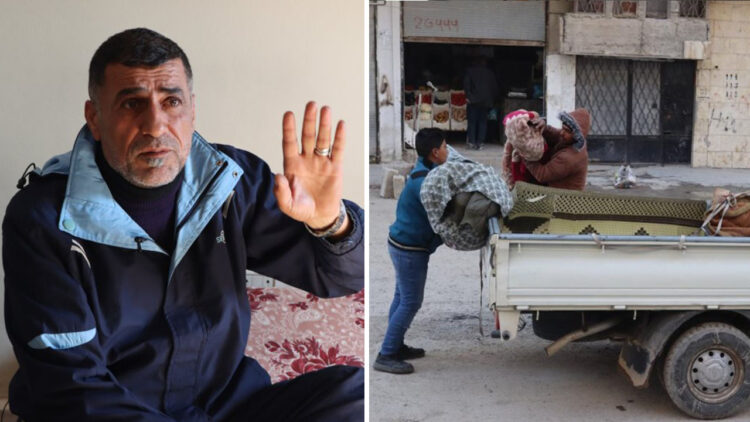
Testimonies from displaced people provide a sobering insight into the crisis. Idris Hisên, a 53-year-old originally from the village of Bafûr in Afrin, recounted his family’s repeated displacement. After fleeing Afrin in 2018, Hisên sought refuge in Tel Rifaat, only to be displaced again following attacks on 29 November 2024. On 1 December, Hisên arrived in Tabqa with hundreds of other families after a perilous journey. He described how SNA militias blocked their way, threatened them and left them overnight in freezing conditions. “They were wearing ISIS and SNA symbols,” he said. “‘If we find any gun parts, we will behead you,’ they warned. My neighbour and friend Henan was killed in front of his family.”
Hisên also witnessed harrowing scenes, including the “beheaded bodies and heads of seven Syrian government soldiers” along the route. “Women covered their children’s eyes to protect them from the horrific sight,” he recalled.
More than 100,000 people have been displaced by the ongoing violence, with another 15,000 expected to arrive in Tabqa in the coming days. The reception centres in Raqqa and Tabqa are at full capacity, and makeshift shelters have been set up in schools, mosques and other public places. Humanitarian agencies warn that conditions will deteriorate without immediate intervention.
Despite the overwhelming challenges, the Kurdish-led Autonomous Administration of North and East Syria (AANES) and aid agencies continue their efforts and appeal to the international community for urgent support to address the growing crisis.