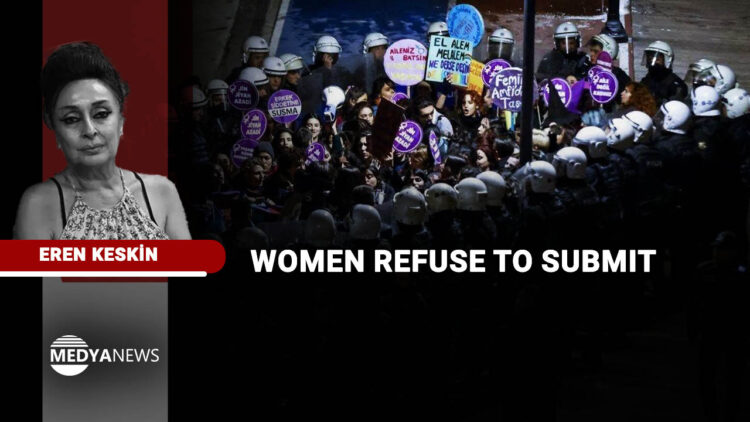
Eren Keskin, human rights defender and lawyer, examines the Istanbul Convention’s significance as a hard-won achievement of women’s struggles in Turkey in her opinion piece entitled ‘Kadınlar biat etmiyor’ (Women refuse to submit). Published in Yeni Yaşam Gazetesi for the occasion of 25 November, the International Day for the Elimination of Violence against Women, the article critiques the Turkish government’s withdrawal from the Convention and its role in legitimising violence. Keskin highlights the resilience of women’s movements and their unwavering determination to fight for justice and reinstate the Convention.
The original article has been translated by Medya News.
Women refuse to submit
By Eren Keskin
This article is being written on 25 November 2024. To understand the state’s attitude towards women, it is enough to look at Beyoğlu in Istanbul. Every corner is filled with police vehicles, access is blocked. Thousands of policemen have taken over the streets to prevent women from entering.
So what will women do today? Today is the International Day for the Elimination of Violence against Women and unfortunately our region is one where violence against women is very common. When we say that violence against women is political, we mean that the language of power legitimises violence, spreads it and creates a negative social perception that makes violence against all women more effective.
Yes, today we must not forget that the discriminatory, marginalising and even hateful language that the state uses against women and LGBTQ+ individuals is reflected as violence against women. This state does not like women – that is clear.
The measures taken in Istanbul today clearly show the state’s perspective on women. As human rights defenders, we wanted to send a letter to the President of Parliament today. We reiterated the importance of the Istanbul Convention. We even told the Speaker that the Istanbul Convention was born out of the struggle for women’s rights in this region. We said: After the case of Nahide Opuz in Diyarbakır, who survived a brutal attack by her husband – who also killed her mother – and after Turkey was condemned by the European Court of Human Rights, the Council of Europe issued a call to all member states. The call was for a convention to protect women from violence. This is how the Istanbul Convention came into being. At its core is the labour of women, earned through their blood and struggle, and a great desire for liberation. It was called the Istanbul Convention because it was opened for signature in Istanbul and Turkey was its first signatory.
However, as with any other issue, the Turkish state lacks a perspective that genuinely aims at democratisation when it comes to women. At that time, the ruling government considered European Union-oriented policies important for its development and followed them. Today, however, a mindset prevails that does not give priority to democratisation and tramples human rights underfoot. That is why, overnight, it withdrew its signature from the Istanbul Convention.
We want this convention, which was born out of the struggle of women, to return. We are not asking for its return, we are saying that we will bring it back. Today we wanted to remind the president of the parliament of his duty. We demanded that the Istanbul Convention be brought back to the parliament for discussion. But we were faced with a police force that did not even allow us to make a statement that would have taken only one or two minutes.
Even in the 1990s, as human rights defenders, we could easily give press statements on the street. Then, the same state mentality used methods such as killings, disappearances and the burning of villages. Today, unfortunately, the same mentality is terribly repressing freedom of expression and assembly. Today we were not even allowed to speak two sentences. Of course we made our statement anyway, but under threat of arrest.
In our region, women face violence in all spheres of life – at home, on the streets, in schools, at work, in prisons and even in detention. The Istanbul Convention had very important provisions. One of them stated: “No tradition, custom or moral concept can justify violence against women”. In effect, the Istanbul Convention was telling all signatory states to change their gendered moral understandings. And this is what disturbed those in power. They know how non-compliant women’s struggle is. Women never give up. This is true not only in our region, but all over the world.
For example, women are the biggest victims of all wars. This was the case in the First and Second World Wars. Thousands of women were killed, raped or disabled. Yet violence against women was not even considered a crime by the Tokyo and Nuremberg Tribunals set up after the Second World War. But women did not give up. After the conflicts in Bosnia and Rwanda, the struggle of the women’s movement led to wartime violence against women being recognised as a war crime. Women achieved this.
Women continue to write their own laws through their struggles, and one of the most important achievements in our written law is the Istanbul Convention.