Sarah Glynn
In this new “age of empire” and of spreading authoritarianism, where even parties that describe themselves as of the left are beating the drums of war, events are tumbling over each other faster than we can comprehend, let alone write about. As I try and make sense of what is happening, I am seeing pictures of millions rallying for democracy in Turkey – protesting against the arrest of Istanbul mayor, Ekrem İmamoğlu, and the government’s attempts to hobble the opposition. I am also seeing accounts of growing Turkish military entrenchment in Syria, and fears that this will trigger further intervention from Israel, alongside reports of ceasefire talks between Turkey and the Syrian Democratic Forces (SDF) of the Autonomous Administration of North and East Syria (AANES).
Erdoğan
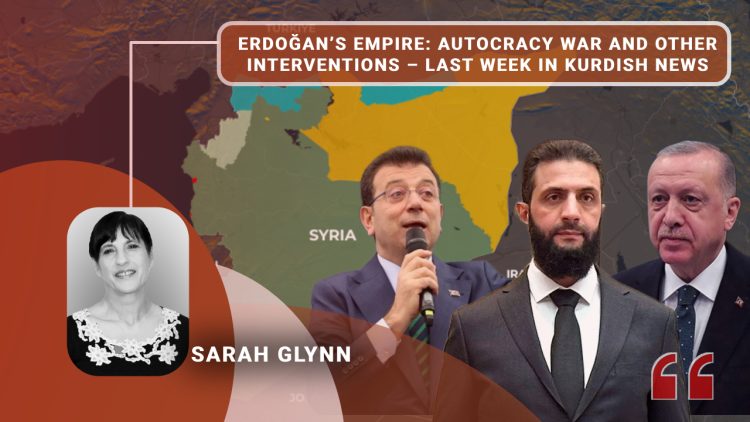
At the centre of all these events is Turkey’s increasingly dictatorial president, Recep Tayyip Erdoğan. The region’s turbulent history cannot, of course, be reduced to the actions of one man – and Turkey’s Kurdish Question goes back a century – but Erdoğan is a product of this history, and its current key protagonist.
For Erdoğan, it is all about power: dictatorial power in Turkey, and influence over former Ottoman lands. All his actions, political and military, are conceived with this in mind. He wants to divide and remove all opposition so as to continue as president of Turkey, and he wants to infiltrate Turkish bases, Turkish advisors and Turkish business into neighbouring countries, especially Iraq and Syria. His bid for power interacts with the power bids of others in a ruthless international competition that is understood as a zero-sum game.
The last “age of empire” culminated in the violent earthquake of the first world war, and in the dismantling of the Ottoman Empire, which had included both Iraq and Syria. A hundred years on, in a similar period of dangerous imperial rivalries, Erdoğan wants to resurrect that empire.
Autocracy in Turkey
At home, Erdoğan’s lust for power means removing the last vestiges of democracy – transforming Turkey from what political scholars label “competitive authoritarianism” to full autocracy. With government control of most media, widespread censorship, and capture of the judiciary, Turkish democracy is already operating on a far from level playing field, but it was still predicted that İmamoğlu would beat Erdoğan in a presidential election.
Long before İmamoğlu’s arrest, Kurdish deputies and mayors and thousands of Kurdish activists had been imprisoned, with some serving long sentences. If other parties had helped to resist these earlier removals and arrests, then we might not now be seeing the removal of İmamoğlu. To paraphrase Pastor Niemöller, “First Erdoğan came for the Kurds, and they did not speak out because they were not Kurds…”
Everyone knows that Turkish elections are not fair, and that Turkish “justice” is deeply compromised, but the charade of political trials and distorted plebiscites still provides a cloak of legitimacy, both internally and in foreign relations. For interlocutors who don’t want to accept inconvenient truths, it provides plausible deniability. The Danish Institute for Parties and Democracy have examined the many ways that such distorted elections can benefit a dictatorship, including by absorbing opposition energy and distracting attention away from oppression.
But the citizens of Turkey are not ready to accept the death of democracy.
Detention and protest
When İmamoğlu was detained on 19 March, he was accused of both corruption and terrorism-linked charges, with the latter based on electoral agreements made with the pro-Kurdish Equality and Democracy (DEM) Party. When he was arrested last Sunday, he was only charged for corruption. This meant that his replacement as mayor could be chosen by other elected councillors rather than by the state governor – though there is still scope for the governor to appoint a trustee as this requires only an accusation of terrorism. If, by not appointing a trustee, the government hoped to diffuse protest, they will have been disappointed.
The detention of İmamoğlu was timed to pre-empt his nomination, last Sunday, as the presidential candidate of the Republican People’s Party (CHP), for which he was due to be elected unopposed. The party decided to go ahead with the ballot anyway, and also to set up additional ballot boxes for people who were not party members to register their support. Ninety-four percent of the party’s 1¾ million members came out to vote for İmamoğlu, and a total of around 15 million people (members and non-members) used the opportunity to make a stand against the theft of democracy.
Despite sadly predictable mass detentions (including journalists and lawyers), police violence, blocked roads and broadcasting bans, huge crowds of protestors came out onto the streets every night, in Istanbul and in cities across the country. Mobilisation was then directed to a mass demonstration at midday yesterday. Attendance at that demonstration was claimed to be 2.2 million. Now the CHP will focus on two demonstrations a week – one in a district of Istanbul and one in another city. They are also launching a signature campaign, which – as well as supporting İmamoğlu – calls for early elections, and they are continuing a boycott of companies associated with the ruling party.
The scale of involvement has been impressive, and the threat to Turkish democracy has mobilised people not previously active in politics; but for this movement to force real change it will have to keep up and increase its momentum, so as to make Turkey ungovernable.
Kurds and the CHP
While the demonstrations have been led by the CHP, protestors are aware that the issue is much bigger than the fate of one man or the fortunes of one party. Turkish democracy is under existential threat. The DEM party has made clear their principled support for resistance against this attack, and their support has been welcomed by CHP leader, Özgür Özel. But many Kurds are hesitant to take an active part in demonstrations led by a party that is the historical source of their oppression. The Turkish flags carried by CHP protestors are the flags of their oppressors, and the images of Ataturk portray the architect of their subjugation.
Kurdish hesitancy was reinforced by the speech, on 22 March, of the CHP Mayor of Ankara, Mansur Yavaş. Yavaş attempted to mock the Kurds and their Newroz celebrations and to suggest that the Kurds were cozy with the government. He talked about Kurdish flags that he regarded as rags, and about police handing out candyfloss to Newroz participants. The origin of the candyfloss story was the kind act of a policeman, who entered into the celebratory spirit. On seeing a disabled candyfloss seller, he bought a bunch of the stuff himself and distributed it to nearby children.
The CHP is a broad church and includes such sympathetic figures as Sezgin Tanrıkulu, a Kurdish deputy for Diyarbakır who has previously been deputy chair of the party. But Yavaş, who began his political career in the far-right Nationalist Movement Party (MHP), represents the CHP’s nationalist base and is very popular.
Özel – in a joint statement alongside DEM Party Co-Chair Tuncer Bakırhan – made clear that the party does not endorse the remarks from Yavaş; but these remarks were welcomed by Erdoğan, who has been trying to play a game of divide and rule with his opponents. At the same time as attacking the CHP, the Turkish government has refrained from their usual attacks on Kurdish Newroz celebrations; and the opening of talks with Abdullah Öcalan has fed hopes of a new peace process. But Öcalan’s message from prison was very clear. His call for the Kurdistan Workers’ Party (PKK) to lay down their arms and dissolve was coupled with a demand for a democratic alternative. For the Kurdish freedom movement, democracy and a solution to the Kurdish question are both dependent on each other. And the Turkish government is showing contempt for democracy.
Turkey in Syria
In Syria, Erdoğan exercises power and influence both through direct military intervention and through proxies. Turkey has carried out three separate invasions and occupations; they have created violent mercenary militias; and they nurtured Hayat Tahrir al-Sham (HTS) the group that has formed the interim government. Along with their militias, they are continuing to attack the AANES, and they have been using their influence on the interim government both to ensure that they clip the wings of the Autonomous Administration and to promote Turkish military, economic and political interests.
On Thursday, the SDF released a press statement that reported that Turkey has been working by cover of night to establish new military bases in Syria. They comment, “The primary objectives of these bases are to strengthen Turkey’s occupation foothold in Syria, facilitate ongoing attacks in northern and eastern regions, and advance further into Syrian territory. This expansion suggests a long-term occupying strategy aimed at consolidating Turkish control over parts of Syria and entrenching its military presence for the foreseeable future.”
The growth of Turkish involvement has produced a typically bellicose response from Israel, which regards Turkey as a competitor for control over the region, and fears the emergence of a strong Islamic neighbour. Benjamin Netanyahu has been attempting to portray a conflict between Israel and Turkey as inevitable. If this happened, the Kurds would be caught in the middle.
At the same time, and without regard to the agreement signed by Interim President Ahmed al-Sharaa and SDF Commander in Chief, Mazlum Abdi, al-Sharaa has been ploughing ahead with creating new interim political structures as though the Autonomous Administration and the people of North and East Syria did not exist. His interim constitution, issued just days after the agreement with the SDF, gave the president autocratic powers and committed Syria to Islamic law. It is impossible for the Autonomous Administration to accept, but that has not stopped al-Sharaa from nominating a new interim government to replace his initial caretaker government. This was sworn in yesterday, and, despite some individuals from different ethnic groups, and one woman, it has been described as “dominated by close al-Sharaa allies who hold key positions”.
Although the agreement signed with the SDF stipulated an end to all fighting in Syria, it has had no impact on Turkey’s attacks. Now, however, there are rumours of a ceasefire between Turkey and the SDF, brokered by the US dominated Global Coalition Against Daesh (ISIS). Turkey does not have a good record for respecting ceasefires, but the interim government may feel that they need the disciplined force of the SDF on board to prevent the country from falling apart. Watch this space.
*Sarah Glynn is a writer and activist and permanent columnist for Medya News – check her website and follow her on Twitter or bluesky