

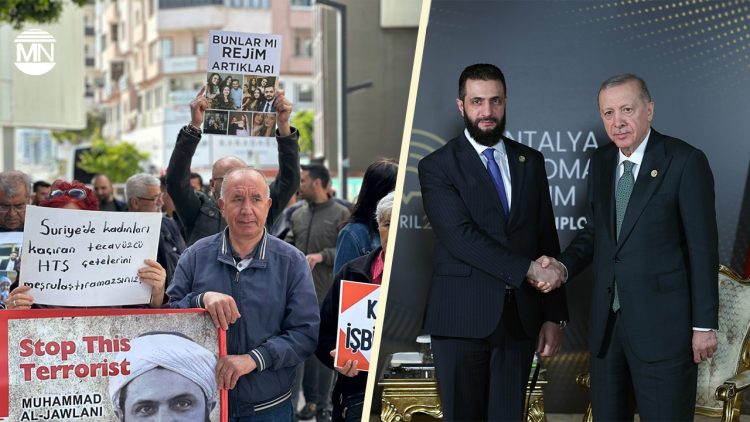
Ahmed al-Sharaa, head of Syria’s transitional government, attended the Antalya Diplomacy Forum in Turkey on Friday, his first major international outing since Bashar al-Assad’s regime collapsed in December 2024. Al-Sharaa, formerly known as Abu Mohammad al-Jolani, leads Hay’at Tahrir al-Sham (HTS), a group with jihadist origins now governing Syria’s interim administration.
The forum, organised by Turkey’s Ministry of Foreign Affairs, drew over 4,000 participants from more than 140 countries to discuss global issues under the theme “Reclaiming Diplomacy in a Fragmented World”. Al-Sharaa met Turkish President Recep Tayyip Erdoğan to address Turkey-Syria relations and regional stability. Erdoğan welcomed efforts “to prevent chaos” in Syria and committed to advocating for the lifting of international sanctions to support its recovery.
Al-Sharaa’s visit triggered widespread protests across Turkey, particularly among Alawites, a religious minority. In Muğla, the Bodrum Alawite Bektashi Culture Association filed a criminal complaint against al-Sharaa, accusing HTS of massacres against Alawites in Syria. “We don’t want a bloodstained killer in our country,” said association president Gamze Ardağ outside Bodrum’s courthouse.
In Adana, Alawite groups and women’s organisations, including Mor Dayanışma (Purple Solidarity, a women’s rights collective), condemned al-Sharaa’s invitation. Pelin Çiçek, speaking for Mor Dayanışma, highlighted HTS’s alleged abuses, stating, “Women are being killed in Syria, and we won’t stay silent.” Protesters announced plans for a women’s solidarity event in Hatay’s Samandağ on 24 April to support Syrian women.
Antalya saw Alawite institutions rally outside the Pir Sultan Abdal Cultural Association (PSAKD), a prominent Alawite organisation, demanding al-Sharaa face international courts. “His arrival is an attack on everyone defending peace and equality here,” said PSAKD manager Abdurrahman Karadağ, linking Syria’s alleged Alawite killings to past massacres in Turkey, such as Sivas and Maraş.
In Mersin, the Tarsus Labour and Democracy Platform labelled al-Sharaa a “war criminal”. Platform spokesperson Mahmut Sarıca accused Turkey’s ruling Justice and Development Party (AKP) of enabling HTS, stating, “This collaboration makes them complicit in Syria’s genocide”.
İstanbul’s Alawite groups gathered in Kadıköy, joined by the pro-Kurdish Peoples’ Equality and Democracy (DEM) Party and other leftist factions. “Syria’s Alawite genocide must end,” read their banners, as Alawite Bektashi Federation vice-president İbrahim Karakaya called for accountability.
Erdoğan, speaking at the forum, urged Syria’s territorial integrity and cautioned against new conflicts, citing the “8 December revolution” that toppled Assad. He tied Syria’s stability to regional concerns, criticising Israel’s actions in Gaza and noting dialogues with leaders like US President Donald Trump.
Turkey’s stance to support Syria’s al-Sharaa-led transitional government stems from both ideological leanings and practical aims, driven by its 911-kilometre border with Syria. Erdoğan’s government has long supported Sunni rebel groups like al-Sharaa’s HTS, which help Turkey limit Kurdish power and strengthen its regional influence. This approach has heightened tensions with Turkey’s Alawites and Syria’s minorities—Alawites, Druzes, Kurds and Christians—who fear exclusion under HTS’s transitional leadership.
Since 2011, Turkey has backed Syrian opposition groups, starting with the Free Syrian Army (FSA). By 2017, Turkey focused on HTS in Idlib, where it took on a peacekeeping role under the 2017–2020 Astana agreements with Russia and Iran. Turkey supplied HTS with weapons and safe routes, claiming it was guiding the group to block Assad’s advance.
Turkey’s wider Syria strategy has always drawn questions for overlooking jihadist groups to weaken Kurdish forces, particularly the Syrian Democratic Forces (SDF). Reports from 2014–2015 cited evidence of Turkey allowing Islamic State (ISIS) members to cross its border to fight Kurds in Ayn el-Arab (Kobani), though Turkey denied direct support. US officials later criticised Turkey’s delayed action against ISIS, suggesting tactical alignment against shared enemies like secular Kurds in northeast Syria.
Alawites, about 10–15% of Turkey’s population and long sidelined, see al-Sharaa’s visit as part of the AKP’s Sunni-focused policies. Protests in İstanbul and Antalya tied Syria’s sectarian abuses to Turkey’s own Alawite struggles, like the 1993 Sivas Massacre that killed 35 Alevis. “The hatred killing in Syria mirrors Sivas,” said Abdurrahman Karadağ, voicing widespread unease about sectarian favouritism.


