

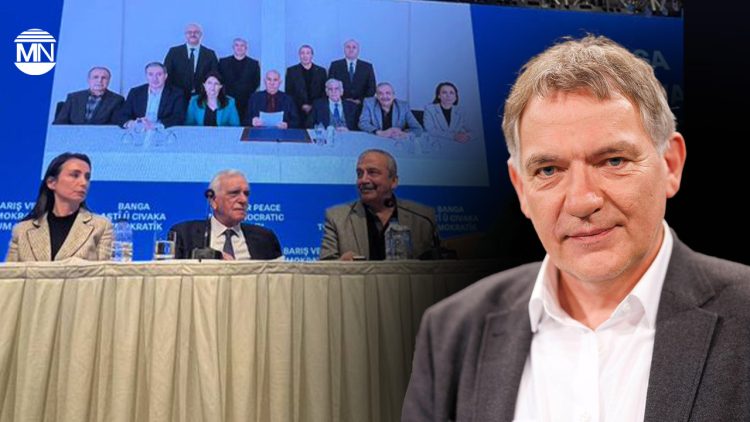
Jan van Aken, the co-chair of Germany’s Left Party (Die Linke), has urged the German government to take concrete steps to support peace in Turkey, including lifting the ban on the Kurdistan Workers’ Party (PKK) and securing the release of Abdullah Öcalan.
In a statement posted on social media, van Aken said:
"Abdullah Öcalan has opened the door for a peace process in Turkey. The German government should do everything it can to support peace. This includes lifting the ban on the PKK. And Öcalan must be released."
Van Aken’s remarks come just days after Die Linke secured almost 9% of the vote in the 24 February federal elections, nearly doubling its 4.7% result in the last elections. His statement signals that Die Linke will continue its support for Kurdish rights and challenge Germany’s security-oriented approach towards Turkey’s policies.
Abdullah Öcalan hat die Tür für einen Friedensprozess in der Türkei aufgestoßen.
Die deutsche Bundesregierung sollte alles dafür tun, Frieden zu unterstützen. Dazu gehört auch eine Aufhebung des PKK-Verbots.
Und Öcalan muss freigelassen werden.https://t.co/YuyaLtKz4C— Jan van Aken (@jan_vanaken) February 27, 2025
The PKK has been banned in Germany since 1993, a decision that has been legally and politically contested. European courts, including the Belgian judiciary and the Court of Justice of the Council of Europe (CoE), have raised concerns over the legal basis for classifying the PKK as a terrorist organisation, arguing that its activities fall under armed conflict rather than terrorism under international law.
Despite these rulings, Germany has maintained its stance, citing NATO ties with Turkey and counterterrorism cooperation as key factors. However, Die Linke has consistently opposed the criminalisation of Kurdish political movements, arguing that Germany should instead support democratic negotiations.
Öcalan’s recent call for the dissolution of the PKK and an end to armed struggle has reignited debates over the Kurdish issue in Europe. While Berlin has largely aligned with Turkey’s security policies, Van Aken’s statement suggests growing political pressure for a reassessment of Germany’s role in a potential peace process.
For the first time in recent history, the German government has openly criticised Turkey’s military operations against Kurdish forces in North and East Syria. Over the past three months, both the German Foreign Ministry and senior diplomatic officials have issued direct warnings to Ankara, urging it to halt its attacks on Kurdish-controlled regions. This shift marked a notable departure from Berlin’s previous reluctance to publicly confront Turkey over its military interventions.
However, with uncertainty over Germany’s next government coalition, it remains unclear whether this new approach towards Turkey will continue. The current ruling coalition, led by the Social Democrats (SPD), Greens, and Free Democrats (FDP), has shown signs of internal divisions regarding Germany’s foreign policy priorities, particularly on arms sales and diplomatic relations with Ankara.
Observers question whether the next German government will maintain its cautious criticisms of Turkey’s military actions, or whether it will revert to prioritising security cooperation and trade ties with Ankara over human rights concerns and Kurdish political rights. Van Aken’s statement reflects a broader debate within German politics over the extent to which Berlin should actively support a peace process and whether it will align itself more closely with Kurdish demands or continue to back Ankara’s counterterrorism narrative.
Germany, home to one of the largest Kurdish diasporas in Europe, has frequently cracked down on Kurdish organisations, citing anti-terror laws. Kurdish activists argue that this has led to the suppression of legitimate political movements.
With Öcalan now calling for a non-armed, political solution, observers suggest that Germany may face increasing calls to shift its stance, particularly from progressive and pro-Kurdish political forces such as Die Linke. The coming months are expected to test whether Berlin’s recent warnings to Turkey signal a long-term policy shift or whether they were temporary reactions to escalating regional tensions.


