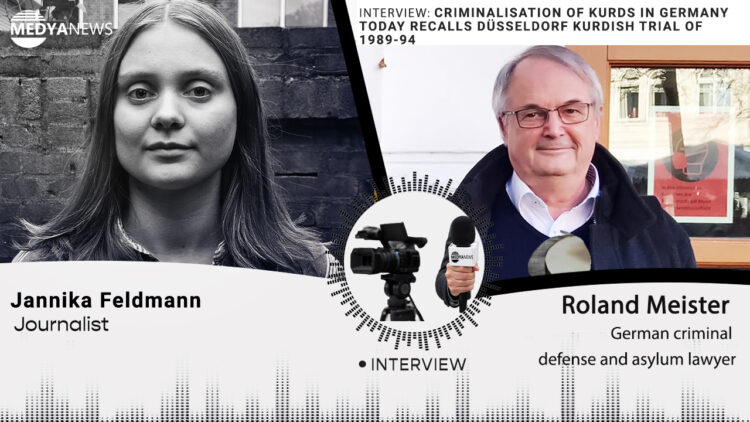
German lawyer Roland Meister has revealed how decades of repression have targeted Kurdish activists in Germany, citing the Düsseldorf Kurdish Trial and Paragraph 129b of the German Criminal Code as tools used to criminalise resistance against Turkey’s military dictatorship while marginalising Kurdish communities, in part one of an interview with Jannika Feldmann of Medya News.
Roland Meister is a criminal defence and asylum lawyer, who has represented many Kurdish and Turkish activists in Germany, including many political refugees who fled from Turkey after the military coup in 1980. He is a contemporary witness of the Düsseldorf Kurdish Trial, which took place between 1989 and 1994 in Germany and involved 20 defendants accused of organising a parallel justice system and membership of the Kurdistan Workers’ Party (PKK), among them PKK executive council members Duran Kalkan and Ali Haydar Kaytan.
Meister recounts that the Düsseldorf trial was the biggest trial under German law since World War II, and was pivotal in isolating the Kurdish movement by the use of allegations of terrorism. He also recalled that the German media’s narrative even before the Düsseldorf Kurdish Trial had “demonised resistance to Turkey’s military dictatorship rather than addressing the abuses of the regime”.
He relates that at that time, Kurdish activists had widespread support among the Kurdish diaspora and also parts of the German population and said that the Düsseldorf trial was used to “isolate” these Kurdish activists from society by declaring them terrorists.
Sharing personal anecdotes from PKK executive council members Duran Kalkan and Ali Haydar Kaytan, Meister tells of his memories: “Another thing, perhaps a little personal, is that Ali Haydar Kaytan and Duran Kalkan did not wait for the end of their asylum procedures in Germany, but preferred to leave Germany and return to their home country. I also represented Ali Haydar Kaytan’s mother, who must have met her son from time to time. Every time she came back, she brought me a pair of warm socks, because he still remembered that it was very cold in Germany in winter, and he didn’t want his lawyer to get cold feet!”
He sees another device in the criminalisation of Kurdish people in Germany in Paragraph 129b of the German Criminal Code, which deals with “membership of criminal and terrorist organisations abroad”. Introduced in 2002 to criminalise alleged Kurdish support for the PKK, it sparked controversy even among German civil lawyers.
Meister also tells of the wider implications of this repression, explaining that it “supports Turkey’s dictatorship” at the same time stifling the cultural and political expression of Kurdish communities in Germany.
Meister, who is himself married to a Kurdish woman with whom he has five children, says that many Kurdish families are faced with legal repression or not being granted citizenship, because many activities like “organising rallies and festivals and teaching the Kurdish language” will be seen as support of the PKK, which is described as a “terrorist organisation abroad”.
Ending on a positive note, Roland Meister states that although it has faced decades of repression by the German state, the Kurdish community in Germany have grown grown resilient, organising rallies, festivals and language courses, and “in recent years […] are becoming less and less intimidated”.